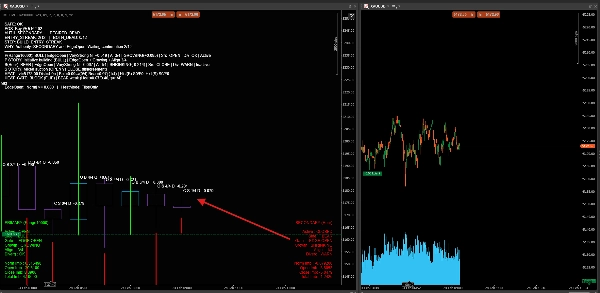
Initiative Acceptance Drafting Engine
Most footprint tools attempt to answer:
who traded more aggressively?
This one answers:
did that aggression actually move the auction?
Because aggression that fails
becomes liquidity.
And liquidity
does not draft price forward.
A Footprint Without Reconstruction
Traditional footprint logic relies on:
bid/ask feed reconstruction
delta stacking
executed trade inference
This creates dependency on:
feed quality
data vendor consistency
tick reconstruction accuracy
This framework does not attempt
to reconstruct intent
from executed prints.
Instead
it models whether directional effort
was structurally accepted
by the auction itself.
Through regression-smoothed displacement analysis
across open-side and close-side vectors
the engine continuously measures:
initiative carry
range expansion persistence
directional alignment
multi-bar acceptance
initiative exhaustion
response absorption
This produces a normalized
initiative imbalance state
which reflects:
continuation
hesitation
balance
pullback
transition
or acceptance
in real time.
Live Auction State — No Repainting
All initiative and acceptance states:
are calculated live
update on formation
and are not revised
after the bar completes.
There is:
no future bar referencing
no smoothing rollback
no retrospective recalculation
no structural repainting
Once initiative is accepted
or absorbed
that auction state is fixed
as part of the drafting process.
What you see in real time
is what the engine saw
when the auction made
its structural decision.
Initiative Must Be Accepted
Not Just Expressed
Markets do not move
because effort occurred.
Markets move
when effort:
persisted
aligned
expanded
and survived opposition
This model continuously evaluates
whether directional effort:
maintained displacement
expanded auction range
aligned across structure
resisted responsive participation
Failure to maintain
multi-factor alignment
causes initiative state
to decay toward neutrality.
Neutralization implies:
auction balance
drafting failure
or structural transition
Drafting Recognition States
The engine distinguishes between:
Initiative Building
Acceptance / Carry
Pullback Absorption
Edge Weakening
Mixed Auction
Balanced Negotiation
Each condition reflects
a participation regime
within the live auction.
Acceptance environments
are governance phases.
Balanced environments
are negotiation phases.
Weakening environments
indicate transition risk.
Optional Price-Level Acceptance Memory
When enabled
price is discretized
into structured auction levels.
Each level tracks:
initiative survival
continuation latency
reversal timing
confirmation intensity
historical carry success
structural rejection
Levels that repeatedly accept
initiative in one direction
develop persistence weighting.
Levels that reject
initiative
lose authority
through decay modelling.
Participation decisions
may optionally be gated
based on whether initiative
was historically accepted
at that price.
Multi-Authority Operation
(Optional Dual Structure Mode)
Operate using:
Single Authority Structure
or
Dual Authority Structure
Primary structure
defines macro drafting state.
Secondary structure
detects tactical initiative
during pullback
or absorption.
Authority may transfer
when secondary initiative
demonstrates superior acceptance
against macro direction.
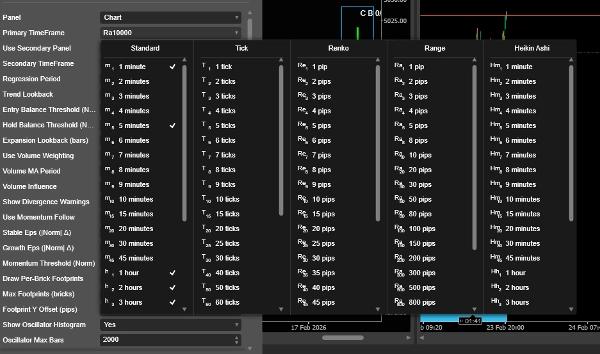
Chart Compatibility
Fully compatible with:
Time-based charts
Renko
Range
Heikin Ashi
Synthetic aggregation
Particularly effective
on non-time-based environments
where initiative carry
is not visually diluted
by temporal compression.
Designed For
Auction-structure traders
Footprint-style execution models
Continuation-based methodologies
Range-bar environments
Initiative-acceptance workflows
Execution-grade structural systems
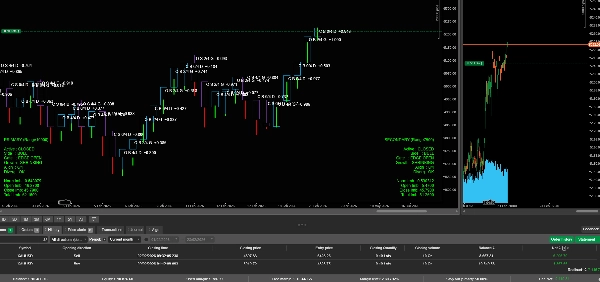
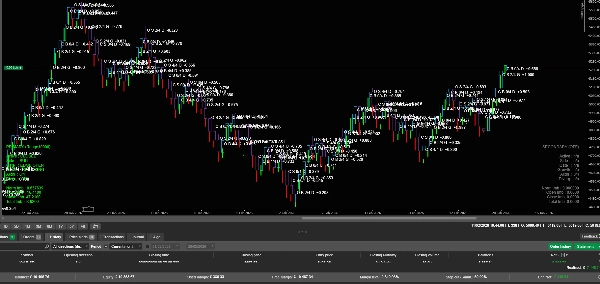
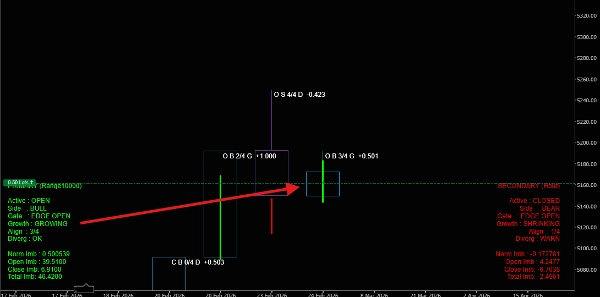
Footprint Panel & HUD — Terminology Guide
(Live Auction State Readout)
All values displayed in the panel are calculated live during bar formation
and do not repaint once the auction state is formed.
Below is what each footprint acronym represents inside the panel.
Core Structural Readings
Norm Imb (Normalised Imbalance)
This is the primary initiative score.
It represents:
the degree to which directional effort
has successfully displaced the auction
and survived opposing participation.
Interpretation:
Value BehaviourMeaning
Near 0
Auction is balanced / negotiating
Increasing positive
Bullish initiative being accepted
Increasing negative
Bearish initiative being accepted
Shrinking magnitude
Initiative losing acceptance
Expanding magnitude
Initiative carrying forward
This is not momentum.
This is accepted displacement.
Open Imb (Open-Side Initiative)
Measures whether directional effort
was introduced early within the auction.
Think:
did initiative originate
from the start of participation?
Helps detect:
initiative entry
early displacement attempts
opening aggression
Close Imb (Close-Side Initiative)
Measures whether directional effort
was maintained into auction completion.
Think:
did initiative survive opposition
until the auction closed?
Helps detect:
initiative carry
trend persistence
auction acceptance
Total Imb (Total Initiative State)
The combined initiative condition
after open and close participation
have been regression-smoothed.
Represents:
net structural drafting force
acting on price
Participation Alignment
Align (0–4)
Measures how many acceptance conditions
are structurally aligned.
Examples include:
range expansion
initiative persistence
multi-bar displacement
open ↔ close agreement
Interpretation:
Align ValueMeaning
0–1
Weak / fragile initiative
2
Developing participation
3
Structurally supported
4
Strong acceptance environment
Higher alignment
= higher likelihood of initiative carry
Edge State
Edge Open
Directional initiative
has crossed the hold threshold
and is considered:
structurally accepted
and capable of drafting price forward
Edge Closed
Directional effort exists
but has not yet demonstrated:
sufficient persistence
multi-factor alignment
or displacement carry
Indicates:
hesitation
absorption
balanced auction
Growth State
GROWING
Initiative acceptance
is increasing in magnitude
Auction is drafting.
STABLE
Initiative persists
but is not expanding
Trend continuation phase
without expansion
SHRINKING
Initiative magnitude
is decaying
Indicates:
absorption
pullback
or transition risk
Divergence Warning
WARN
Displayed when:
open-side initiative
and close-side initiative
are structurally misaligned.
Indicates:
mixed participation
initiative disagreement
or potential regime shift
How To Use The Settings
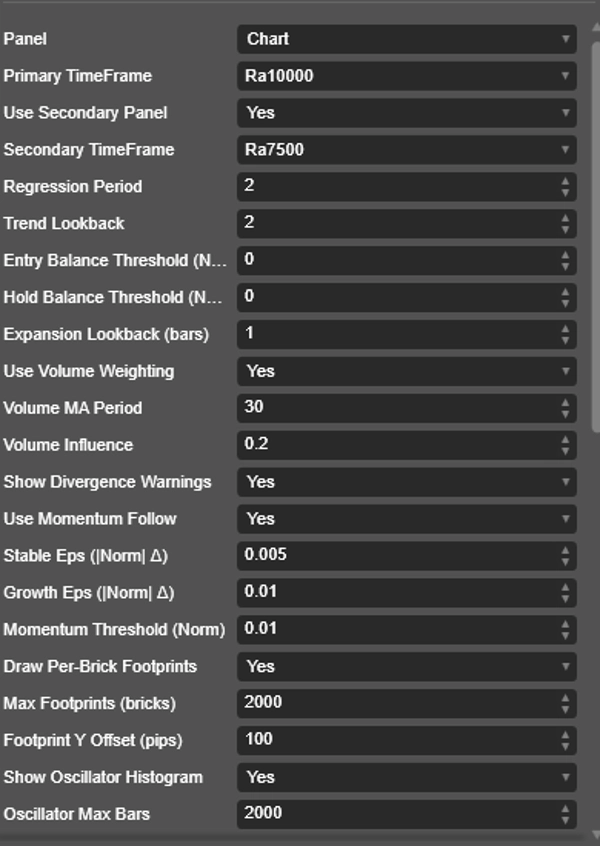
Regression Period
Controls smoothing applied
to initiative modelling.
Lower values:
faster reaction
higher sensitivity
more tactical
Higher values:
smoother drafting
less noise
better for macro structure
Trend Lookback
Defines how many auctions
must demonstrate directional carry
before initiative is recognised
as structurally persistent.
Higher values:
slower but more reliable
trend confirmation
Entry Balance Threshold
Minimum imbalance required
before initiative is considered:
tradable
or structurally meaningful
Hold Balance Threshold
Minimum imbalance required
for initiative to be considered:
still accepted
and actively drafting price
If imbalance falls below this:
initiative is considered absorbed
or neutralised
Expansion Lookback
Defines how many auctions
are evaluated for:
range persistence
initiative survival
multi-bar displacement
Helps differentiate:
true continuation
vs short-lived impulse
Volume Weighting
Use Volume Weighting
When enabled:
initiative readings
are influenced by participation size
not just displacement
Volume MA Period
Defines smoothing applied
to participation volume
within initiative modelling.
Volume Influence
Controls how strongly
volume participation
affects initiative acceptance.
Higher values:
greater emphasis
on participation backing
Momentum Follow
Stable Eps
Minimum change in imbalance
required for initiative
to be considered persistent.
Growth Eps
Minimum change required
to classify initiative
as actively expanding.
Momentum Threshold
Minimum imbalance required
for participation
to be considered directional
rather than balanced.
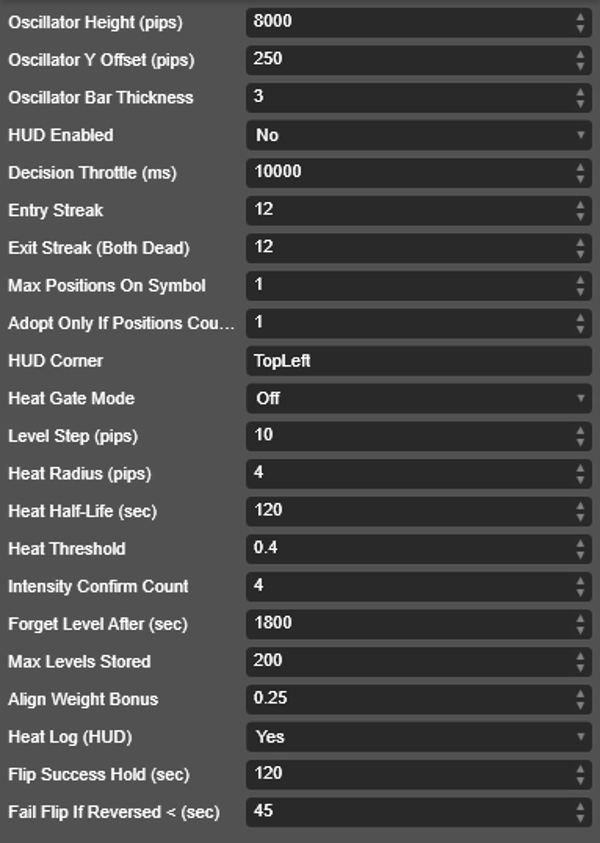
Heat Memory (Optional)
Heat Mode
Controls whether:
price-level acceptance history
can influence entries
or flips
Level Step
Defines discretisation spacing
for price-level memory zones.
Heat Radius
Distance from a stored level
where initiative is considered relevant.
Heat Threshold
Minimum persistence
required for a level
to be considered:
structurally proven
Intensity Confirm Count
Number of initiative confirmations
required at a level
before acceptance is trusted.
Heat Half-Life
Controls how quickly
old acceptance information
decays over time.
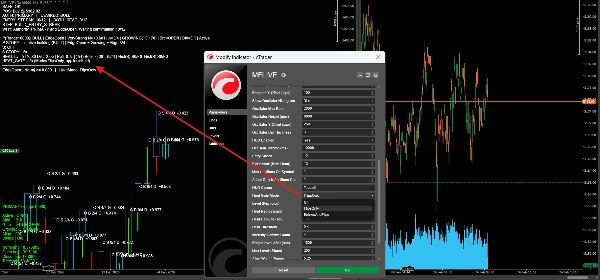
HUD Panel
HUD displays:
current initiative state
authority alignment
participation strength
structural acceptance
entry streak state
neutralisation streak
optional heat approval
HUD can be enabled
when using heat memory
to visualise
participation persistence
at price.


.png)
.png)