



Description
ADVANCED MACD PRO — ADAPTIVE MULTI-TIMEFRAME MACD, DIVERGENCE AND TRADE-MANAGEMENT ENGINE
One indicator that adapts itself to any symbol and any timeframe, grades every signal it produces, filters it through a full precision stack, turns each surviving signal into a managed trade plan, learns from its own outcomes and reports everything on a live dashboard.
Classic MACD is a single fixed formula — 12/26/9 on the close — that behaves completely differently on EURUSD M1 than on XAUUSD H4, shows an anonymous dot when the lines cross, gives you no plan once it does, and has no idea whether the signal it just produced is any good. Advanced MACD Pro rebuilds it as a measurement engine: the oscillator is assembled from selectable kernels and price inputs, every timeframe-dependent number is derived from a documented scaling law instead of a lookup table, each crossover and divergence is scored from 0 to 100 against thirteen independent scale-free components, every live signal is projected into an explicit Entry, SL, TP1 and TP2 plan whose lifecycle is then managed bar by bar, and the realised performance of each signal family is fed back into the score.
The indicator runs with AccessRights.None — it cannot open, modify or close anything on your account. It suggests; you decide and execute.
━━━━━━━━━━━━━━━━━━━━━━━━━━━━━━━━━━━━━━━━
QUICK FACTS
• Indicator type: oscillator, MACD-based, in a separate indicator window (not an overlay). Divergence scanner, multi-timeframe confluence score, trade-plan projection engine, momentum trendlines, session markers, CSV signal journal, on-chart signals and alerts.
• Strategy type: scalping, intraday, swing and position trading — standalone, or as a confirmation layer on an existing trend-following or reversal system.
• Preferred periods: any, from tick and M1 through Renko and Range charts to Monthly. Parameters re-derive per period, so one configuration covers M1, M5, M15, H1, H4, D1 and W1 without retuning.
• Preferred instruments: liquid markets — forex majors and crosses, metals (XAUUSD, XAGUSD), indices (NAS100, US500, GER40), crypto (BTCUSD, ETHUSD), stocks, futures and CFDs. Every threshold is normalised per symbol.
• Trading use cases: timing entries on MACD and signal-line crossovers; spotting exhaustion and continuation with A/B/C-graded regular and hidden divergences; filtering against a higher-timeframe bias; trading a ready-made plan with two R-multiple targets, break-even and trailing suggestions; reading momentum support and resistance and their breaks; fast scalping on M1 to M5; exporting every signal and its outcome to a spreadsheet; machine-readable trigger outputs for cBots.
• Suggested setup: no leverage, account size or broker requirements. This is an analysis tool — it does not place orders.
━━━━━━━━━━━━━━━━━━━━━━━━━━━━━━━━━━━━━━━━
- THE ADAPTIVE ENGINE — ONE CONFIGURATION, EVERY TIMEFRAME
A documented scaling law derives almost every reference value from the resolved bar duration: one term keeps the statistical reliability of the smoothed difference constant as bars get shorter, because microstructure noise dominates on fast charts, and the other moves the indicator between a constant bar count and a constant wall-clock horizon. It rescales the three MACD legs, pivot lookback, minimum and maximum pivot distance, the RSI, ATR and ADX periods, trend EMA and slope window, outcome horizon, trade-plan horizon, trendline pivot gap, efficiency-ratio period, volume-price window, normalisation window, statistics window and the volatility distribution window.
You control the law, not the numbers: Timeframe Scaling (BarCount, Balanced, TimeHorizon), High Timeframe Policy (Canonical or HorizonMatched), Microstructure Noise Horizon, Global Sensitivity (the speed dial — the top of the range halves every resolved period, the bottom doubles them), Max Period Multiplier (a hard ceiling) and Adaptation Mode (Automatic, or Manual, which honours every dialog value verbatim and logs any drift at start-up). Whatever the mode, the resolved profile is printed to the Log on start — legs, kernels, price input, filter-bank periods, early-entry band, pivot geometry, every gate, the session, the windows, the plan and trendline rulers, the warm-up estimate and the MTF ladder — which makes support questions answerable in one line.
━━━━━━━━━━━━━━━━━━━━━━━━━━━━━━━━━━━━━━━━
- FOUR TRADING STYLES
Trading Style is the master switch, deliberately independent of the timeframe: it sets what a timeframe cannot infer — kernel lag, price weighting, entry timing, which precision gates are armed, how selective the quality floor is, how long an outcome gets to develop, and how the plan is shaped. Each style pins the full scaling-reference surface it consumes, so it resolves identically whatever a saved template held.
• UNIVERSAL — every parameter exactly as you set it.
• SCALPING — a precision stack in one click: zero-lag Hull kernel on both legs; Volume-Price-Adjusted input, which weights each bar by tick volume, relative volatility and candle-body ratio and so suppresses the low-participation wick that fakes a crossover; early entry at lambda 0.92; raised sensitivity with BarCount scaling; every gate armed (trend slope, ADX 18, volatility spike, cluster and repeat suppression, adaptive ATR floor at the 25th percentile, post-pivot follow-through required); the widest pivot search; session from the symbol's own calendar with a London and New York fallback; quality floor 60, weak 72, alert 76; alert cooldown off; a scalping outcome horizon (1.0 ATR target against a 1.2 ATR stop); a tight plan (0.35 ATR buffer, 0.8R and 1.5R targets, 2.5 ATR trail); markers on the forming bar; 200 ms panel refresh.
• SWING — the balanced classic: canonical 12/26/9 on close, exponential kernel, lambda 0.96, Balanced scaling with the Canonical higher-timeframe policy; two confluence rungs under a soft penalty; regular and hidden divergences; quality floor 55, weak 68, alert 72; 60-bar outcome horizon at 1.5 ATR; closed-bar markers; structure stop with a 0.5 ATR buffer and classic 1R and 2R targets; 3.0 ATR chandelier trail; trendlines and session markers on; alert cooldown 3 bars.
• POSITION — a plan that lives for weeks: slower references (18/39/12, sensitivity 0.85), TimeHorizon scaling with the HorizonMatched policy, three rungs under a HARD gate so an entry against the higher-timeframe flow is refused outright; regular reversals only; the highest selectivity (floor 65, weak 78, alert 82) with ADX armed and follow-through required; session gate off; 120-bar horizon at 2.0 ATR; crossover markers off, because the plan is the actionable event; wide structure stop (0.75 ATR buffer) with 1.5R and 3R targets; 4.0 ATR trail; slow durable trendlines only; alert cooldown 6 bars.
Switch back to Universal at any moment to regain full control of all 162 parameters.
━━━━━━━━━━━━━━━━━━━━━━━━━━━━━━━━━━━━━━━━
- THE OSCILLATOR — MACD REBUILT FROM COMPONENTS
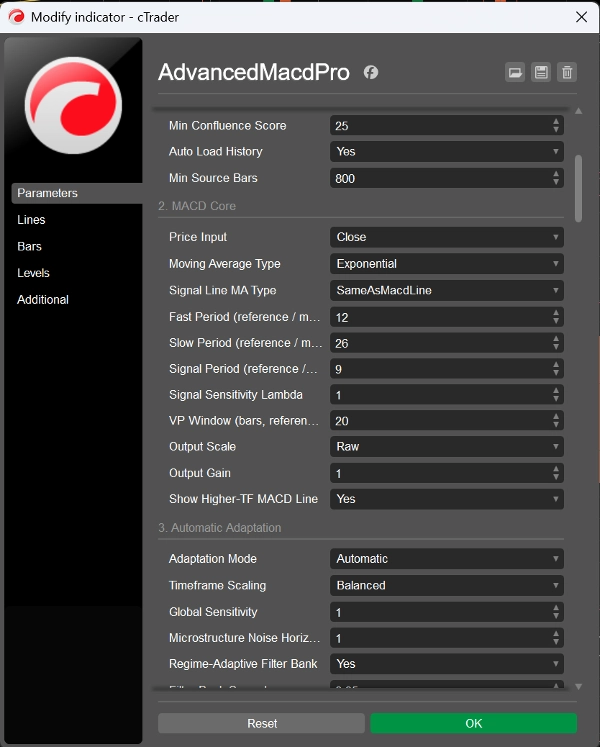
• Ten moving-average kernels for the MACD line: Exponential (classic Appel), Hull, Kaufman Adaptive, DEMA, TEMA, Time Series (least-squares), Weighted, Triangular, Simple, Wilder. MACD is structurally a band-pass filter, and de-lagged kernels shift the pass band toward higher frequencies without adding noise — the honest way to make it faster. The signal-line kernel can be overridden on its own; by default it follows the MACD kernel so the crossover stays symmetric.
• Six price inputs: Close, Volume-Price-Adjusted, Typical, Weighted, Median, Heikin-Ashi close.
• Regime-adaptive filter bank: two additional MACD instances straddling the nominal periods (spread up to 80 percent) blended by the smoothed Kaufman Efficiency Ratio — responsive in a trend, smooth in chop. The centre frequency follows the regime instead of being fixed at compile time.
• Early-entry crossover with a causal latch, measured in the oscillator's own units so it is scale-free: exactly one trigger per oscillator excursion, never a duplicate BUY followed by BUY, never a crossing that passes unannounced. A price-scaled noise floor snaps sub-ulp differences to zero, so a flat tape cannot fabricate phantom crossovers, and non-finite readings are rejected rather than treated as evidence.
• Three output scales — Raw (identical to the platform MACD), ATR-normalised (comparable across symbols and timeframes) and self-normalised (z-like) — plus an output gain. Warm-up bars use a continuous fallback estimator, so the left edge of the pane never shows a step.
• Four-bucket strength histogram (Bull Strong, Bull Weak, Bear Strong, Bear Weak): whether momentum is building or fading is readable at a glance.
• Higher-TF MACD line: the first confluence rung in the same window, under the same strict closed-bar mapping and in the same display units as the primary line.
━━━━━━━━━━━━━━━━━━━━━━━━━━━━━━━━━━━━━━━━
- TRUE MULTI-TIMEFRAME CONFLUENCE
The primary engine runs on the chart's own timeframe, any timeframe from M1 to Monthly, or a custom name — canonical forms (Minute15, Hour4, Renko10), trader shorthand (M15, H4, D1, W1, MN, T1000), Heikin-Ashi variants, tick, Renko and Range charts. Above it, up to three higher-timeframe levels are computed, each with its own complete adaptive profile — not the primary setting re-read on a coarser series.
• The ladder is derived automatically (M1 to M5 to M30 to H2; M15 to H1 to H4 to D1; H1 to H4 to D1 to W1; H4 to D1 to W1 to MN) or pinned explicitly, for example M15,H1. An explicit list is always ordered by ascending bar duration, so the weights decay with distance and the higher-TF output is the nearest rung. A rung the platform cannot hand out is stepped over, not fatal.
• Each level contributes a state score from minus 100 to plus 100 (position versus zero, MACD versus signal, histogram direction); the levels combine into one confluence score with a BULL, FLAT or BEAR reading.
• Confluence Gate: Off (informational), SoftPenalty (lowers the quality score, centred on your threshold) or HardGate (below the threshold the signal is rejected outright).
• Hidden MTF Alignment Gate: a hidden continuation divergence is rejected when the ladder strongly disagrees with its direction — the classic trap of a hidden bear printed into a higher-timeframe melt-up. On by default.
• Strict Non-Repaint MTF Mapping (default on) excludes the still-forming higher-timeframe bar entirely, so every quoted value is final and a replay reproduces it exactly. History is requested and subscribed automatically, and on a reload every committed reading resets to the neutral footing the ladder starts from.
━━━━━━━━━━━━━━━━━━━━━━━━━━━━━━━━━━━━━━━━
- THE DIVERGENCE ENGINE AND THE QUALITY SCORE
Precision comes from how pivots are found and how pairings are chosen, not from drawing a line between two obvious points.
• Prominence-filtered fractal pivots: a ZigZag-style significance test measures how far an extremum stands clear of the deeper of its two neighbouring troughs, in ATR — the mechanism that removes the micro-pivots behind most false divergences on fast timeframes. Ties on the left are tolerated, ties on the right are not, so a plateau resolves to exactly one pivot.
• Multi-candidate search: every pivot inside the distance window is scored and the strongest pairing wins, with up to 20 candidates, so divergences that span an intermediate pivot are no longer missed.
• Both families — regular (reversal) and hidden (continuation) — separately switchable, coloured, counted and learned, under the classic zero-line rule (Appel, Brown): a regular bearish divergence must be built above zero, a regular bullish one below it, and the zone depth is scored.
• Scale-free leg requirements: a minimum price leg in ATR and a minimum oscillator leg as a fraction of the oscillator's own RMS. RSI confirmation acts as both a hard veto and a graded component; histogram agreement is a quality factor, never a veto, because the histogram also contains the signal line and can legitimately lag.
• A, B and C grading: class A means the oscillator not only disagrees but has turned back through zero — genuine exhaustion rather than a shallow diagonal. Hidden families are graded with a family-aware momentum delta, so a continuation pattern is never structurally condemned to grade C.
• Separation fit penalises both very tight pairs (one swing split in two) and very wide pairs (no causal connection left); duplicate and cluster suppression keep one signal per end pivot per family; and trimming keeps plans alive — when a divergence loses its drawn rank only its graphics go, so a plan still being managed keeps its levels, alerts and journal rows.
Every surviving candidate then receives a weighted quality score from 0 to 100 built from thirteen components: oscillator disagreement, price-leg size, pivot prominence, pivot separation, zero-line zone depth, graded RSI agreement, histogram agreement, the A/B/C grade, trend alignment, post-pivot follow-through, volatility regime, higher-timeframe confluence, and the realised win rate of this exact signal family. Everything is normalised against a scale-free reference, so a score of 78 means the same thing on EURUSD M1 and on XAUUSD weekly; and components that cannot be evaluated are dropped from both the numerator and the denominator, never replaced by a neutral value.
Around the score sit the hard gates, each independently switchable: trend filter (direction-aware EMA slope); adaptive volatility floor (a percentile of this instrument's own realised ATR-percentage distribution, with the floor in force shown in the panel); ADX filter; volatility-spike and dead-tape detection; post-pivot follow-through, which replaces the naive down-close count that punished exactly the bottoms a bullish divergence exists to catch; session gate (Auto reads the symbol's own trading calendar, Manual UTC takes an explicit window that may wrap past midnight); quality floor and weak threshold.
━━━━━━━━━━━━━━━━━━━━━━━━━━━━━━━━━━━━━━━━
- ADAPTIVE LEARNING AND LIVE STATISTICS
Every registered signal is tracked to a decision: won (ATR target touched first), lost (ATR stop touched first) or expired (horizon elapsed). Evaluation uses intrabar highs and lows, stops at the first of target, stop or horizon, is strictly incremental and look-ahead free, and only counts closed bars. Results accumulate in four buckets — Regular Bull, Regular Bear, Hidden Bull, Hidden Bear — with memory bounded by proportional forgetting that preserves the win rate, which is what feeds the score. Once a bucket has enough samples, its realised win rate becomes a component of every new signal's quality: the indicator stops trusting a signal family that has stopped working on your broker's feed.
Statistics persist in LocalStorage per symbol and per timeframe, throttled and restored on restart; a LocalStorage failure can never break the indicator. The panel reports win rate with sample count, expectancy in R and profit factor under the very outcome rules the learning engine applies, average quality, average favourable and adverse excursion in ATR, and each family's win rate.
━━━━━━━━━━━━━━━━━━━━━━━━━━━━━━━━━━━━━━━━
- TRADE MANAGEMENT — EVERY LIVE SIGNAL BECOMES A MANAGED PLAN
A confirmed divergence is a trade idea, not a picture. The projection engine turns every live signal into an explicit plan drawn as labelled horizontal levels on the PRICE chart from the confirmation bar, and then manages it.
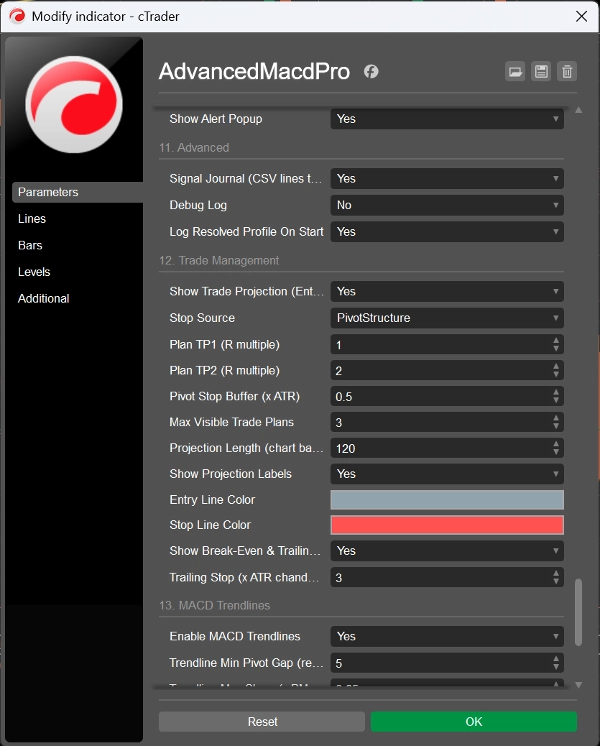
• Entry, stop and two targets. The stop comes from one of two rulers: PivotStructure (default), beyond the divergence pivot extreme plus an ATR buffer (0.5 default), which puts the stop where the structure that produced the signal is actually invalidated; or AtrMultiple, the same ATR stop the learning engine grades outcomes with, so the levels drawn are literally the levels your win rate describes. Targets are R-multiples of the initial risk (default 1R and 2R). If the risk-to-reward geometry cannot be honoured, the plan is repaired rather than drawn wrong.
• Lifecycle on closed bars only: RUNNING, then TP1 HIT, then TP2 HIT, STOPPED or STALE — resolved from intrabar highs and lows with the conservative same-bar rule, so a bar that could have touched both the stop and a target always fills the stop first. A bar that reaches the second target without a recorded first-target touch books and announces it as well, so the chart, the journal and the alerts tell the same story. The plan horizon is four times the outcome horizon, so a position plan gets room to work while a scalp plan expires quickly and is marked STALE instead of running forever.
• Styling that cannot lie: every level is solid while the plan runs and turns dotted the moment it is reached or the plan finishes, with a suffix of HIT (paid), VOID (invalidated) or STALE (horizon elapsed).
• Break-even and trailing suggestions: once the first target pays, a dotted break-even line appears at entry; while the plan runs, a chandelier trailing stop (best close since entry minus a multiple of ATR, mirrored for shorts, default 3.0 ATR) is drawn and refreshed once per newly closed source bar. It is a true ratchet — the scan window is the plan's whole lifetime, so an aged plan's trail can never regress — and it never suggests a level worse than the original stop.
• Budget and cleanliness: Max Visible Trade Plans (default 3) caps how many plans are drawn, oldest trimmed first, and every visible plan is extended as the chart grows, not just the newest one. Plans survive the "draw only most recent N bars" window, so a managed plan is not deleted just because its signal graphics aged out. Every level carries a full tooltip.
• Plan alerts: "Plan Level Reached" announces each touch with the level, price, time, direction, plan id and the R-multiple actually paid.
━━━━━━━━━━━━━━━━━━━━━━━━━━━━━━━━━━━━━━━━
- THE CSV SIGNAL JOURNAL — YOUR OWN SIGNALS AS DATA
Three id-keyed CSV streams in the platform log, keyed on the signal id so a signal and its lifecycle rows join reliably:
• AMP-JOURNAL — one line per live confirmed divergence with the full plan: id, time, symbol, source timeframe, regular or hidden, bull or bear, grade, quality, confluence, entry, SL, TP1, TP2, both R multiples, ATR at entry and the stop mode.
• AMP-PLAN — one line per lifecycle event: first target hit, second target hit, stop hit or expired, with the bar and the price.
• AMP-OUTCOME — the learning engine's verdict per record: win, loss or expired.
Only live events are journaled: a start-up or history-reload rescan re-resolves the past but never re-emits it, so the streams stay duplicate-free across restarts. Copy the lines into a spreadsheet and you have a per-signal audit trail — which grades pay, which families decay, what your real excursions are, whether the second target is ever reached on this symbol.
━━━━━━━━━━━━━━━━━━━━━━━━━━━━━━━━━━━━━━━━
- MOMENTUM TRENDLINES AND SESSION MARKERS
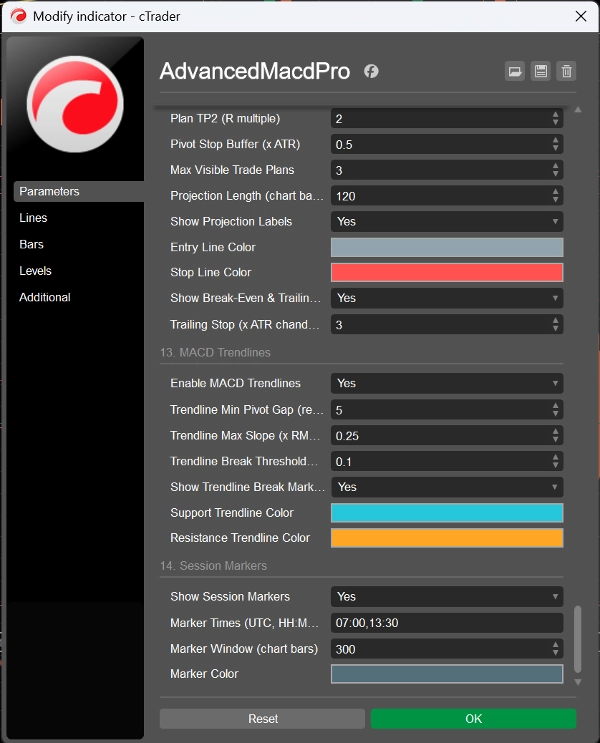
Momentum trendlines. Support and resistance lines are drawn automatically through the confirmed pivots that also feed the divergence engine — the momentum reading of a price swing low or swing high — and extended toward the newest closed bar. A pairing is accepted only if the line was not violated anywhere between its own two anchors, and the anchor search uses the same candidate budget and minimum pivot gap as the divergence search. Everything is measured in the oscillator's own scale, because a MACD lives in price units and "points per bar" would mean something different on every symbol: the slope cap (default 0.25 RMS per bar) and the break threshold (default 0.10 RMS) are multiples of the rolling mean absolute MACD. A support line breaks when the MACD closes below it, a resistance line when it closes above; the break is marked with a triangle and a "TL BREAK" label, alerted once per line generation, and reported in the panel. Detection runs on closed source bars only, so trendline signals never repaint. A stale line is neither tested nor extended, because extrapolating it would manufacture meaningless breaks.
Session markers. Thin vertical lines on the price chart at configurable UTC times (default 07:00 and 13:30, the London and New York opens), drawn only on closed chart bars inside a rolling window (default 300 bars), each with a tooltip naming the time. Times are a plain HH:MM list, sorted automatically, with invalid entries ignored. Markers are occurrence-complete inside wide bars: a Weekly or Monthly bar contains every configured time once per day, and the whole span is swept up to the bar's real close, so a session that opens mid-bar is still marked on the right day and never duplicated at a month border. A rolling window plus a hard object cap means a wide-bar chart can never flood the object store. Pure context: markers never interact with signal logic and never appear in the statistics.
━━━━━━━━━━━━━━━━━━━━━━━━━━━━━━━━━━━━━━━━
- SIGNALS, ALERTS AND THE INFORMATION PANEL
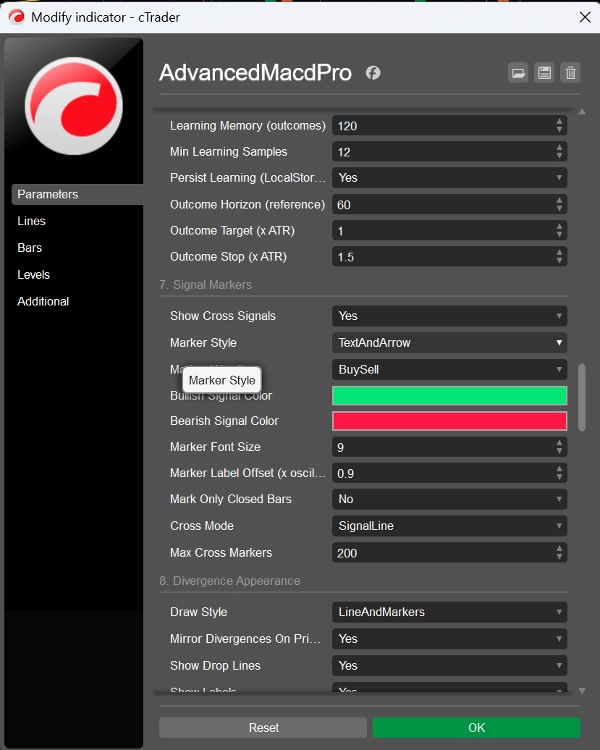
Crossover markers: an arrow anchored exactly on the crossing point plus a plain-language label clear of the histogram. Cross Mode selects which family the markers follow — signal line (default), zero line, or both, each with its own wording — and replaces the old zero-line checkbox. The trigger OUTPUTS stay bound to the signal-line latch in every mode and the alert toggles stay independent of it, so what is drawn, what is exported and what is announced are three separate decisions. Four wordings, four marker styles including None for machine-readable-only operation, separate bull and bear colours, font size, label offset, and a Mark-Only-Closed-Bars switch. Markers are keyed by source index, so they are never duplicated and never missed when several chart bars share one source bar; on the forming bar they are provisional and withdrawn if the cross does not survive.
Divergence rendering: line, markers or both; optional drop lines; labels in Plain, Compact or Full wording with grade and quality independently switchable; six colours; thickness and style; marker icons; an optional mirror of the lines on the price chart; a cap on drawn divergences; and a draw-only-the-most-recent-N-bars window. Every object carries a full tooltip.
Six alert triggers on three independent channels — a Log line, a colour-coded platform popup (so it works with the terminal in the background) and a sound with separate bullish and bearish tones. Each channel has its own switch, each is isolated, and every platform call on the alert path is guarded, so a failed sound, popup or log write can never break signal processing. Triggers: signal-line cross, zero-line cross, divergence (above your alert quality bar and only for effectively live signals), MTF confluence flip, MACD trendline break, plan level reached. Only On Closed Source Bar makes alerts strictly non-repainting; anti-spam latches allow one alert per event; every freshness window is scaled by the source-to-chart bar ratio, so a finer source on a coarser chart can no longer silently swallow an alert; and Alert Cooldown sets a hard minimum spacing between alerts of the same kind.
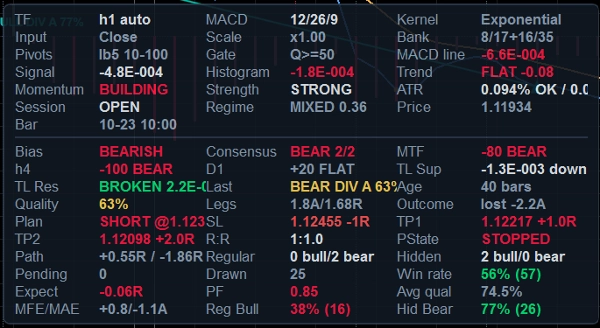
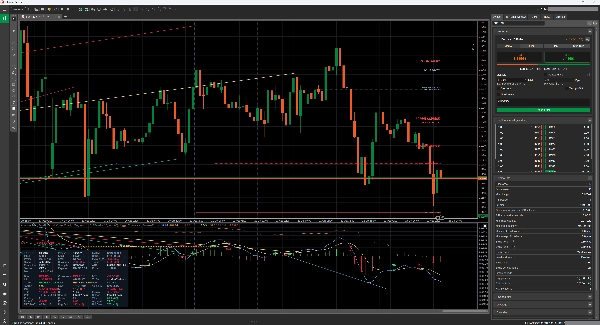
The information panel is a compact dashboard built from real chart controls: opaque cards pinned to the corners of the indicator window, with a static-text fallback for older builds. Four layouts, three horizontal sides, vertical edge, font size, opacity, margin, four colours, per-section toggles, an adaptive statistics window and a refresh interval down to 50 milliseconds. Row allocation is demand-capped in every layout: no blank rows, an empty section is hidden rather than drawn as an empty card, and when one card drops out the survivor receives the full height budget. It shows resolved values, never the dialog's — which is the whole point, since a style preset or a clamp can make the two disagree — across five blocks: configuration (style, timeframe, resolved legs, kernels, price input, filter bank, pivot geometry, quality gate); market (MACD, signal, histogram, trend with slope, momentum, ATR as a percentage with the floor in force, session, regime, ADX, price, bar time); signals (overall bias, confluence score with each level listed, trendline state); the live plan of the most recent signal (entry, stop, both targets with their R multiples, R to R, state, and the path price actually travelled in plan-R units); and statistics (last divergence with grade, age, quality and outcome; a census of regular and hidden bull and bear signals; win rate with sample size; expectancy in R and profit factor; average quality; per-family win rates).
━━━━━━━━━━━━━━━━━━━━━━━━━━━━━━━━━━━━━━━━
- AUTOMATION READY AND ENGINEERED TO BE TRUSTED
All twelve series are exposed as indicator outputs: MACD, Signal, four histogram buckets, Bull Trigger, Bear Trigger, Bull Divergence, Bear Divergence, Zero Line and MACD Higher TF. A cBot or another indicator can consume every event directly; set Marker Style to None and you have a clean, machine-readable signal source with nothing drawn. For the plan levels programmatically rather than visually, parse the AMP-JOURNAL and AMP-PLAN CSV lines — they carry entry, stop, both targets, the R multiples and every lifecycle event, with the signal id as the join key.
Underneath: a deterministic, non-repainting core that is incremental and constant cost per tick; automatic history loading with a warm-up estimate; memoised volume-price scans so redundant ticks stay cheap; safe drawing wrappers so a single failed chart object can never take the indicator down; culture-invariant formatting everywhere, so the log, panel, markers, CSV streams and alerts agree regardless of your terminal's locale; and defensive handling of every platform edge case — a missing higher-timeframe series, a symbol with no trading calendar, an unavailable LocalStorage, a build without the popup API. AccessRights is None: it asks for nothing.
This build has also been through repeated full-engine correctness audits, including a compile against the published cAlgo API reference at the strictest analysis level and independent re-implementations of the numeric core cross-checked value by value. In user terms: no look-ahead on irregular calendars, so on a Monthly chart with a 28-day February the cross marker, divergence anchor, plan level and trendline break all land on the same chart bar as the outputs they describe; closed bars are truly closed, so a coalesced tick stream or a reconnect cannot freeze a stale price into a closed bar; non-finite values are rejected at every decision point; and every panel row, tooltip, log line and CSV field was checked against what the engine actually runs.
Scientific and technical basis: operator analysis of MACD as a phase-corrected smoothed derivative and band-pass filter (Li, 2025); the volume-price-adjusted MACD input and the early-entry rule (Lin and co-authors, 2026); the Kaufman Efficiency Ratio as regime weight (Kaufman, 1995); the variance-ratio and microstructure-noise argument behind the period scaling law (Lo and MacKinlay, 1988); Brown's A/B/C divergence grading and momentum trendlines; the Appel and Murphy MACD rules; the LeBeau chandelier exit behind the trailing suggestion; Van Tharp's R-multiple plan algebra behind the two targets.
━━━━━━━━━━━━━━━━━━━━━━━━━━━━━━━━━━━━━━━━
- THE USER MANUAL
A real manual instead of a readme: 34 chapters in three sections, roughly 33 000 words, 76 reference tables and annotated screenshots, including a kernel gallery of the same chart rendered through nine different kernels. The parameter reference covers all 162 parameters in 15 groups, and the diagnostics chapters cover everything printed at start-up plus the three CSV streams field by field. It walks through installation, every glyph on the pane, every panel line, trading divergences and crossovers, managing a projected plan from entry to the second target, stop or expiry, reading trendline breaks, a multi-timeframe workflow, the gates in practice with a symptom-to-knob table, exporting the journal, ready-made presets, what NOT to do, performance and chart hygiene, how to verify the non-repaint claim yourself, FAQ, troubleshooting and a glossary.
• READ ONLINE or DOWNLOAD FOR OFFLINE USE: https://juan-elias-artesano.github.io/AURUM-QUANT-WIKI/
The offline archive is fully self-contained: unpack it, open the manual in any browser, and it works with no internet connection.
━━━━━━━━━━━━━━━━━━━━━━━━━━━━━━━━━━━━━━━━
HOW TO USE IT
IN TWO MINUTES. Drop it on any chart in a separate indicator window and leave everything at defaults: Universal style, Automatic adaptation, source set to the current chart, two confluence levels. Read the resolved profile in the Log and use the panel as your dashboard. You already have MACD, a strength-coloured histogram, the higher-TF line, BUY and SELL markers, graded divergences, a confluence score, momentum trendlines, session markers, a projected plan for every live signal, alerts and self-learning statistics.
SCALPING (M1 to M5). Set Trading Style to Scalping — that is the entire setup. Trade the arrow when it agrees with the confluence direction; treat an A-grade divergence above your weak threshold as the higher-conviction entry; let the panel's regime reading and ATR state tell you when to stand aside. After a few hundred bars, check the per-family win rates and raise the floor for the family that is not paying.
INTRADAY AND SWING (M15 to D1). Set Trading Style to Swing, or stay on Universal. Use the crossover for timing, the zero-line position and the confluence score for direction, divergences for exhaustion and continuation, and the projected plan for the trade itself: enter on the signal, stop at the structure level the plan drew, take part off at the first target, move to break-even where the chart and the panel both show you, and trail the rest with the chandelier suggestion.
POSITION (W1 to MN). Set Trading Style to Position: slower horizon-matched references, a hard three-rung confluence gate, regular reversals only, crossover markers off because the plan is the actionable event, and a plan given a 120-bar horizon with 1.5R and 3R targets and a 4 ATR trail.
MANAGING A PLAN. Read the plan rows in the panel and the levels on the chart. Solid means live, dotted means finished or paid. When the first target reads HIT, the break-even line appears — that is your cue to move risk to break-even. While the plan runs, the TRAIL line is the chandelier suggestion. When it ends it is labelled STOPPED, STALE or fully HIT, and the AMP-PLAN row tells you which level closed it and when.
BUILDING YOUR OWN STATISTICS. Turn on Signal Journal, trade normally for a few weeks, then copy the three AMP CSV streams from the log into a spreadsheet and join them on the id column: grade, quality, confluence, entry, stop, both targets, the R multiples, the outcome and the realised excursion for every signal the engine produced on your broker's feed.
TUNING. Global Sensitivity is the speed dial, Min Quality Score the selectivity dial. Pivot Prominence, Min Price Leg and Min Oscillator Leg control how obvious a divergence must be. Stop Source, Plan TP1, Plan TP2 and Pivot Stop Buffer shape the plan. Trendline Max Slope and Break Threshold control trendline strictness. Alert Cooldown controls how much you hear about it. Switch Adaptation Mode to Manual when you want your numbers used verbatim.
━━━━━━━━━━━━━━━━━━━━━━━━━━━━━━━━━━━━━━━━
WHAT YOU GET
• Advanced MACD Pro indicator for cTrader (cAlgo API). Single file, no external dependencies, no access rights requested.
• 162 parameters in 15 clearly named groups, all documented, and 12 output series.
• A complete trade-management engine: projected Entry, SL, TP1 and TP2 plans with a managed lifecycle, break-even and chandelier trailing suggestions, plan-level alerts and a visible-plan budget.
• Momentum trendlines on the oscillator with break markers, alerts and panel rows, plus UTC session markers on the price chart.
• A three-stream CSV signal journal, spreadsheet-ready and duplicate-free across restarts.
• Four trading-style presets (Universal, Scalping, Swing, Position), each pinning its full scaling-reference surface.
• Works on any instrument and any timeframe, from tick and M1 through Renko and Range charts to Monthly.
• Full diagnostics: resolved-profile log, per-signal skip reasons in Debug mode, start-up consistency checks.
• The complete user manual, online and as an offline archive.
IMPORTANT LIMITATIONS AND NOTES
• This is an analytical indicator, not a trading robot. It does not open, manage or close positions — with AccessRights.None it cannot. Projected levels are analysis and suggestions, not orders.
• It does not provide financial advice and does not guarantee profitable results.
• The multi-timeframe engine and the higher-TF line need sufficient history on the higher timeframe; on very illiquid symbols some rungs may be unavailable and are then stepped over.
• Volume-based inputs depend on the quality of the broker's tick-volume feed and may be less informative on exotic instruments.
• Learning statistics need resolved samples before they influence the score; until then that quality component is dropped from the calculation rather than guessed.
• Best results are on liquid markets: major FX pairs, index CFDs, metals and top-tier crypto. Custom indicators from the Store install on cTrader Windows and Mac.
Disclaimer
Trading involves risk. Past performance does not guarantee future results.
Summary
Key features include:
- Multi-timeframe confluence scoring with up to four levels, combining MACD line, signal line, histogram, and trend data into a quality-scored signal from 0 to 100.
- A divergence engine detecting and grading regular and hidden divergences with precision pivot analysis and multiple quality filters.
- A trade management engine that converts each confirmed signal into a managed trade plan with explicit entry, stop loss, two profit targets, break-even, and trailing stop suggestions, visualized on the price chart and tracked through a lifecycle.
- Momentum trendlines and session markers for contextual analysis.
- Extensive alerting options and a live dashboard panel displaying configuration, market data, signals, active plans, and adaptive learning statistics.
- A CSV signal journal exporting detailed per-signal data for external analysis.
- Four trading styles (Universal, Scalping, Swing, Position) preset for different trading horizons and approaches.
- Fully non-repainting, deterministic core with automatic history loading and robust error handling.
- 162 configurable parameters grouped for fine-tuning, supported by a detailed 34-chapter user manual available online and offline.
The indicator is analytical only; it does not execute trades and requires no special access rights. It is optimized for liquid markets including forex majors, metals, indices, crypto, stocks, futures, and CFDs.