
Beschreibung
DIE IDEE
Ein gleitender Durchschnitt, der von einem gewählten Preisniveau aus startet, anstatt jede Analyse in einen festen Rückblickzeitraum zu zwängen.
DAS PROBLEM
Ein traditioneller gleitender Durchschnitt wird durch eine Periode definiert.
20 Balken. 50 Balken. 200 Balken.
Aber manchmal ist die wichtige Frage nicht wie viele Balken Sie messen möchten.
Es ist wo die Messung beginnen sollte.
Eine feste Periode blickt vom aktuellen Balken zurück, weiß aber nicht, welches Preisereignis für Ihre Analyse relevant ist.
Wenn hier eine Korrektur beginnt oder dort ein Impuls startet, kann ein 50-Perioden-MA nicht angewiesen werden:
"Beginne die Messung ab diesem Ereignis."
Die Periode definiert das Messfenster.
Sie definiert nicht ihren Ursprung.
DAS KERNKONZEPT: DER ANKER DEFINIERT DEN URSPRUNG. DER MA MISST VON DORT AUS.
Der verschiebbare gleitende Durchschnitt ändert den Referenzpunkt.
Traditionelle gleitende Durchschnitte machen die Periode zur primären Referenz.
Der verschiebbare gleitende Durchschnitt macht den Ursprung zur primären Referenz.
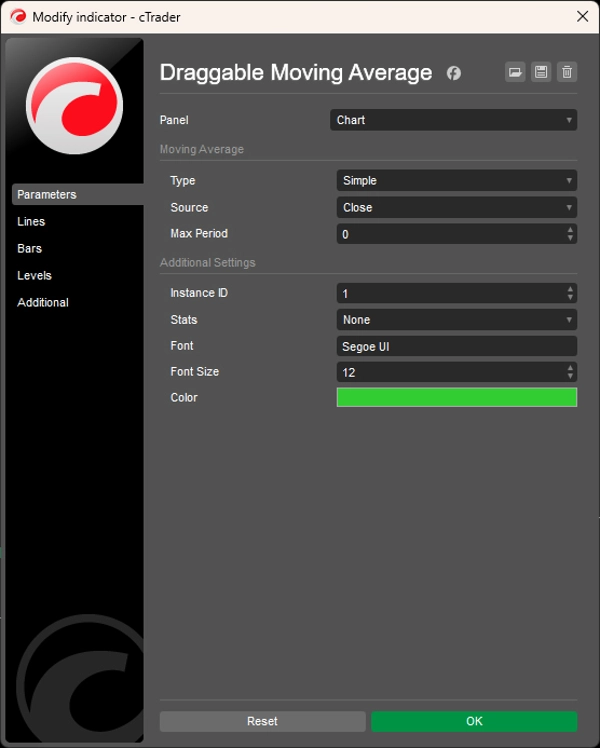
Die Periode bestimmt weiterhin, wie die Berechnung funktioniert, während der Max-Perioden-Parameter das rollierende Berechnungsfenster begrenzt, das sich vom Anker aus nach vorne entwickelt.
Aber der Anker bestimmt wo die Messung beginnt.
Das ändert die Frage von:
"Welche MA-Periode soll ich verwenden?"
zu:
"Von welchem Preisereignis möchte ich, dass dieser MA misst?"
WAS ES TUT
Der verschiebbare gleitende Durchschnitt ermöglicht es Ihnen, diesen Ursprung selbst zu definieren.
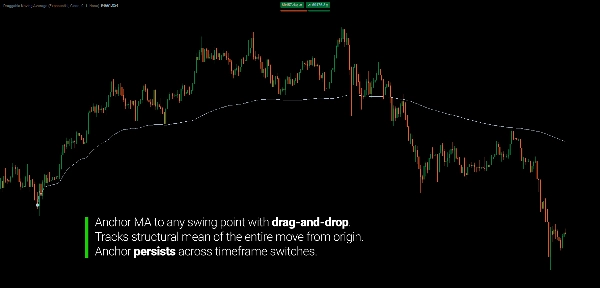
Setzen Sie den Anker auf einen beliebigen Balken in der Preishistorie, und der gleitende Durchschnitt beginnt ab genau diesem Punkt nach vorne zu berechnen.
Ziehen Sie den Anker zu einem anderen Balken, und der MA berechnet sich sofort neu.
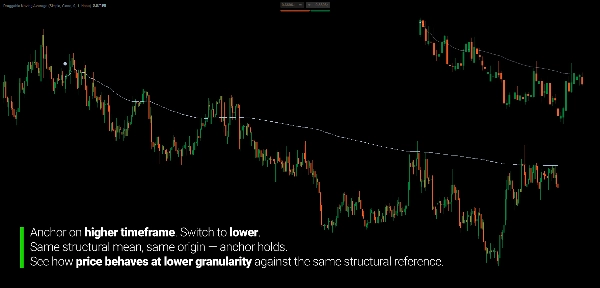
Wechseln Sie die Zeitrahmen, und der Anker bleibt an derselben historischen Referenz befestigt, während sich die Berechnung an die auf dem neuen Chart verfügbaren Daten anpasst.
Die Referenz ist explizit — nicht in einer Periode verborgen.
WIE ES FUNKTIONIERT
Der Prozess ist bewusst einfach:
1. Setzen Sie den Anker.
Wählen Sie jeden Balken, der für Ihre Analyse wichtig ist.
2. Der MA beginnt dort.
Die Berechnung beginnt an Ihrem gewählten Ursprung und entwickelt sich nach vorne.
3. Lassen Sie den Preis sich entwickeln.
Wenn neue Balken erscheinen, integriert der Durchschnitt die sich entwickelnden Preisdaten.
4. Bewegen Sie den Anker, wenn sich Ihre Referenz ändert.
Ziehen Sie den Anker zu einem anderen Balken, und die gesamte Berechnung wird sofort aktualisiert.
Es ist nicht nötig, die MA-Periode ständig zu ändern, um einen anderen Startpunkt zu approximieren.
Ändern Sie die Referenz selbst.
EIN GLEITENDER DURCHSCHNITT, DER UM DIE BEWEGUNG RUNDHERUM GEBAUT IST
Wenn ein MA am Beginn einer bestimmten Preisbewegung verankert ist, entwickelt sich die Berechnung von diesem Ursprung aus nach vorne.
Das gibt dem MA einen anderen Kontext als einem herkömmlichen rollierenden Durchschnitt.
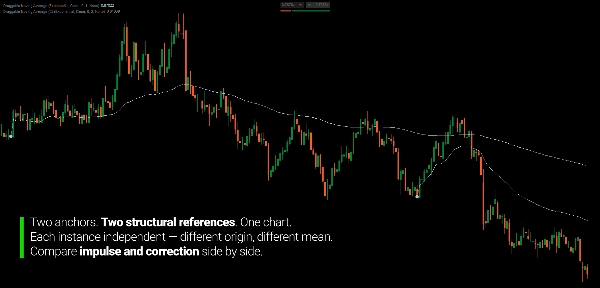
Eine Korrekturbewegung kann ihren eigenen verankerten MA haben.
Ein Impuls kann einen anderen haben.
Ein großer Schwung kann einen weiteren haben.
Sie fordern den MA nicht mehr auf, eine willkürliche Anzahl jüngster Kerzen zu beschreiben.
Sie bitten ihn, einen bestimmten Teil des Marktes zu messen.
BEOBACHTEN SIE, WIE SICH DER PREIS UM DEN MITTELWERT ENTWICKELT
Der verankerte MA kann als Referenz verwendet werden, um zu beobachten, wie sich der Preis während der Bewegung verhält.
Der Preis kann:
- sich während starker Bewegung vom Mittelwert entfernen
- während Konsolidierung oder Korrektur zum Mittelwert zurückkehren
- den Mittelwert kreuzen, wenn sich der Charakter der Bewegung ändert
- den Mittelwert nach einer Richtungsänderung erneut aufsuchen
Diese Verhaltensweisen werden nicht als automatische Handelssignale behandelt.
Der Zweck ist einfacher:
den Durchschnitt einer definierten Preisbewegung sichtbar zu machen.
Die Bedeutung ergibt sich aus der Bewegung, die Sie messen möchten — nicht aus einer bestimmten MA-Zahl.
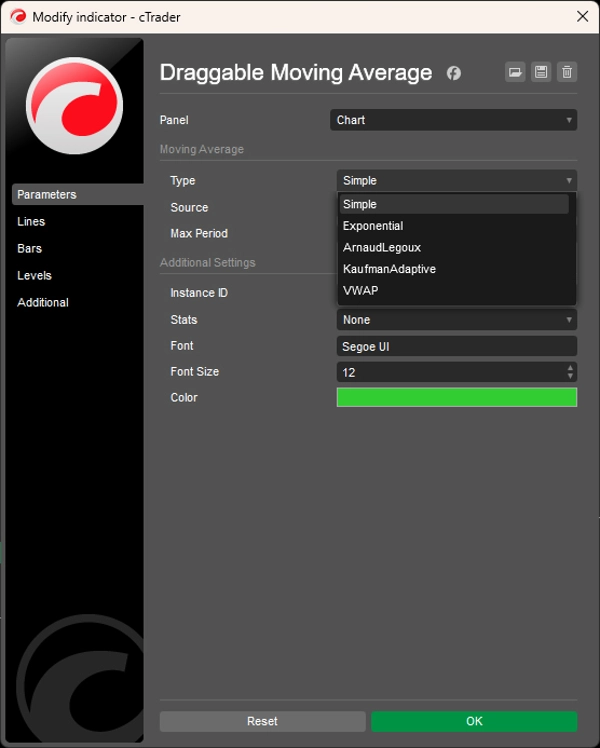
FÜNF WEGE, DEN MITTELWERT ZU BERECHNEN
Wählen Sie die Berechnung, die am besten zu Ihrer Analyse passt:
Einfach (SMA)
Ein einfacher arithmetischer Mittelwert, der sich vom Anker aus entwickelt.
Exponential (EMA)
Legt größeren Wert auf neuere Preisdaten.
Arnaud Legoux (ALMA)
Ein gewichteter Durchschnitt, der entwickelt wurde, um Verzögerungen zu reduzieren und gleichzeitig Glätte zu bewahren.
Kaufman Adaptive (KAMA)
Passt seine Glättung entsprechend der Markteffizienz an.
VWAP
Misst den volumengewichteten Durchschnittspreis vom gewählten Ursprung aus.
Alle Berechnungstypen behalten die gleiche Grundidee bei:
der Anker definiert, wo die Messung beginnt.
DIE REFERENZ ÜBERLEBT DEN ZEITRAHMENWECHSEL
Eine der nützlichsten Eigenschaften eines definierten Ankers ist, dass die Referenz nicht verschwindet, wenn Sie den Zeitrahmen wechseln.
Verankern Sie den Beginn einer Bewegung im Tageschart.
Wechseln Sie zu H1.
Dann zu M15.
Der Anker bleibt an demselben historischen Punkt gebunden, während der MA sich mit den auf dem neuen Zeitrahmen verfügbaren Daten neu berechnet.
Das macht ihn nützlich für Multi-Timeframe-Analysen, bei denen das gleiche Preisereignis über verschiedene Chartauflösungen hinweg die Referenz bleiben muss.
OPTIONALE STATISTIKEN
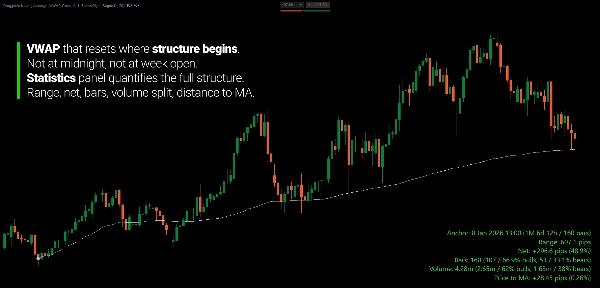
Das optionale Statistikfenster bietet eine quantitative Ansicht der Preisbewegung zwischen dem Anker und dem aktuellen Balken.
Es kann anzeigen:
- Spanne in Pips
- Nettoveränderung in Pips und Prozent
- Anzahl und Prozentsatz bullischer/bärischer Balken
- Volumen und Prozentsatz bullisch/bärisch
- Preisabstand vom MA in Pips und Prozent
- Dauer
- Anzahl der Balken seit dem Anker
Das Panel ist optional.
Das Kernwerkzeug bleibt der verankerte gleitende Durchschnitt.
MEHRFACHE REFERENZEN
Mehrere Instanzen können gleichzeitig verwendet werden.
Ein MA kann am Beginn einer Korrektur verankert sein.
Ein anderer kann am vorhergehenden Impuls verankert sein.
Jede Instanz hat ihre eigene Identität, sodass verschiedene Preisbewegungen unabhängig auf demselben Chart gemessen werden können.
ENTWICKELT FÜR MESSUNG, NICHT FÜR SIGNALJAGD
Der verschiebbare gleitende Durchschnitt sagt Ihnen nicht, wo Sie kaufen oder verkaufen sollen.
Er gibt Ihnen etwas Fundamentaleres:
eine Möglichkeit, genau zu definieren, welchen Teil des Marktes der gleitende Durchschnitt messen soll.
Verwenden Sie ihn, um zu studieren:
- Impuls- und Korrekturbewegungen
- Schwungentwicklung
- Preisverhalten um einen definierten Mittelwert
- Mittelwertumkehr innerhalb einer spezifischen Bewegung
- Veränderungen im Charakter einer Bewegung
- Höherwertige Zeitrahmenreferenzen aus niedrigeren Zeitrahmencharts
- Unterschiedliche Preisverteilungen von verschiedenen Ursprüngen
Der Indikator entscheidet nicht, welcher Punkt wichtig ist.
Sie wählen die Referenz. Der MA misst, was von dort aus passiert.
HAUPTMERKMALE
- Vollständig verschiebbarer Anker
- Benutzerdefinierter Startpunkt
- MA berechnet sich sofort neu, wenn der Anker verschoben wird
- Anker bleibt bei Zeitrahmenwechsel erhalten
- Fünf MA-Methoden: SMA, EMA, ALMA, KAMA, VWAP
- Acht auswählbare Preisquellen
- Max-Perioden-Begrenzung mit rollierendem Fenster vom Ankerursprung
- Optionales Statistikfenster mit vier Eckpositionen
- Mehrere unabhängige Instanzen
- Entwickelt für Multi-Timeframe-Analyse
---
Trading beinhaltet Risiken. Dieser Indikator ist ein Werkzeug der technischen Analyse und sollte zusammen mit einem angemessenen Risikomanagement verwendet werden.
Zusammenfassung
This approach transforms the MA into a structural mean that reflects the average price evolution from a defined origin, aiding in mean reversion and reversal detection. Price behavior around this anchored MA provides insights into momentum, consolidation, and potential trend exhaustion.
The indicator supports five MA calculation methods—Simple (SMA), Exponential (EMA), Arnaud Legoux (ALMA), Kaufman Adaptive (KAMA), and Volume Weighted Average Price (VWAP)—with a configurable maximum period to cap the lookback window. It offers eight price source options and an optional statistics panel displaying real-time metrics such as range, net change, volume splits, and price distance from the MA.
Multiple instances can run simultaneously, each with a unique ID, allowing concurrent analysis of different structural moves without conflicts. This tool is designed for swing and position traders, multi-timeframe analysts, and discretionary traders who require precise, structure-based MA anchoring rather than arbitrary period-based averages.
Kundenbewertungen
Diskussion
Häufig gestellte Fragen (FAQ)



![„[Hamster-Coder] Moving Average MTF“-Logo](https://cdn.ctrader.com/image/webp/b11b98b1-194d-4b8e-b00e-d611826ad159_31226)

Preis
