


説明
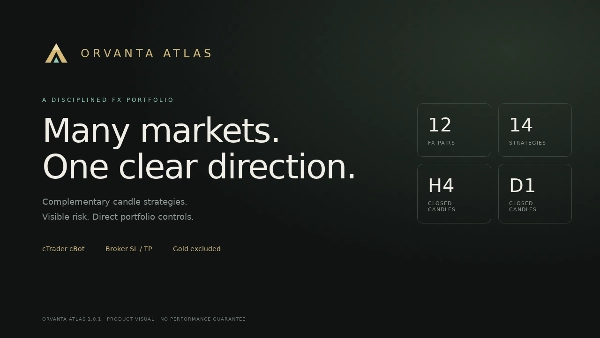
Orvanta Atlas is a rules-based FX portfolio cBot that combines 14 candle-pattern strategies across 12 currency pairs. It evaluates completed H4 and D1 candles, manages entries from one instance, and provides configurable risk controls with historical performance monitoring.
Strategy and trading approach
The portfolio combines candle-breakout signals with selected SMA20 and EMA50 filters. It is designed for systematic intraday and swing trading rather than rapid scalping. Positions may remain open overnight or over weekends.
Supported pairs: AUDJPY, AUDUSD, CHFJPY, EURJPY, EURUSD, GBPJPY, GBPUSD, NZDJPY, NZDUSD, USDCAD, USDCHF and USDJPY.
Entry logic and execution
The core signal requires a bearish previous candle, followed by a bullish candle that closes above the previous candle's high. Depending on the selected rule, the closing price must also be above or below its moving average. The predefined portfolio includes both buy and sell responses to this bullish pattern; sell rules are not a mirrored bearish-pattern strategy.
Signals are evaluated when the next H4 or D1 bar opens. Eligible trades use market orders with broker-side stop loss and take profit. AUDJPY and GBPUSD have mutually exclusive buy/sell filters on the same signal candle. Positions from different signal candles may coexist, including opposite directions on a hedged account.
Run one instance on EURUSD M1; the cBot obtains H4/D1 data for its portfolio automatically. M1 is the host chart and backtest data resolution, not the strategy signal timeframe. Orders can be rejected when spread, volume, margin or risk limits are not satisfied.
Money management and risk profile
Choose fixed USD stop-risk sizing or a percentage of account equity. Volume is rounded down to the broker's permitted step. Fixed USD sizing is converted into the relevant currency; the account does not need to be denominated in USD.
The strategy uses no martingale sizing, grid recovery or loss-based lot escalation. It still carries leveraged FX risk: correlated pairs and multiple open positions can produce substantial combined losses. Stop-risk amounts are targets before fees, slippage and gaps, not guaranteed maximum losses.
Daily equity-loss and equity-drawdown guards block new entries. They do not automatically liquidate existing positions. These guards use total account equity, so other trading activity and account cash flows can affect them.
Key default parameters
- Risk per entry: USD 100 in FixedUsd mode; alternative EquityPercent setting: 0.5%.
- Open stop-risk budget: USD 1,500.
- Daily account equity-loss guard: 5%; account equity-drawdown guard: 20%.
- Maximum positions: 20 across the portfolio and 8 per pair.
- Maximum entry spread: 3 native pips.
- Estimated margin for a new order: up to 80% of available free margin.
- Stops: rule-specific fixed distances or ATR-based distance; take-profit ratios range from 1:1 to 1:3.
Dashboard and performance alerts
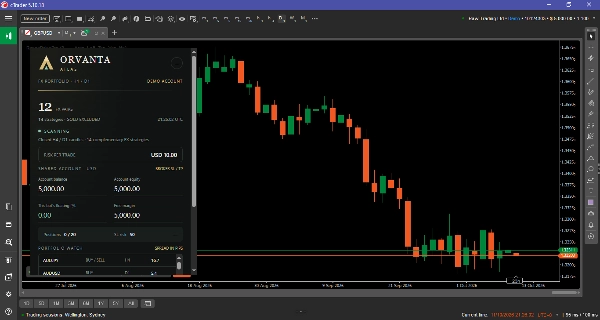
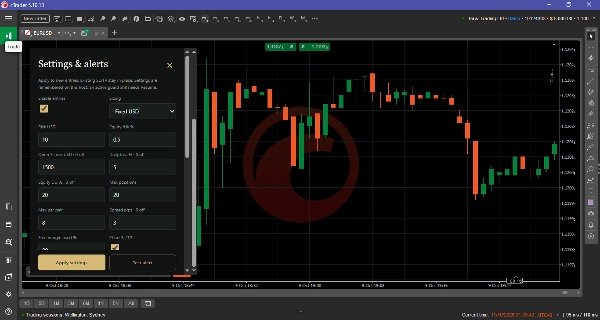
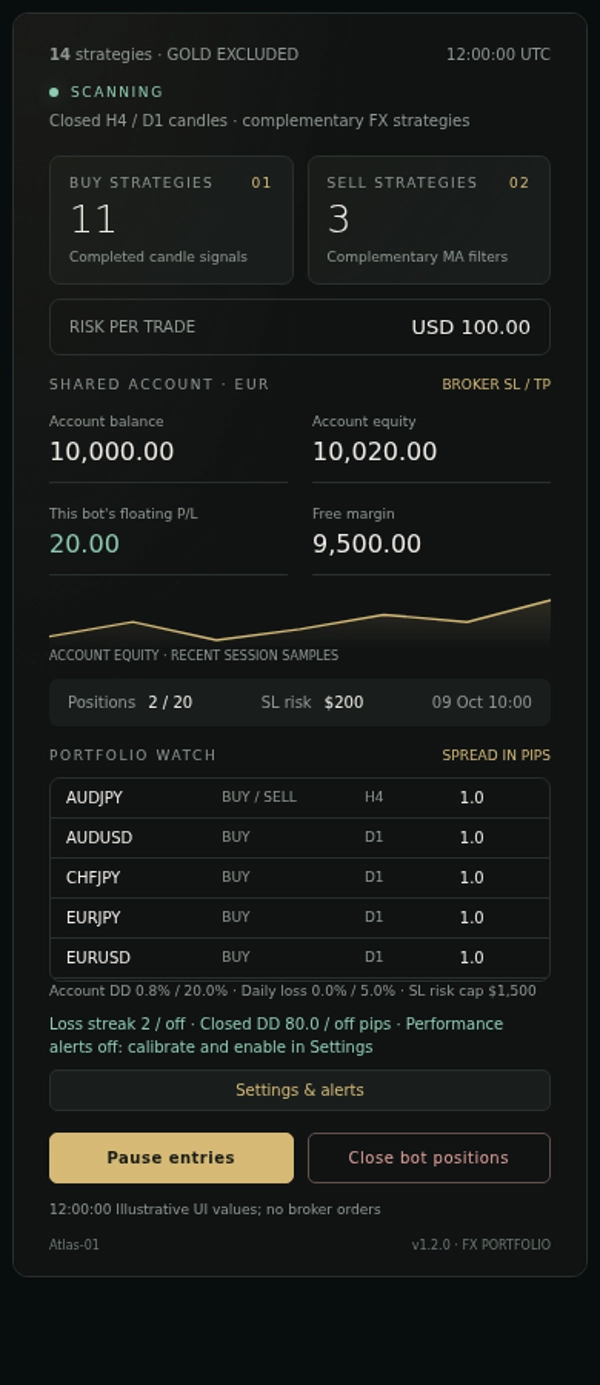
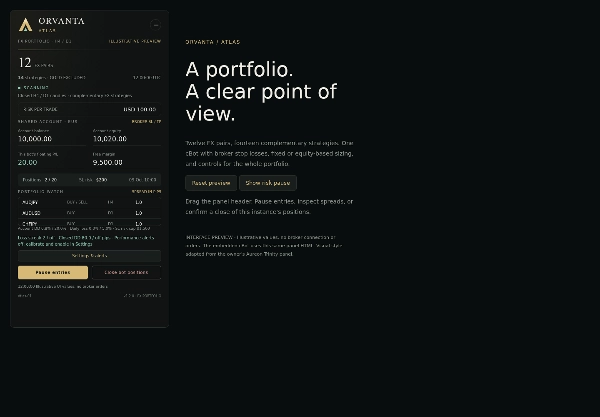
The draggable dashboard minimizes to a circular logo. Its settings panel allows changes to sizing, execution limits and notifications. Pause entries or confirm a close of this instance's positions. Changing settings does not replace existing positions' SL/TP.
Calibrate performance alerts for your account
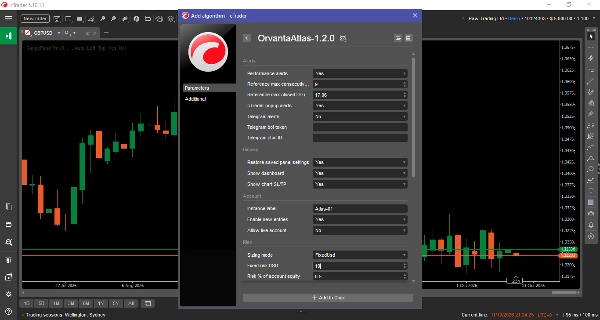
Performance alerts, cTrader popup alerts and Telegram alerts are OFF by default. Both reference fields start at 0 (not configured). The cBot continues recording closed-deal metrics while alerts are off; account equity-loss and drawdown entry guards remain separate controls.
- Backtest on your own broker account with M1 bars, using the same selected pairs, account currency, starting capital, leverage, risk per entry, spread, commission and execution settings you intend to use. Choose a representative period that includes different market conditions. Do not copy another account's results as your default.
- At the end of the test, open the cBot log and find the last
OA_TRACErecord whosekindisrisk_final. CopyMaxLossStreakinto Reference max consecutive losses andMaxDrawdownPipsinto Reference max closed DD (pips). Use the maximum fields, not the final/currentLossStreakorDrawdownPips. The native report's balance/equity DD percentages are different metrics and must not be entered in the pip field. - Enter these values in the cBot's Alerts parameters before starting, or through Settings & alerts on the dashboard. Both must be positive to enable comparison. If a test reports zero for either maximum, leave monitoring off and gather more representative history before choosing a reference.
- Enable Performance alerts (called Risk monitoring alerts in the panel), select cTrader popup and/or Telegram, then apply. For Telegram, enter your own token/chat ID and use Test alert in a demo/live session. Backtests never send external notifications.
- Repeat calibration after changing broker/account, portfolio subset, sizing, execution settings or the test period. Record the account, period and settings alongside your chosen reference. Subsets are supported if calibrated using that exact subset.
An alert triggers only when the current net-loss streak or closed-deal pip drawdown is strictly greater than its configured reference. Equality does not trigger an alert. One notification per metric per excursion is sent; recovery rearms it. Changing a reference or re-enabling monitoring checks the current state and may trigger a fresh alert, without replaying recovered past excursions. These are review alerts, not automatic trade stops or guaranteed loss limits.
Metrics use only this instance's owned closing deals, ordered by closing time and closing deal ID. Consecutive losses use net profit below zero; breakeven resets the streak. Pip drawdown is peak-to-trough loss on cumulative, equally weighted gross pips, starting from zero, rounded to 0.1 pip per deal. It excludes floating P/L, commissions and swaps. Partial closes count as separate closing deals. Use the same broker pip convention for calibration and monitoring.
Non-secret panel settings are restored by account and instance label on the same host. To use newly edited cTrader parameters at restart, set Restore saved panel settings = false. On upgrading from versions with a built-in reference, alerts remain off until you supply your own reference and enable them. Monitoring history is recovered from the available instance journal and broker history; use a fresh instance label for a deliberately new monitoring history.
Optional Telegram notifications require a bot token and chat ID. cTrader popup alerts are also available. Custom push notifications to cTrader Mobile are not supported by the current Algo API.
Who it is for
Best suited to intermediate and experienced cTrader users who understand leverage, portfolio exposure, margin and drawdown, and want a defined multi-pair strategy with visible controls. Less suited to traders seeking guaranteed returns, tightly fixed loss limits or unattended operation without performance reviews.
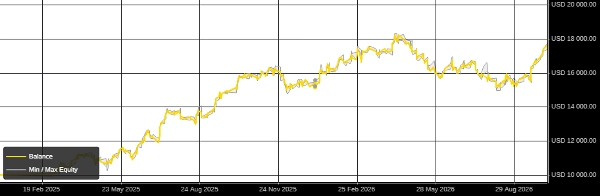
A hedged account and access to all selected broker symbols are required. The reference test used EUR 10,000 and 1:100 leverage; these are tested conditions, not a verified minimum balance or a recommendation for every account. Smaller accounts require reassessment of trade risk, minimum volume and margin. Broker and prop-firm compatibility must be checked individually.
Important limitations
The reference period overlaps strategy-selection data and is not an independent out-of-sample test. M1 simulation, broker sessions, spreads, commissions, swaps and execution conditions can produce different results in live trading.
Pip drawdown is calculated from the equally weighted cumulative gross pips of closed deals, excluding floating P/L, commissions and swaps. Consecutive losses use net profit after costs. Neither measure is interchangeable with account equity drawdown. Different settings, partial closes or broker pip conventions affect comparability.
Native CLI backtests and browser-based panel tests have been completed. The native Desktop panel, cloud execution and live Telegram delivery have not yet been validated. Start with a demo account and verify operation with your broker. The host must remain active for entry controls, monitoring and notifications to operate.
Trading involves risk. Past performance does not guarantee future results.
概要
The cBot operates from a single EURUSD M1 chart, automatically obtaining higher timeframe data. Trades are executed via market orders with broker-side stop loss and take profit, supporting configurable risk management including fixed USD or equity percentage sizing. It limits maximum open positions (20 total, 8 per pair) and enforces daily equity-loss and drawdown guards to block new entries.
A draggable dashboard provides control over settings, execution limits, and notifications, including optional performance alerts via cTrader popups or Telegram. Alerts are calibrated through backtesting on the user’s broker account to monitor risk metrics such as maximum consecutive losses and pip drawdowns.
OrvantaAtlas-1.2.0 requires a hedged account and access to all selected symbols. It is intended for intermediate to experienced cTrader users familiar with leverage, margin, and portfolio risk management.
カスタマーレビュー
ディスカッション
よくあるご質問
この作成者の他の商品











価格