

Descripción
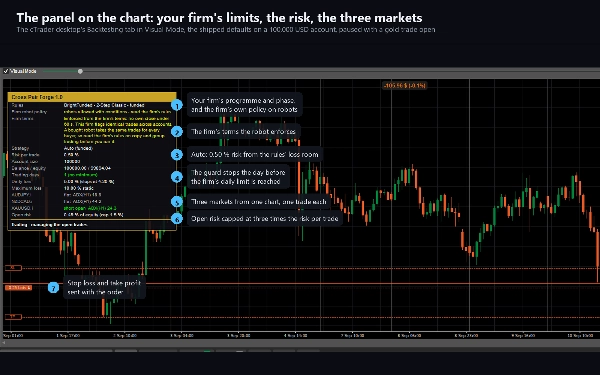
Cross Pair Forge trades three markets from one chart - AUDJPY, NZDCAD and gold - with a prop-firm guard built in. Choose your firm's programme, the phase and the account size: the guard loads that programme's limits, the strategy sizes every trade from them, and the robot stops before any limit is reached.
HOW IT TRADES
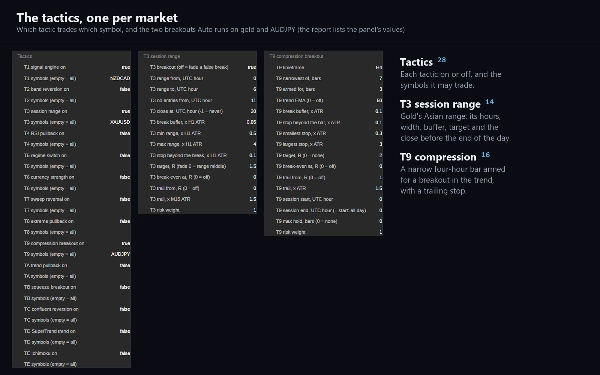
One tactic per market, at most one position per symbol, and never more than three times the risk per trade open at once. On gold, an Asian-range breakout: the high and low of the Asian session are marked, and a 5-minute close beyond them in the European morning is followed, with the stop at the middle of the range, a fixed target and a close before the end of the day. On AUDJPY, a four-hour compression breakout: a four-hour candle narrower than the six before it marks a coiled range, and a 15-minute close beyond it in the direction of the four-hour trend is followed, with a trailing stop. On NZDCAD, a momentum entry: a short-term RSI extreme that turns, taken only while the hourly ADX shows a strong market and never into a supply or demand zone, with a partial close, break-even and a trailing stop. Every trade gets its stop loss and take profit with the broker right after the fill; a trade whose stop the broker refuses is closed. All trades close on Friday evening. No grid, no martingale, no averaging down.
RISK SET FROM YOUR FIRM'S RULES
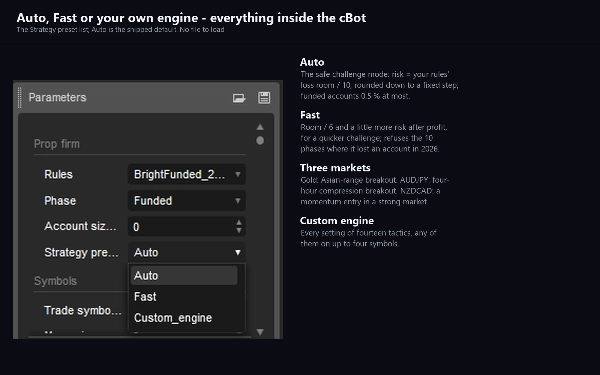
Strategy preset Auto (the default) takes the room your programme leaves - the maximum loss, less when it trails your equity - divides it by ten and rounds down to a fixed step between 0.25 and 3 %. Fast, the opt-in mode for a quicker challenge, divides it by six and adds a little risk after closed profit; it refuses the programmes where it lost an account in its 2026 simulation and asks for Auto there. A funded account trades 0.5 % at most in both modes, with no increase after profits. The panel shows the risk of the next trade.
THE GUARD
On every price change of any of the three symbols, before anything else, the guard checks the whole account:
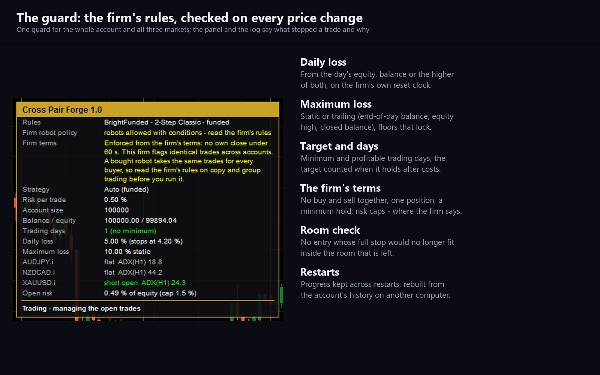
• Daily loss: measured the way the firm measures it (from the day's starting equity, starting balance or the higher of the two; as a share of the account size or of the day's start) and reset on the firm's own clock, with daylight saving.
• Maximum loss: static or trailing (end-of-day balance, equity high or closed balance), including floors that stop trailing at the account size.
• The profit target with the minimum trading days, profitable-day rules, consistency rules, daily profit caps, open-loss caps, news pauses and weekend rules where the firm has them.
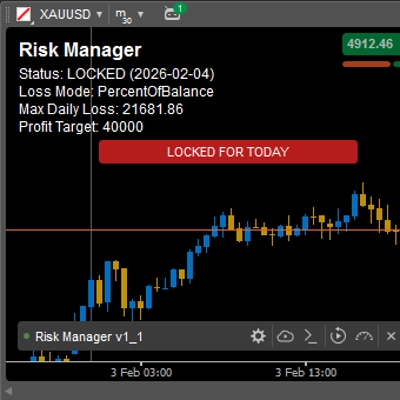
It stops before each limit by a buffer, closes the open trades when a limit comes near, refuses an entry whose full stop would no longer fit inside the room that is left, and says why on the chart panel and in the log.
THE FIRM'S TERMS, KEPT
Many firms add terms for robots. Where your firm's terms say so, the robot never holds a buy and a sell together, holds one position at a time, keeps each trade open for the firm's minimum time before closing it itself, caps the risk per trade or per day, keeps the risk constant, or counts a trading day only when a trade opens and closes on it. The panel shows which of these apply. A robot you buy takes the same trades for every buyer, and some firms flag identical trades across accounts as copy or group trading: read your firm's rules on this before you buy a challenge. Cross Pair Forge does not disguise its trades.
FIRM PROFILES, CUSTOM RULES
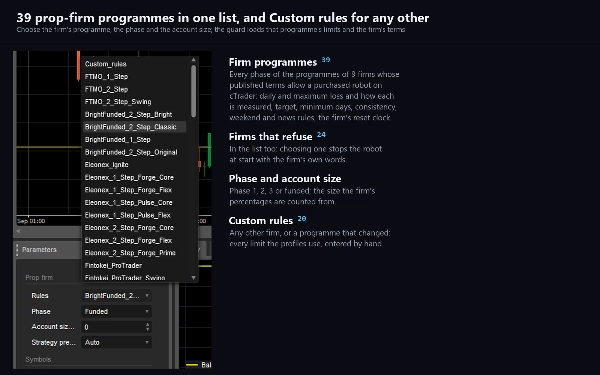
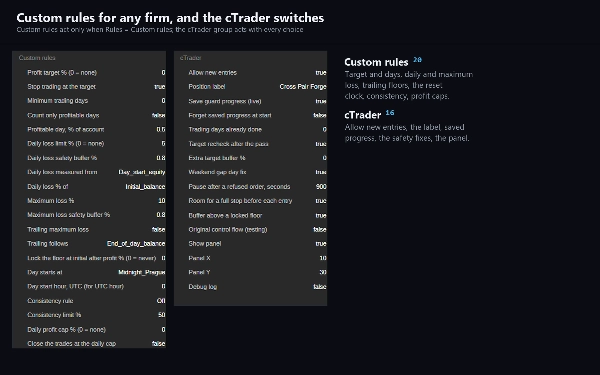
The Rules list holds 39 programme profiles of the 9 firms whose published terms allow a purchased robot on cTrader, phase by phase, read on the firms' own pages. The 24 firms whose terms do not allow it are in the list too: choosing one stops the robot at start with the firm's own words. Any other firm, or a programme that changed, is set up in the Custom rules group: every limit the profiles use can be entered by hand.
CUSTOM ENGINE
Custom engine opens every setting: the three tactics above, eleven more (band reversion, RSI pullback, an efficiency-ratio regime switch, currency strength, liquidity sweeps, short-term extremes, and five models with a confluence score: trend pullback, Bollinger-Keltner squeeze, z-score reversion, SuperTrend and Ichimoku), each assignable to any of up to four symbols. Its defaults are the tested three-market portfolio.
RESTARTS
The guard's progress (the day's start, the trading days, a halt, a reached target) and the risk Auto or Fast chose are kept when cTrader restarts. On another computer or in the cloud the guard is rebuilt from the account's own trade history.
BACKTEST
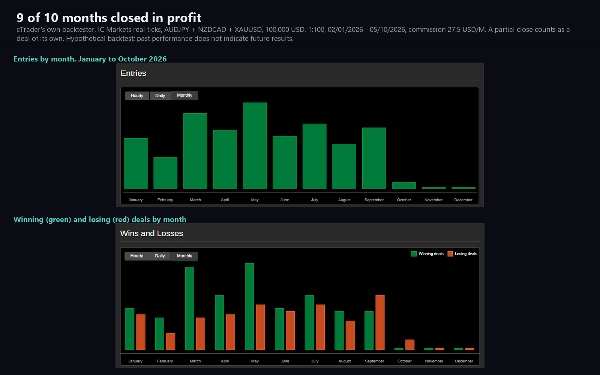
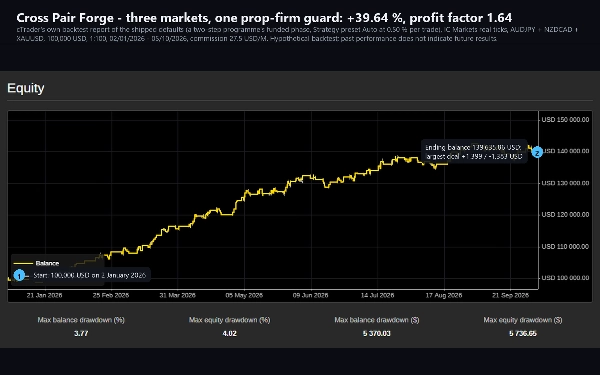
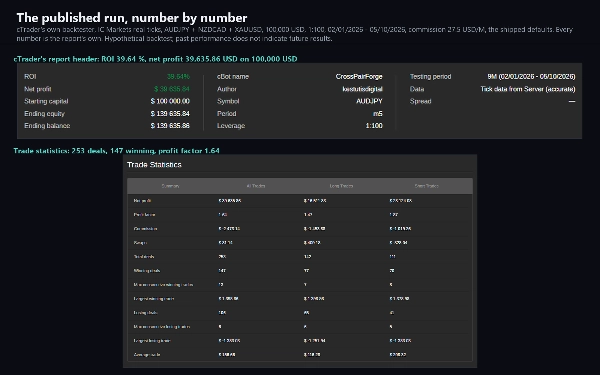
cTrader's own backtester, IC Markets tick data from the server, from 2 January 2026 to 5 October 2026, 100,000 USD starting balance, commission 27.5 USD per million, the default settings: a two-step programme's funded phase (5 % daily loss, 10 % static maximum loss), Strategy preset Auto (an Asian-range breakout on gold, a four-hour compression breakout on AUDJPY and a momentum entry on NZDCAD, at 0.50 % per trade). Net profit +39,635.86 USD (+39.64 %), profit factor 1.64, 253 trades (147 won), maximum balance drawdown 3.77 %, maximum equity drawdown 4.02 %. Auto was chosen on 2026 prices, so this shows how it traded the year it was chosen on; it is not a forecast, and in quieter markets it trades less and earns less.
WHAT IT DOES NOT PROMISE
Passing a challenge is not promised, and neither is a fixed number of days. The tactics need movement: in quiet months they trade less and pass slower, and a run of losing trades is normal. Fast reaches targets sooner and loses more accounts than Auto. The guard keeps the robot inside the limits; an account can still end at a loss limit rather than at the target. A price gap can fill a stop beyond its level. Firms change their rules; compare the profile with your firm's current rules.
TECHNICAL NOTES
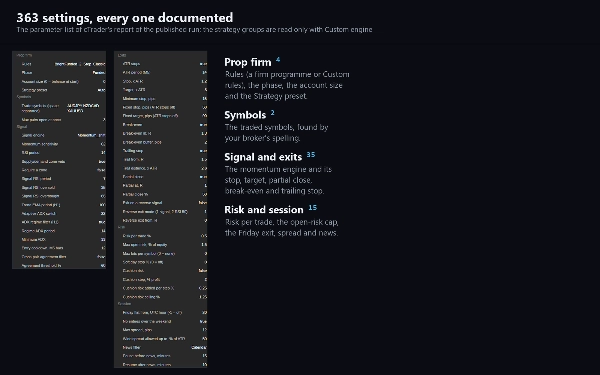
No access rights required. One instance on any chart trades the three symbols, found by your broker's spelling (AUDJPY.i, XAUUSD.r and similar); a symbol the account does not offer is skipped. Hedging and netting accounts both work: it holds at most one position per symbol. It loads its own history at start and builds its own 5-minute to daily bars on any chart timeframe. Runs on cTrader Desktop, Web and in the cloud; the economic calendar is read through cTrader's own networking service. Every one of the 363 parameters is documented.
SUPPORT
Questions go to the discussion on this page; please attach the instance log and your parameter values.
Trading leveraged products involves risk of loss; backtest results are hypothetical and past performance does not indicate future results.
Resumen
The bot employs distinct strategies per market: an Asian-range breakout on gold, a four-hour compression breakout on AUDJPY, and a momentum-based RSI entry on NZDCAD, each with defined stop loss, take profit, and trailing stop mechanisms. It maintains at most one position per symbol and limits total simultaneous risk exposure. Trades close before the weekend, and no grid, martingale, or averaging down techniques are used.
CrossPairForge supports 39 predefined firm program profiles and allows custom rule entry for other firms. It operates on cTrader Desktop, Web, and cloud platforms, reconstructing guard status from trade history after restarts. The bot uses cTrader’s backtester with IC Markets tick data for performance evaluation. It includes extensive risk management tools such as stop loss, take profit, trailing stops, break-even, equity stops, session and news filters, and complies with firm-specific trading terms.