Description
La carte thermique de tendance Matrix pro
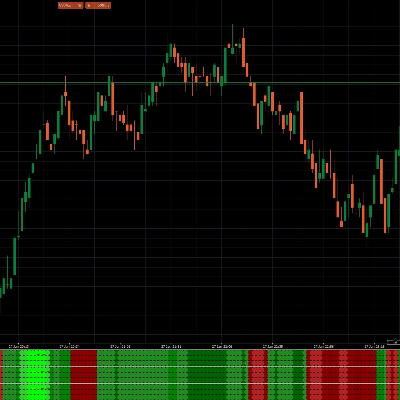
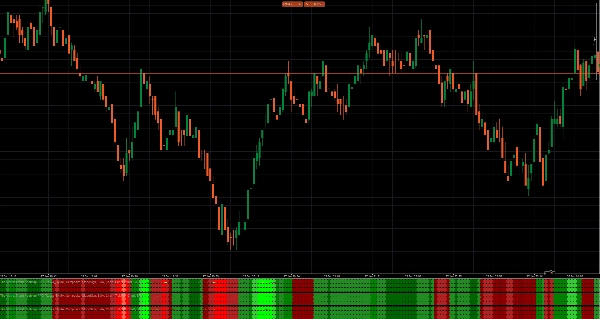
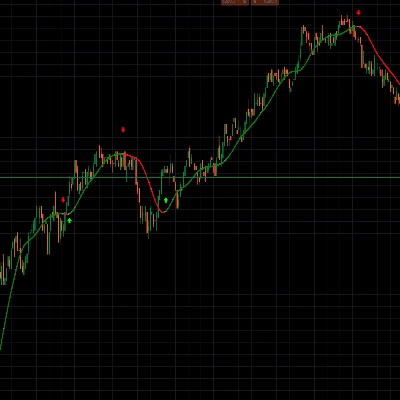
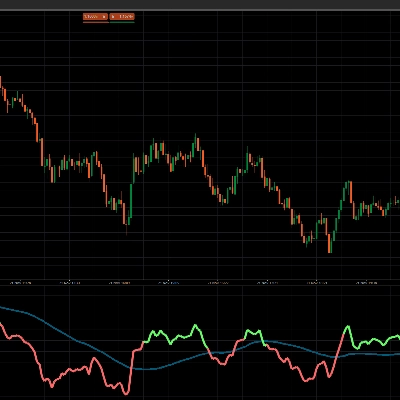
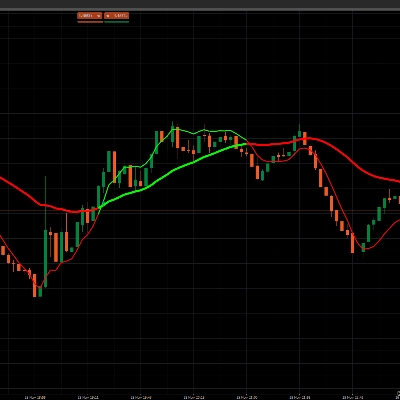
Cet indicateur est un moteur de tendance et de force multi-horizon conçu pour montrer—d’un coup d’œil—si le marché est haussier (vert), baissier (rouge) ou neutre, et à quel point ce biais directionnel est réellement fort.
Au lieu de s’appuyer sur une seule « ligne de tendance », il combine structure EMA + direction de la pente + volatilité (ATR) + cohérence en un seul score de force composite clair. Le résultat est une lecture plus fluide et plus fiable de la direction—surtout sur des graphiques rapides—sans les retournements constants que l’on observe dans les marchés choppés.
Réglage par défaut (Tick 30 / 1 minute)
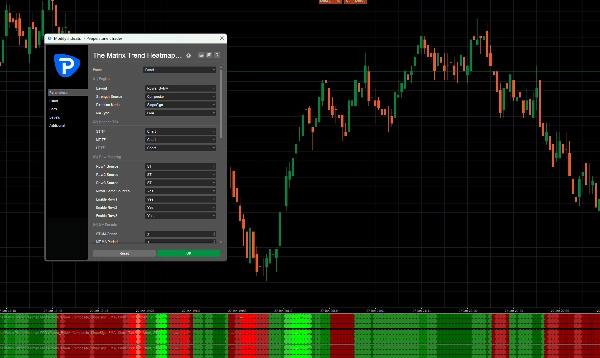
Les réglages par défaut sont spécifiquement calibrés pour les graphiques Tick 30 et 1 minute. Ces valeurs ne sont pas aléatoires—elles sont calibrées comme un ensemble complet pour équilibrer vitesse + stabilité, de sorte que l’indicateur réagit rapidement aux véritables changements de tendance tout en filtrant le micro-bruit.
Points forts par défaut :
- Type de MA : EMA
- Mode de direction : SlopeSign
- Périodes ST / MT / LT : Graphique (logique alignée, pas de décalage de TF)
- Périodes MA ST / MT / LT : 3 (réponse rapide, idéal pour Tick30/1m)
- Période ATR : 14 (normalisation stable de la volatilité)
- Lookback de la pente : 3 (réactif sans scintillement excessif)
- Barres de cohérence : 12 (filtre le micro-chop sur les graphiques rapides)
- Force maximale : 2 (garde les visuels propres et contrôlés)
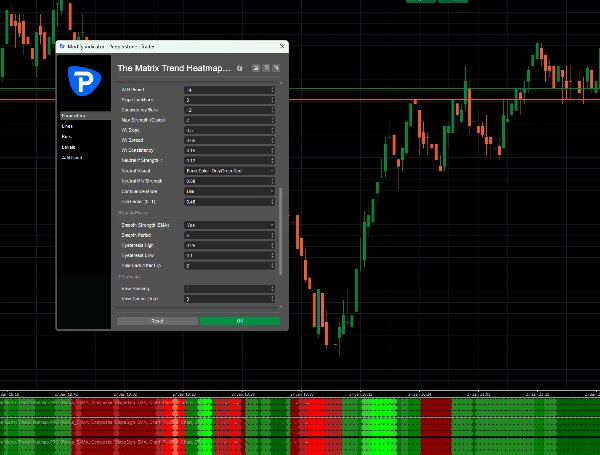
Pondération composite (par défaut) :
- W : Pente = 0.50 (direction + momentum est le principal moteur)
- W : Écart = 0.35 (confirmation de l’espace/pression du mouvement)
- W : Cohérence = 0.15 (qualité de la tendance sur plusieurs barres)
Seuil neutre (par défaut) :
- Neutre si force < 0.12
Lorsque la force descend en dessous de ce niveau, l’indicateur considère intentionnellement le marché comme « sans avantage », vous aidant à éviter le sur-trading pendant les phases de range.
Ce que fait l’indicateur
1) Direction (SlopeSign)
La direction est déterminée par la pente (angle) de la moyenne mobile sélectionnée (par défaut : EMA).
- Pente positive → Tendance haussière (vert)
- Pente négative → Tendance baissière (rouge)
2) Force composite (pas seulement « tendance activée/désactivée »)
La couleur et l’intensité représentent la force de la tendance, pas seulement la direction. Les tendances fortes apparaissent plus décisives et stables ; les tendances faibles s’estompent vers le neutre.
3) Cadre multi-horizon (ST / MT / LT)
L’indicateur supporte plusieurs « horizons » (court / moyen / long). Dans les réglages par défaut, ceux-ci sont mappés au temps du graphique pour garder un comportement cohérent et prévisible sur Tick 30 / 1 minute.
Pourquoi c’est utile (valeur réelle en trading)
La plupart des indicateurs de tendance échouent de deux manières :
- ils sont trop lents (confirmation tardive), ou
- ils sont trop bruyants (retournements constants dans les marchés latéraux).
Ce moteur résout cela en combinant :
- Pente (direction + momentum)
- Écart (pression/espace de mouvement)
- Cohérence (comment la tendance persiste proprement)
Tous normalisés avec ATR, pour que le comportement reste plus stable à travers différents régimes de volatilité—particulièrement important sur les graphiques rapides.
Comment l’utiliser (simple et efficace)
Filtre de tendance (usage principal)
- Cherchez uniquement des configurations longues lorsque le moteur reste vert.
- Cherchez uniquement des configurations courtes lorsque le moteur reste rouge.
- En neutre, attendez soit—ou ne tradez qu’avec une confirmation supplémentaire et des objectifs plus serrés.
Timing des entrées
Utilisez votre propre déclencheur (repli, cassure, motif, etc.), mais laissez l’indicateur définir le contexte directionnel et la force.
Éviter le chop
Phases fréquentes neutres/faibles = range/pas d’avantage.
C’est l’indicateur qui vous dit : protégez le capital, réduisez la taille, ou attendez une structure.
Ajustements sûrs (sans casser le réglage)
Si vous le voulez plus calme (moins sensible) :
- Augmentez le Lookback de la pente de 3 → 4/5
- Augmentez les barres de cohérence de 12 → 14/16
Si vous le voulez plus rapide :
- Gardez le Lookback de la pente à 3, et ajustez seulement légèrement le seuil neutre (par exemple, 0.12 → 0.10) avec précaution.
Conseil : changez un paramètre à la fois. Les réglages par défaut sont calibrés comme un système équilibré.
Résumé en une ligne
Un moteur de tendance rapide basé sur la pente EMA normalisée par ATR avec un score de force composite (Pente + Écart + Cohérence), réglé par défaut pour les graphiques Tick 30 et 1 minute, conçu pour réduire le bruit et mettre en évidence les conditions de tendance à fort avantage.





![Logo de "[Stellar Strategies] Smart ADX"](https://cdn.ctrader.com/image/webp/af13b084-b6f6-41db-b7bc-c7e688b57b05_36929)