

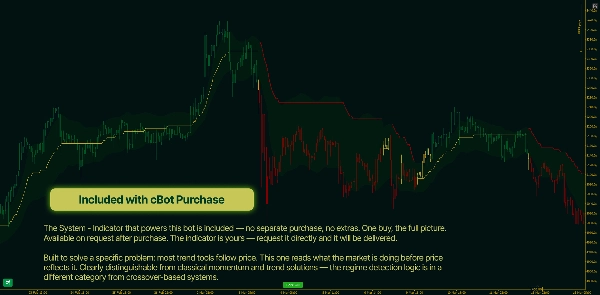
Description
Exemple de backtest micro-compte à 100 $
- Points clés
Le régime sous-jacent doit passer par la même porte de confirmation que celle imposée par l’indicateur — un nombre défini par l’utilisateur de barres consécutives maintenant le nouvel état avant qu’il ne soit accepté. Les pics d’une seule barre, les faux cassures et les mouvements contraires erratiques sont filtrés à la source. Le bot n’entre pas dans un régime de manière spéculative ; il attend que le signal soit ratifié par la structure même du marché.
- Niveaux de prix dérivés du régime, pas de formules fixes. Entrée, drawdown et zones favorables — calibrés au moment où la tendance est confirmée.
Lorsqu’un régime est confirmé, la géométrie du canal de l’indicateur et la structure de cette barre spécifique produisent trois niveaux de référence de prix. Ce ne sont pas des multiples ATR ou des décalages de pips appliqués uniformément — ils reflètent où le prix se trouvait réellement, et où se situaient les limites statistiques du canal, au moment où le régime s’est formé. Les niveaux sont uniques à chaque événement de régime et se mettent à jour vers l’avant — mais uniquement dans la direction favorable, jamais contre la tendance.
- Hiérarchie des signaux dans chaque régime. Quatre opportunités structurées, chacune avec son propre rôle.
-
- Entrée — placée à la confirmation du régime, exécutée immédiatement en tant qu’ordre au marché tant que le signal est frais
- Entrée consécutive — une réentrée au niveau d’ancrage de la tendance après que le prix s’en soit éloigné puis soit revenu, placée en tant qu’ordre en attente
- Favorable — une position plus profonde dans la direction du régime, au niveau qui reflète un point de départ à plus forte conviction au sein de la structure du canal
- Drawdown — une opportunité proche de la limite de risque, pour ajouter à prix réduit avant que le régime ne soit considéré comme invalide
Chaque type de signal possède un réglage de volume indépendant, permettant de moduler l’exposition différemment à chaque niveau de la structure.
- Gestion des ordres consciente du régime. Lorsque le régime se termine, tout ce qui y est lié prend fin.
Le bot suit chaque ordre et position selon le régime qui l’a produit. Lorsque le régime bascule — confirmé par la même porte qui l’a ouvert — tous les ordres en attente non remplis du régime précédent sont annulés sans intervention manuelle. Un réglage optionnel étend cela aux positions remplies, les clôturant au moment où le régime opposé est confirmé et maintenant le carnet aligné avec la vue directionnelle actuelle.
- Extension adaptative des niveaux. Les niveaux de référence suivent la tendance au fur et à mesure de son développement.
À mesure que le prix évolue dans la direction d’un régime confirmé, les niveaux de référence peuvent être configurés pour avancer avec lui — suivant l’ancrage de la tendance et l’extrémité du canal uniquement dans la direction favorable, sans jamais revenir en arrière. Chaque pas est gouverné par un décalage configurable relatif à la largeur du canal, donnant à l’extension une qualité délibérée et consciente de la structure plutôt qu’une dérive continue. Cela maintient les références d’entrée et de drawdown pertinentes tout au long d’une tendance de longue durée plutôt que de les ancrer définitivement à son origine.
- Filtre horaire de session. Tradez uniquement les heures qui comptent pour vous.
Une fenêtre de session configurable restreint toute prise d’ordre à des heures UTC spécifiques. En dehors de cette fenêtre, aucune nouvelle position ou ordre en attente n’est ouvert. Les positions existantes restent actives et entièrement gérées — le filtre ne régule que le moment où un nouveau risque est pris, pas la gestion des trades ouverts.
- Dimensionnement des positions. Lots fixes ou risque proportionnel à l’équité — à vous de choisir.
Le volume peut être défini comme une taille de lot fixe ou comme un pourcentage de l’équité actuelle du compte. En mode équité, la taille de la position est calculée automatiquement en utilisant la distance de stop configurée, de sorte que le risque par trade s’adapte au compte plutôt que de rester fixe en termes monétaires.
- Prêt pour les comptes Prop Firm et financés. Protection intégrée conçue autour des règles de challenge.
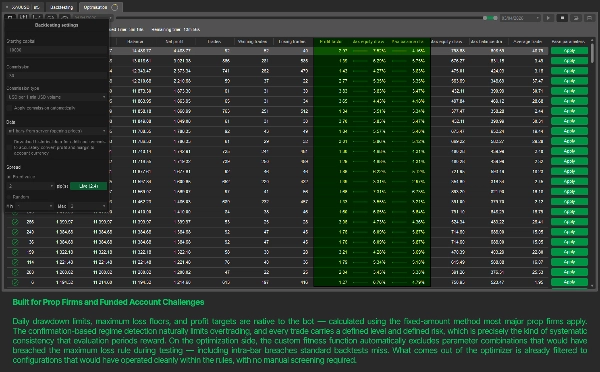
Trois limites de risque indépendantes sont disponibles : un drawdown maximal journalier, une perte totale maximale et un objectif de profit. Les trois se réfèrent au solde initial en utilisant la méthode à montant fixe qui correspond à la plupart des structures majeures de prop firm. Un affichage en direct sur le graphique montre l’exposition actuelle par rapport à chaque limite active, y compris un compte courant des jours où la limite journalière a été dépassée — utile pour le suivi du challenge sur toute la durée.
- Optimisation avec contraintes réelles. La grille de résultats montre ce qui passe réellement, pas ce qui semble bon sur le papier.
Une fonction de fitness personnalisée est active dans l’optimiseur cTrader. Les combinaisons de paramètres qui dépassent la limite de perte maximale — y compris les stops intra-barres invisibles à la clôture de la barre — se voient automatiquement attribuer un score négatif et sont exclues du résultat. Les combinaisons restantes dans la grille sont celles qui auraient opéré dans les limites de risque configurées pendant toute la période de test.
- Ce qui le rend différent
La plupart des systèmes de tendance automatisés reposent sur une logique réactive : un indicateur retardé franchit un seuil, un trade s’ouvre. La base ici est différente à chaque niveau. Le signal qui pilote la détection de régime est une lecture propriétaire de la participation au marché — pas du prix lui-même — conditionnée par des étapes qui traitent spécifiquement le bruit, le retard et la dérive statistique avant qu’un régime ne soit déclaré. Le canal de prix qui fournit la référence structurelle est dérivé de la distribution réelle du comportement récent du marché, pas d’une formule appliquée uniformément.
Le régime sur lequel le bot agit doit être mérité via la porte de confirmation de l’indicateur. Les niveaux qu’il trade sont spécifiques à chaque événement de régime, pas standardisés pour tous. La gestion des ordres qui suit est liée au cycle de vie du régime — les ordres placés dans un régime sont annulés lorsque ce régime se termine, automatiquement et complètement.
Le système est sélectif par conception. Il contourne une partie significative de ce que les systèmes conventionnels traderaient. Lorsqu’il agit, les conditions derrière le trade sont le produit du même pipeline statistiquement fondé qui rend les appels de régime de l’indicateur sous-jacent significativement différents d’un simple croisement standard.
Résumé
The bot features a hierarchical signal system with four distinct trade opportunities per regime: immediate entry at confirmation, re-entry at the trend anchor, deeper favorable positions, and drawdown entries near risk boundaries. Each signal type supports independent volume settings for flexible exposure management. Order and position management is regime-aware; all pending orders tied to a regime are canceled when the regime ends, with optional closure of open positions upon regime reversal.
Additional functionalities include an adaptive level extension that tracks trend progression, a configurable session time filter restricting new trades to specified UTC hours, and flexible position sizing via fixed lots or equity-proportional risk. Risk management tools incorporate maximum daily drawdown, total loss limits, and profit targets calibrated to initial balance, supporting prop firm challenge compliance. The bot’s optimization excludes parameter sets breaching risk limits, ensuring realistic backtest results. It supports forex, indices, and EURUSD markets with a scalping trend strategy on 5-minute charts.
Discussion
Avis clients
5 | 0 % | |
4 | 67 % | |
3 | 33 % | |
2 | 0 % | |
1 | 0 % |