
Beschreibung
Executive summary
- Purpose: An automated SpotBrent grid robot designed to generate recurring cash flow from intraday oil-price movement, rather than pursue aggressive account compounding or capital growth.
- Approach: Combines a stable price-level grid with adaptive daily and hourly volatility-based grids, so the bot can react to both normal price movement and changing market conditions.
- Directional control: Uses an internal sell-zone and mean-reversion-style market-location filter to determine whether new grid entries are opened as buys or sells.
- Capital requirement: The strategy has no conventional stop loss and may retain floating positions during extended trends. For 0.01 lot, the tested minimum capital was approximately $1,621, while the practical recommended starting capital is $2,500 or more for lot size 0.01 and this can be scaling linearly. For example, lot size = 0.04 for starting capital of $10,000.
Overview
This is an automated SpotBrent grid trading robot designed to generate recurring cash flow from intraday oil-price movement.
The strategy is intended to capture repeated price fluctuations and convert them into realised profits over time. It is not designed as an aggressive capital-growth or rapid-compounding system. Instead, it is designed for traders who want to allocate sufficient capital to a systematic grid strategy and seek potential weekly or monthly realised cash flow from SpotBrent volatility.
The bot has been developed and researched specifically for SpotBrent. It should not be assumed to work in the same way on other oil instruments, forex pairs, indices, metals, cryptocurrencies, or CFDs without separate research, testing, and validation.
Strategy type
The robot uses a multi-layer grid trading approach with mean-reversion characteristics.
It combines:
- A structured grid based on internal price levels.
- A daily adaptive grid that recalculates according to broader market volatility.
- An hourly adaptive grid designed to respond to shorter-term intraday volatility.
- An internal directional price-zone filter that determines whether the bot is permitted to open new buy or sell positions.
The strategy is designed to take advantage of recurring movement around its active price levels. It uses both stable and volatility-adaptive grid structures so that the trading framework is not dependent on only one fixed distance between entries.
The exact grid spacing, adaptive formulas, directional-zone calculation, and internal execution rules are deliberately protected within the robot and are not exposed as user-adjustable parameters.
Entry and execution behaviour
The cBot continuously monitors the SpotBrent price and checks for interactions with its internal grid levels.
When price reaches a valid grid area:
- The bot checks whether an equivalent directional position is already active at that grid location.
- It applies its internal directional price-zone filter.
- It opens a market buy or sell position only when the relevant conditions are satisfied.
- It can operate across several grid layers at the same time, combining structural, daily adaptive, and hourly adaptive price levels.
- Each new position is opened with a predefined take-profit target.
- Take-profit levels can be adjusted to account for overnight financing or swap changes where applicable.
The strategy includes duplicate-entry protection, meaning it is designed to avoid repeatedly opening the same directional grid trade at the same recognised price level.
Position management
This robot does not use a conventional stop loss on individual grid positions.
A position that moves into floating loss is not intentionally closed by the bot simply because it is negative. Instead, the position remains open and waits for price to return to its internally managed take-profit target.
The operating principle is therefore:
- Open positions at valid grid levels.
- Close positions when their assigned profit target is reached.
- Retain positions that are temporarily in floating loss.
- Wait for price movement and mean reversion to bring those positions back to their take-profit area.
This means the strategy is designed to realise profits from completed take-profit cycles rather than close losing trades to limit individual trade loss.
However, it is essential to understand that “not closing at a loss” does not remove risk. It transfers the main risk from realised trade losses to floating drawdown, margin usage, exposure duration, and the possibility of broker-enforced closure if available equity becomes insufficient.
The bot does not guarantee that every negative position will recover. In a prolonged or extreme market trend, a position may remain open for a long time, additional grid positions may accumulate, and the broker may close positions automatically if margin requirements are not met.
Directional price-zone filter
The bot does not operate as a simple unrestricted two-way grid.
It uses an internal directional price-zone filter to define which direction is permitted for new grid entries:
- In a designated elevated market zone, the system operates in sell mode.
- Outside that zone, the system operates in buy mode.
This creates a mean-reversion-style directional bias. The objective is to avoid opening both buy and sell positions indiscriminately at every grid level.
The exact formula and price-zone boundaries are part of the protected internal strategy logic.
Take-profit and swap management
Each position is opened with an internal take-profit target.
The bot is designed to realise profits when price moves through its expected grid range and reaches the relevant target. Positions that are negative are kept open rather than being closed at a loss by the robot.
For positions held overnight, broker financing or swap can change the net economics of the trade. The robot includes swap-aware take-profit management, allowing it to update the take-profit level after material swap changes so that position targets better reflect financing effects.
Actual live results can be materially affected by broker spread, commission, swaps, contract specifications, rollover timing, liquidity, execution delay, slippage, price gaps, and leverage.
Historical backtest results
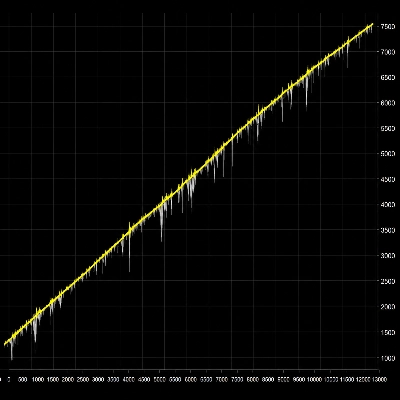
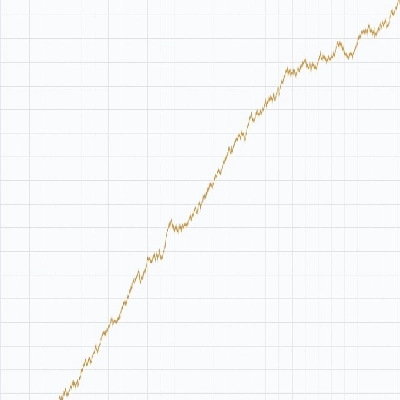
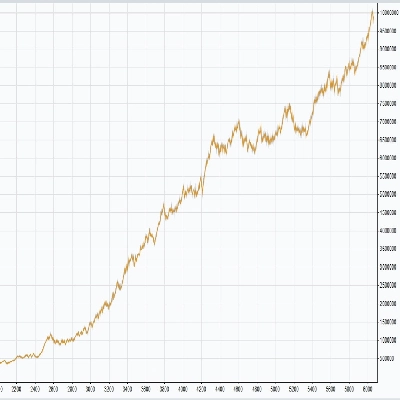
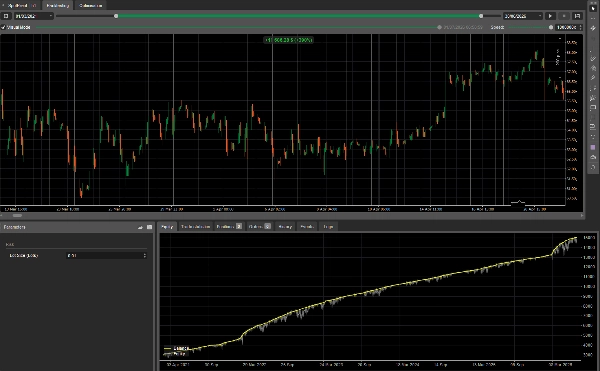
The following historical test was performed on SpotBrent, using a fixed 0.01-lot setting, from 1 March 2021 to 30 June 2026.
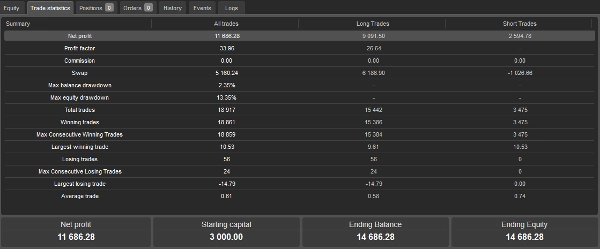
Referring to the images; these are historical backtest results only. They do not represent a guarantee of future performance.Trade-Statistic-4.jpg+1
Why equity drawdown is higher
The backtest recorded a maximum balance drawdown of 2.35% and a maximum equity drawdown of 13.35%.Trade-Statistic-4.jpg
The difference is important:
- Balance drawdown reflects realised closed results.
- Equity drawdown includes floating profit and floating loss from positions that remain open.
Because the bot does not intentionally close a position when it is in unrealised loss, the equity curve can fall below the balance curve while the strategy waits for price to return to take-profit levels.
The final backtest result should also be interpreted carefully. At the end of the test period, any remaining open positions were forcibly closed by the testing environment. Some positions may therefore have been closed while still negative, even though they had not reached the strategy’s intended take-profit outcome.
This does not prove those positions would have recovered if the test had continued. It also does not mean the floating loss was irrelevant. Floating losses are real account risk because they consume equity, reduce free margin, and can lead to a forced broker stop-out if capital is inadequate.
Capital and margin management
This is a capital-intensive grid strategy. Adequate funding is essential because the system may hold several positions open while waiting for price to return to its profit targets.
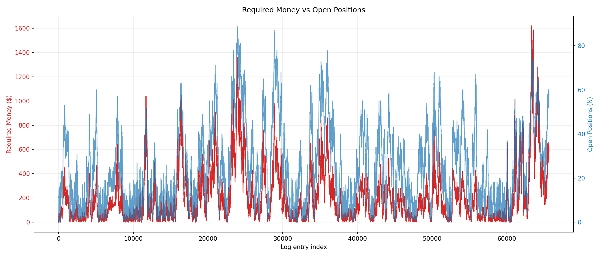
Your historical required-money analysis, based on the strategy’s internal monitoring method, showed a maximum observed requirement of approximately $1,620.22 at 0.01 lot during the backtest period. The chart also indicates a peak of roughly 88–89 simultaneously open positions, subject to confirmation from the raw backtest log.log_gridoilcashconverter_v1_S_margin_profile-2.jpg
The $1,620.22 figure should be treated as a historical observed reference, not as a guaranteed future maximum or a broker-defined margin requirement.
The $2,500 recommendation at 0.01 lot applies an approximate 50% capital buffer above the maximum historical required-money observation. This buffer is not a guarantee of survival in future market conditions.
Capital requirements may exceed historical observations during abnormal volatility, large gaps, major geopolitical developments, supply shocks, illiquid trading conditions, spread widening, changes to broker leverage, or persistent one-directional oil-price movement.
Historical cash-flow profile
The strategy is positioned as a potential cash-flow system rather than a capital-growth system.
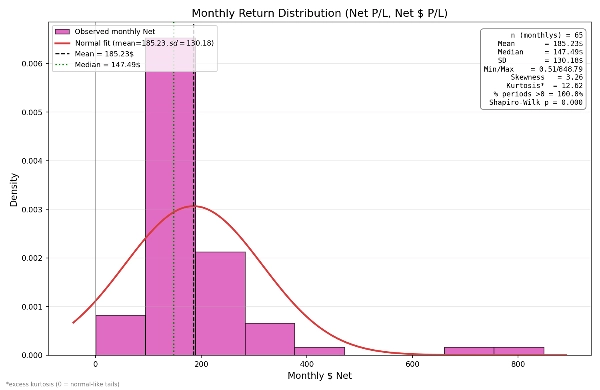
For the 0.01-lot backtest, the historical distribution analysis showed:
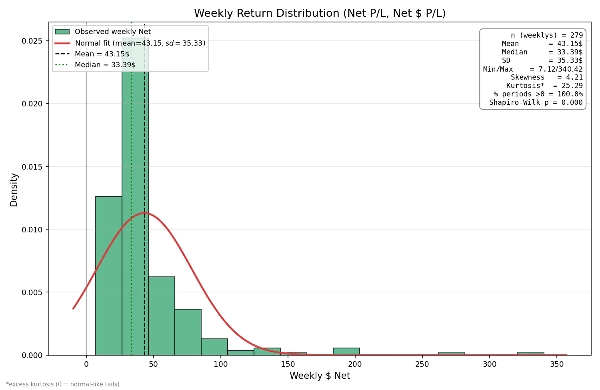
Weekly; Mean return $43.15, Median return $33.39 From $7.12 to $340.42 over 279 weeks
Monthly; Mean return $185.23, Median return $147.49 From $0.51 to $848.79 over 65 months
The median is highlighted because the distribution of returns was positively skewed. A relatively small number of unusually high-return periods increased the arithmetic mean, so the median may provide a more representative indication of the typical historical period in this dataset.weekly_return_hist_abs-5.jpg+1
This does not mean the median is a minimum return, a forecast, or a guaranteed income amount. Historical performance can change materially in live trading.
If lot size is increased, potential cash flow may scale linearly upward, but so do the risks. Increased lot size can increase margin use, floating drawdown, exposure during trending markets, financing effects, and the chance of broker stop-out.
*Illustrative scaling of historical results only. It is not a forecast, guarantee, income promise, or representation of expected future performance.
Who this bot is for
This bot may be suitable for traders who:
- Trade SpotBrent and understand oil-market volatility, leverage, financing, spread behaviour, and event risk.
- Want a rules-based automated system designed to capture repeated intraday price movement.
- Understand that grid strategies can retain floating losses for extended periods.
- Prefer potential cash-flow generation over a strategy designed for rapid account growth.
- Have sufficient capital and are willing to keep a large free-margin buffer.
- Can tolerate periods with multiple open positions and meaningful unrealised drawdown.
- Are prepared to monitor account equity, margin conditions, broker notices, and exceptional oil-market events.
- Start at 0.01 lot and validate the bot under their own broker conditions before scaling.
Who should not use it
This bot is not suitable for traders who:
- Need a conventional stop loss on every trade.
- Cannot accept floating drawdown or long holding periods for losing positions.
- Require guaranteed monthly income or fixed returns.
- Have insufficient capital for the selected lot size.
- Intend to withdraw a large proportion of account capital while positions remain open.
- Cannot monitor free margin and exposure during adverse market conditions.
- Want a high-growth, aggressive-compounding strategy.
- Intend to run the bot on instruments other than SpotBrent without independent testing.
Important limitations and risk warning
- The robot does not intentionally close individual positions in unrealised loss. It waits for the market to return to its take-profit levels.
- An open loss can remain open for an extended period and may increase before recovery occurs.
- There is no guarantee that price will return to any grid level or take-profit target.
- A broker stop-out, margin call, manual intervention, account closure, trading halt, price gap, or exceptional market event can still force the closure of negative positions.
- Historical results are not predictive of future performance.
- The backtest was performed using one instrument, one lot size, and a specific set of historical broker and market conditions.
- The bot is not financial advice. Each user is responsible for position sizing, account funding, broker selection, margin monitoring, and risk decisions.
Zusammenfassung
The robot continuously monitors SpotBrent prices and opens market buy or sell positions at valid grid levels, each with predefined take-profit targets that can adjust for overnight financing or swap changes. It does not use conventional stop losses; instead, it retains positions in floating loss, waiting for price to revert to profit targets. This approach transfers risk from realized losses to floating drawdown and margin exposure.
Backtests from March 2021 to June 2026 indicate a maximum equity drawdown of 13.35% and a potential return on investment of approximately 390%. The strategy requires sufficient capital, with a recommended starting balance of $2,500 for a 0.01 lot size, scaling linearly with lot size. It is suitable for traders familiar with SpotBrent volatility, margin management, and willing to tolerate multiple open positions and unrealized drawdowns.