
Description
ECFX XAU Redline — Automatisation multi-moteur de l’or pour cTrader
ECFX XAU Redline est un cBot multi-moteur conçu spécialement pour le trading automatisé de l’or sur cTrader. Plutôt que de dépendre d’un seul indicateur, d’un seul modèle d’entrée ou d’une seule condition de marché, Redline coordonne plusieurs familles de stratégies gérées indépendamment en utilisant des données de marché M5 et H1 complètes.
Chaque famille de stratégies possède sa propre logique d’entrée, ses filtres, ses étiquettes de position, ses règles de dimensionnement et ses contrôles de gestion des trades. Un cadre Redline partagé fournit ensuite une gestion des ordres consciente du courtier, une normalisation des volumes, des contrôles de marge, des limites d’exposition, des réponses aux drawdowns, une protection contre les pertes journalières et un tableau de bord informatif sur le graphique.
Redline est destiné à l’instrument d’or négociable du courtier, tel que XAUUSD ou un équivalent suffixé par le courtier. La configuration de référence fournie utilise XAUUSD.P sur un graphique M5. Certains moteurs analysent en interne les barres H1 complètes, de sorte que l’utilisateur n’a pas besoin d’attacher plusieurs instances de cBot à plusieurs périodes.
Redline peut être activé et scanner correctement sans ouvrir immédiatement une position. Un trade n’est envisagé que lorsque les conditions de marché, de direction, de temps, de spread, d’exposition et de risque du moteur concerné sont réunies.
Le panel de moteurs Redline
Redline combine quatre familles de stratégies principales dans un seul cBot.
1. LOCK30X M5 Core
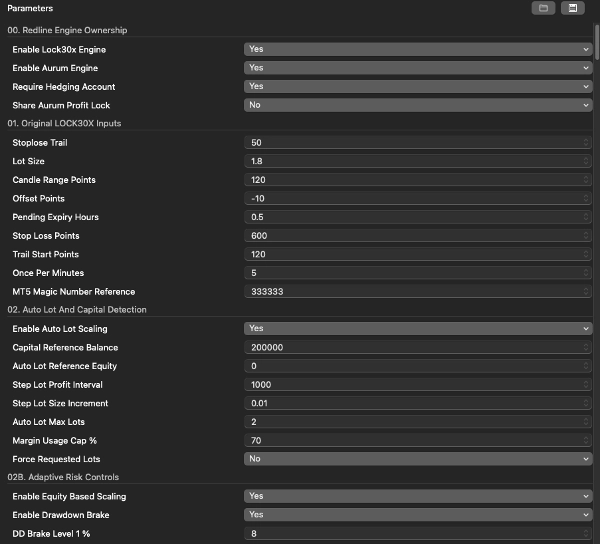
Le LOCK30X Core évalue les plages des chandeliers M5 complétés et applique des filtres configurables de direction, d’heures de trading, de jours de la semaine et de régime.
Lorsqu’un chandelier complété est qualifié, le moteur peut préparer une entrée en attente en utilisant son seuil de chandelier configuré, son décalage d’entrée, sa distance de stop-loss, l’expiration de l’ordre et le délai de décision. Selon la direction, il peut utiliser une logique buy-limit ou sell-stop.
Le Core inclut des contrôles pour :
- Sélection de la direction achat et vente.
- Fenêtres horaires d’entrée configurables multiples.
- Qualification de la plage du chandelier.
- Expiration des ordres en attente.
- Stop loss initial.
- Activation et distance du trailing stop.
- Protection optionnelle au point d’équilibre.
- Sorties optionnelles à durée maximale.
- Règles optionnelles de fermeture forcée programmée.
- Détection de flux de marché obsolète.
- Tampons d’entrée et de distance de stop conscients du courtier.
- Dimensionnement des positions conscient de la marge.
Dans le profil de référence v1 16 fourni, les configurations d’achat du Core sont activées et celles de vente du Core sont désactivées. Ce choix de direction s’applique uniquement au LOCK30X Core ; d’autres moteurs Redline peuvent toujours trader dans les deux directions.
2. TC48/72 Complément de tendance isolé
Le Complément de tendance est une manche de stratégie H1 contrôlée séparément conçue pour participer aux tendances soutenues de l’or.
Il évalue les plages de prix roulantes complètes de 48 heures et 72 heures ainsi que l’alignement des moyennes mobiles exponentielles et la moyenne de la vraie amplitude. Lorsque la tendance complétée, la position du prix, la session et les conditions de spread sont réunies, le moteur peut placer un ordre d’achat stop ou de vente stop en attente au-delà de la plage complétée pertinente.
Chaque position TC48 ou TC72 peut utiliser :
- Un stop loss initial basé sur l’ATR.
- Un objectif de take-profit d’urgence basé sur l’ATR.
- Activation du point d’équilibre et verrouillage des profits.
- Gestion du trailing stop basée sur l’ATR.
- Une amélioration minimale du trailing pour réduire les demandes de modification inutiles.
- Une durée maximale de détention.
- Expiration des ordres en attente.
- Filtrage du spread.
- Filtrage par heure d’entrée.
- Contrôles de direction achat et vente.
- Limites maximales de positions ouvertes et d’entrées journalières.
- Limite virtuelle de perte d’équité journalière.
- Plafond dédié à l’utilisation de la marge.
- Déduplication optionnelle des chevauchements.
- Capitalisation optionnelle des profits.
- Freins optionnels au drawdown au niveau de la manche.
Les moteurs TC48 et TC72 utilisent des étiquettes séparées et maintiennent leur propre solde virtuel, résultat flottant, nombre d’entrées journalières et référence de risque journalière. Leurs résultats réalisés et flottants sont séparés du solde protégé du Core et des calculs d’équité utilisés par d’autres parties de Redline.
Dans le profil de référence fourni, les achats et ventes TC sont tous deux activés. L’exposition de référence est 0.20 lot par zone pour une équité de référence de 50 000 USD, avec un maximum de deux positions TC ouvertes, douze entrées par jour, un plafond d’utilisation de marge TC de 10 % et un plafond virtuel de perte d’équité journalière de 3 %. La capitalisation des profits et le frein optionnel au drawdown TC sont désactivés dans le profil fourni.
Ces valeurs décrivent uniquement la configuration de référence. Elles ne constituent pas des recommandations de risque personnelles.
3. Aurum Vélocité, Canal et Repli
Aurum est une famille de stratégies M5 étiquetée indépendamment contenant trois types de signaux possibles :
- Vélocité évalue les chandeliers complétés pour un mouvement suffisant et la force du corps du chandelier.
- Canal évalue les clôtures complétées par rapport à un canal de prix récent configurable.
- Repli est un modèle optionnel de repli EMA et ATR.
Le profil fourni active Vélocité et Canal tout en laissant Repli désactivé. Les directions d’achat et de vente Aurum sont toutes deux disponibles.
Aurum dispose de ses propres contrôles pour :
- Période temporelle du signal.
- Session de trading.
- Jours de la semaine autorisés.
- Sélection de la direction.
- Filtrage de la qualité par heure d’entrée.
- Positions ouvertes maximales.
- Limites d’entrées journalières.
- Délai de refroidissement par moteur.
- Limites de spread.
- Dimensionnement fixe ou référencé à l’équité.
- Lots maximaux et utilisation de la marge.
- Stop loss initial.
- Activation et distance du trailing stop.
- Gestion optionnelle du point d’équilibre.
- Durée maximale de détention.
- Fermeture optionnelle en fin de session.
- Protection contre les pertes journalières.
- Réduction du volume basée sur le drawdown.
- Protection de l’équité au plus haut.
Vélocité, Canal et Repli utilisent des étiquettes séparées, permettant à Redline d’identifier et de gérer leurs positions indépendamment.
4. Portefeuille de stratégies Sovereign H1
Sovereign est un portefeuille de profils de stratégie H1 basés sur l’ATR. Chaque profil actif peut préparer son propre ordre stop en utilisant une distance d’entrée spécifique au profil, une distance de stop-loss, un ratio take-profit et une période d’expiration.
Le moteur Sovereign inclut :
- Contrôles de direction achat et vente.
- Contrôles de fréquence des signaux H1.
- Filtrage du spread maximal.
- Étiquettes séparées pour chaque profil de stratégie.
- Calculs d’entrée, stop-loss et take-profit basés sur l’ATR.
- Expiration des ordres en attente spécifique au profil.
- Dimensionnement de position fixe ou pondéré.
- Paramètres de risque par stratégie.
- Contrôles de marge.
- Contrôles des ordres et positions du vendredi.
- Vérification indépendante de l’exposition pour chaque profil de stratégie.
Huit profils de stratégie Sovereign ont des chemins d’exécution actifs dans l’implémentation actuelle de cTrader. L’interrupteur visible Strategy 9 est conservé pour la compatibilité de configuration mais ne place pas de trades.
Modules d’extension optionnels
Redline contient également deux couches d’exécution optionnelles qui sont désactivées dans le profil de référence fourni.
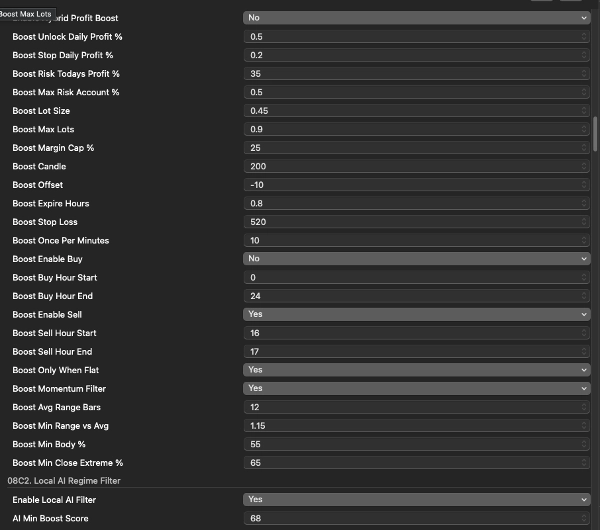
Hybrid Profit Boost est conçu pour devenir éligible uniquement après que des conditions de profit journalier configurables ont été atteintes. Il peut évaluer l’élan du chandelier, la plage, la force du corps, la position de clôture, le spread, le drawdown et la récente série de pertes avant de préparer un trade supplémentaire. Sa taille de position peut être limitée à la fois par un pourcentage du profit disponible de la journée et un pourcentage maximal de l’équité du compte.
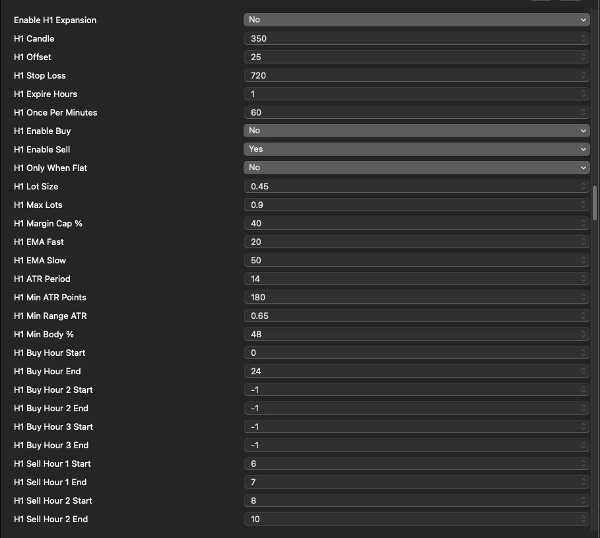
H1 Expansion évalue les chandeliers H1 complétés en utilisant les conditions de plage, de corps de chandelier, d’ATR et de tendance EMA. Il dispose de sessions d’achat et de vente séparées, de contrôles de direction, de plafonds de lots et de marge, de filtres de régime récents, de contrôles des jours de la semaine et de réglages de durée maximale de détention.
L’activation de l’un ou l’autre module optionnel crée une configuration différente du profil de référence fourni et doit être testée séparément.
Score de qualité de marché local
La liste des paramètres inclut un Filtre de Régime IA Local. Il s’agit d’un score de qualité de marché déterministe basé sur des règles utilisé par l’option Hybrid Profit Boost. Il évalue des facteurs configurés tels que la plage du chandelier, le corps du chandelier, la position de clôture, le coussin de profit journalier disponible, le spread, le drawdown et la série de pertes actuelle.
Ce n’est pas un service d’intelligence artificielle à distance, il ne contacte pas un modèle IA externe et ne reçoit pas de signaux de trading tiers. Parce que Hybrid Profit Boost est désactivé dans le profil de référence fourni, ce score ne crée pas d’entrées supplémentaires dans le profil de stock par lui-même.
Gestion des ordres et des positions
Selon le moteur actif, Redline peut utiliser des ordres au marché, des ordres buy-limit et des ordres buy-stop ou sell-stop.
Le cadre de gestion disponible inclut :
- Prix d’entrée normalisés par le courtier.
- Stop loss initiaux.
- Objectifs de take-profit d’urgence lorsque utilisés par le moteur.
- Protection au point d’équilibre.
- Trailing stops.
- Contrôles minimums de pas de trailing.
- Expiration des ordres en attente.
- Durée maximale de détention.
- Options de sortie programmées.
- Filtres de direction et de session.
- Limites de spread.
- Limites de position maximale.
- Limites d’entrées journalières.
- Étiquettes uniques par moteur.
- Contrôles de protection avant modification des stop-loss et take-profit.
La source Store inclut également un contrôle de sécurité du courtier conçu pour éviter l’envoi d’une modification combinée de stop invalide après que le marché a déjà atteint ou franchi un niveau de take-profit existant. Lorsque cette situation est détectée, Redline laisse l’instruction de take-profit existante intacte au lieu de la remplacer par une demande invalide.
Plusieurs moteurs Redline peuvent détenir une exposition en même temps sur un compte de couverture. Une limite appliquée à un moteur ne plafonne pas nécessairement l’exposition combinée de tous les moteurs activés.
Dimensionnement adaptatif des positions et réponse au drawdown
Redline prend en charge plusieurs méthodes de dimensionnement des positions car ses moteurs ont des objectifs différents.
Selon le moteur et la configuration, le dimensionnement peut utiliser :
- Lots fixes.
- Mise à l’échelle référencée au solde ou à l’équité du compte.
- Mise à l’échelle par palier de profit.
- Multiplicateurs d’allocation par moteur.
- Plafonds de lots maximaux.
- Contrôles estimés de marge.
- Plafonds d’utilisation de la marge.
- Normalisation des minimums, maximums et pas de volume du courtier.
- Réductions de volume basées sur le drawdown.
- Réductions de volume en mode récupération.
- Capitalisation optionnelle des profits TC.
Le mode de récupération du Core est conçu pour réduire la taille des positions pendant un drawdown. Il n’a pas pour but d’augmenter le volume dans une tentative de rattraper des pertes précédentes.
Les spécifications des contrats d’or diffèrent considérablement entre les courtiers. La même valeur de lot affichée peut représenter une exposition monétaire très différente lorsque la taille du contrat, la valeur du tick, la taille du tick, les unités de volume, l’effet de levier ou les règles de marge changent. Le profil fourni laisse la normalisation optionnelle de la taille du contrat du courtier désactivée, donc les utilisateurs doivent vérifier la spécification de l’or du courtier prévu avant de trader.
Ne copiez pas une taille de lot d’un autre courtier, d’une capture d’écran ou d’un compte sans vérifier la taille du contrat, la distance du stop, la valeur du tick, l’effet de levier, la commission, le swap et la marge estimée.
Protection contre les pertes journalières
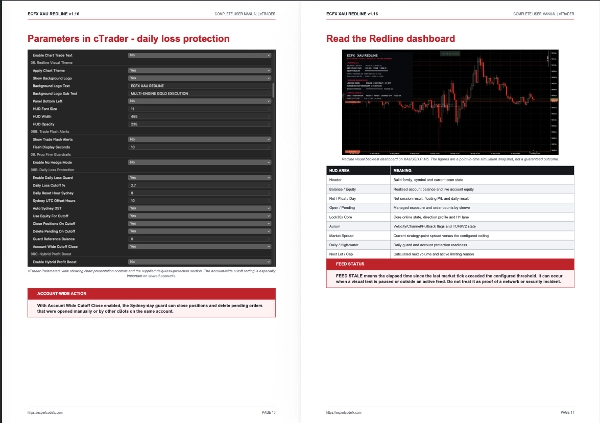
Le profil fourni inclut une garde contre les pertes journalières mesurée à partir d’une réinitialisation configurable de la journée de trading de Sydney, avec un ajustement automatique de l’heure d’été disponible.
La garde peut utiliser l’équité ou le solde et peut :
- Mettre en pause le trading Core après la coupure.
- Supprimer les ordres en attente.
- Fermer les positions ouvertes.
- Rester verrouillée jusqu’à la prochaine réinitialisation configurée de la journée de trading de Sydney.
Important : le profil fourni a la fermeture à l’échelle du compte activée. Si la coupure journalière configurée est atteinte, la garde peut fermer des positions et supprimer des ordres en attente appartenant à d’autres cBots ou trades manuels — pas seulement l’exposition étiquetée Redline.
Un compte dédié est donc fortement recommandé à moins que l’utilisateur ait délibérément examiné et modifié le comportement à l’échelle du compte.
Les gardes contre les pertes journalières, les plafonds de marge, les stop loss et les freins au drawdown sont des mécanismes de gestion des risques, pas des plafonds de perte garantis. Les gaps de marché, le slippage, les ordres rejetés, les déconnexions, les stop-outs, la liquidité indisponible ou les défaillances du courtier et de la plateforme peuvent entraîner des pertes au-delà d’un niveau configuré.
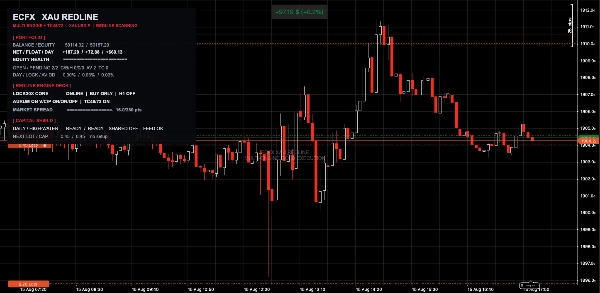
Tableau de bord Redline sur le graphique
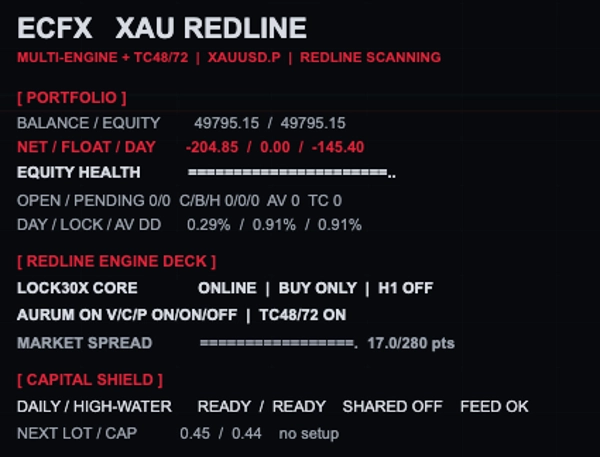
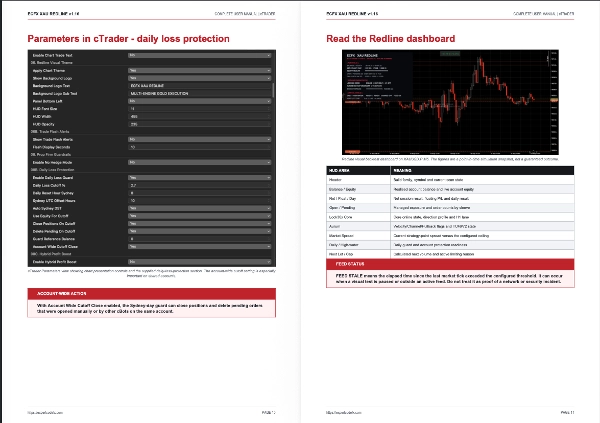
Le tableau de bord Redline est conçu pour garder l’état de fonctionnement du système visible sans nécessiter une inspection constante des journaux.
Selon les paramètres visuels sélectionnés, il peut afficher :
- Symbole actuel et mode de fonctionnement.
- Solde et équité.
- Résultat net, flottant et journalier.
- Indication de santé de l’équité.
- Comptes des positions ouvertes et des ordres en attente.
- Exposition par famille de moteurs.
- Utilisation actuelle de la perte journalière.
- État du drawdown du compte et d’Aurum.
- Statut des moteurs LOCK30X, Aurum et TC48/72.
- Spread actuel par rapport au seuil configuré.
- Statut de verrouillage journalier et de verrouillage au plus haut.
- Santé du flux de marché.
- Volume calculé suivant Core et Aurum.
- Statut de fonctionnement actuel et raison du signal.
Le cBot contient également un thème de graphique Redline, un branding de fond, un texte de trade optionnel, des marqueurs d’entrée optionnels et des alertes flash de trade optionnelles.
Un moteur affiché comme en ligne signifie qu’il est activé et en fonctionnement. Cela ne signifie pas qu’une entrée valide doit être disponible immédiatement.
Profil de référence
Le profil de référence v1.16 fourni est configuré autour de :
- Plateforme : cTrader.
- Référence d’instrument : XAUUSD.P.
- Graphique de base : M5.
- Période temporelle accessible en interne : H1 si nécessaire.
- Mode de compte : Couverture.
- LOCK30X Core : activé.
- Configurations d’achat Core : activées.
- Configurations de vente Core : désactivées.
- Aurum : activé.
- Aurum Vélocité : activé.
- Aurum Canal : activé.
- Aurum Repli : désactivé.
- Sovereign : activé.
- Complément de tendance TC48/72 : activé.
- Directions d’achat et de vente TC : activées.
- Hybrid Profit Boost : désactivé.
- H1 Expansion : désactivé.
- Garde contre les pertes journalières : activée.
- Fermeture à l’échelle du compte activée.
- Mise à l’échelle automatique de l’équité et freins au drawdown Core : activés.
La version payante actuelle expose 359 paramètres regroupés par moteur, exécution, risque, protection du courtier, diagnostics et paramètres visuels. Les acheteurs doivent commencer avec les valeurs par défaut exactes actuelles ou le préréglage v1.16 correspondant et éviter de charger des préréglages d’anciennes versions.
Modifier les paramètres du moteur, de direction, de date, d’heure, de spread, de signal, de dimensionnement ou de protection crée une configuration différente. Changez une zone à la fois et retestez avant de comparer le résultat avec toute preuve de référence.
Exigences du compte et de fonctionnement
Pour la configuration prévue :
- Sélectionnez le symbole d’or négociable réel du courtier.
- Attachez une instance Redline à un graphique M5.
- Utilisez un compte de couverture tant que l’option Require Hedging Account reste activée. Le cBot est conçu pour s’arrêter en temps réel sur un compte netting car la propriété séparée des moteurs ne peut pas être préservée de la même manière.
- Examinez chaque paramètre de volume, marge, session, perte journalière et à l’échelle du compte avant de commencer.
- Utilisez une instance Redline configurée délibérément par symbole et stratégie de compte sauf si les ID d’étiquette et les protections partagées ont été soigneusement revus.
- Effectuez un backtest de la version exacte en utilisant des données de tick serveur précises et un spread, une commission, un swap, un effet de levier et des spécifications de contrat d’or réalistes.
- Effectuez un test en avant de la configuration inchangée sur le compte démo du courtier prévu avant d’envisager une utilisation en réel.
- Gardez cTrader, le trading algorithmique et la connexion au marché disponibles chaque fois que des positions ou des ordres en attente nécessitent une gestion.
- Après l’arrêt, la mise à jour ou la suppression du cBot, inspectez manuellement Trade Watch. L’arrêt du cBot ne garantit pas que chaque position ou ordre en attente existant a été fermé.
- Revérifiez la configuration après tout changement de courtier, symbole, effet de levier, compte, version de cTrader ou version de Redline.
Accès et dépendances externes
Le package Store actuel déclare AccessRights.None, il ne demande donc pas d’accès élevé aux fichiers, processus ou périphériques.
Redline ne nécessite pas :
- Un abonnement à un signal payant.
- Un service d’IA à distance.
- Une DLL.
- Un indicateur personnalisé.
- Une connexion WebRequest.
- Un copieur de trades externe.
Redline n’est pas non plus un service économique ou d’actualités en direct. Le paramètre visible Sovereign NFP est conservé comme champ de compatibilité et ne doit pas être interprété comme un filtre d’actualités actif.
De même, « Prop Safe » dans un nom de paramètre fait référence à un contrôle configurable de lot maximal. Cela ne certifie pas que Redline est conforme aux règles de FTMO ou de toute autre société de trading propriétaire. Les limites, pratiques interdites, fuseaux horaires, calculs de drawdown et conditions de compte de chaque société doivent être vérifiés indépendamment.
Pour qui Redline est conçu
ECFX XAU Redline est destiné aux traders qui souhaitent une automatisation configurable et visible de l’or et qui sont prêts à tester la version exacte sous leurs propres conditions de courtier.
Il convient particulièrement aux utilisateurs qui apprécient :
- Plusieurs familles de stratégies identifiées indépendamment.
- Traitement des signaux basé sur des barres complètes et des règles.
- Contrôles configurables d’exécution et d’exposition.
- Gestion des volumes et marges consciente du courtier.
- Un tableau de bord de fonctionnement détaillé.
- Attribution et propriété distinctes des moteurs.
- La capacité d’activer, désactiver et tester indépendamment les composants de stratégie.
Redline n’est pas un produit à profit garanti, une promesse de revenu passif, un système à l’épreuve des débutants ou un substitut à la surveillance du compte.
Avis de risque
ECFX XAU Redline est un logiciel de trading automatisé et ne garantit pas de profit.
Le trading à effet de levier sur l’or peut entraîner des pertes rapides et importantes. L’expansion du spread, les gaps, le slippage, les ordres rejetés, la commission, le swap, la liquidité limitée, les différences de spécifications du courtier, les différences d’heure serveur, les pannes internet, les pannes de plateforme et les interruptions VPS peuvent affecter matériellement l’exécution et les résultats. Plusieurs moteurs peuvent créer une exposition simultanée, et certains ou tous les fonds déposés peuvent être perdus.
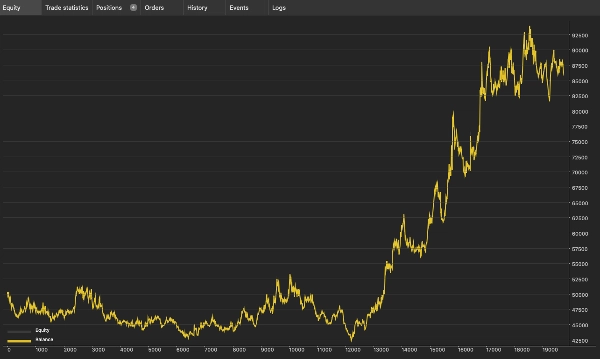
Les backtests et résultats de démo sont des simulations. Ils ne peuvent pas prédire la performance future et peuvent différer significativement du trading réel. Testez la version exacte et les paramètres avec le courtier prévu, utilisez une exposition appropriée au compte et ne tradez qu’avec de l’argent que vous pouvez vous permettre de perdre.
ECFX XAU Redline rassemble plusieurs méthodes de trading de l’or dans un cadre cTrader transparent, avec des familles de stratégies étiquetées indépendamment, une exécution configurable, des contrôles d’exposition adaptatifs et une surveillance détaillée sur le graphique. Son but est de fournir un système structuré pour tester et automatiser les stratégies d’or — pas d’éliminer le risque de trading.
Résumé
Key features include broker-aware order handling with market, limit, and stop orders; adaptive position sizing based on fixed lots, account equity, margin checks, and drawdown responses; extensive risk management tools such as stop losses, trailing stops, break-even protection, daily-loss guards, maximum drawdown limits, and exposure controls. The system supports configurable trading sessions, spread filters, and scheduled exits.
An on-chart dashboard provides real-time visibility of symbol status, equity, open positions, engine activity, drawdown states, and risk usage. The supplied reference profile targets hedging accounts with a base M5 chart and includes detailed parameter settings for each engine. Redline requires careful configuration and testing with the intended broker’s Gold contract specifications and is intended for users seeking transparent, configurable Gold automation with multiple strategy components under one framework.