


설명
이 전략은 일중 가격이 명백한 세션 또는 이전 범위 극한을 넘어 유동성을 자주 침범한 후 세션 VWAP와 같은 공정 가치 참조점으로 되돌아가는 관찰을 중심으로 구축되었습니다. 목표는 모든 움직임을 예측하는 것이 아니라, 보상 대비 위험이 개선되는 미리 정의된 더 깊은 수준에서 선택적으로 유동성을 제공하고, 지속적인 방향성 재가격 조정과 유사한 조건을 무시하는 것입니다.
완전한 의사 결정 흐름
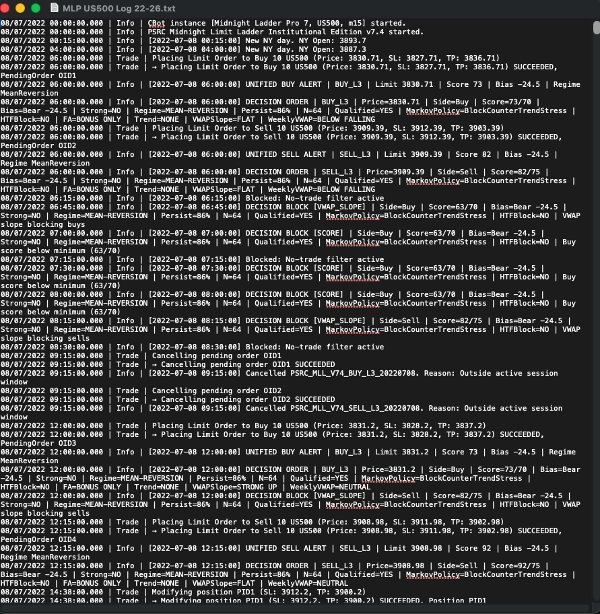
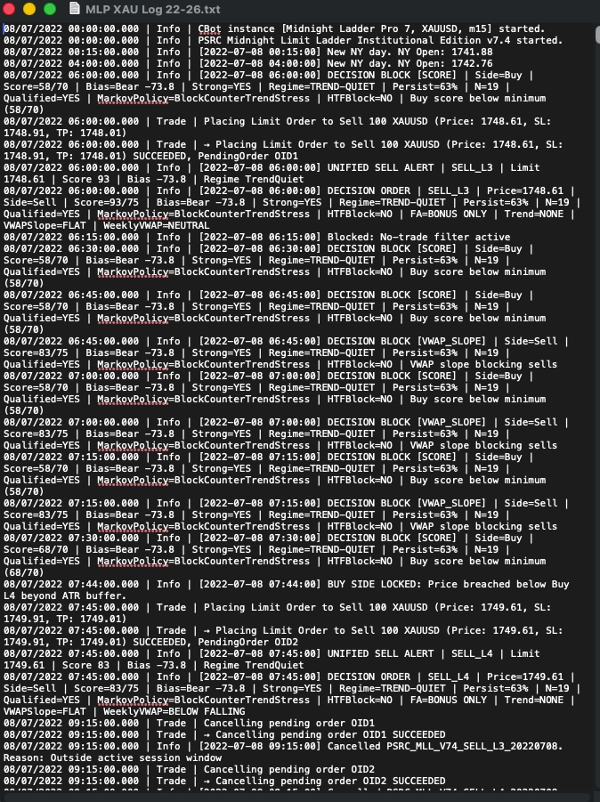
cBot은 다음 순서로 시장을 평가합니다:
1. 뉴욕 일/주 초기화; NY 자정 개장, 세션 범위 및 VWAP 누적기 초기화.
2. 일간 및 H4 데이터에서 확인된 상위 시간대 컨텍스트 업데이트.
3. 기관 일간 편향 및 마르코프 체계/지속성 계산.
4. 전일 고가/저가, 아시아 범위, 자정 VWAP, 주간 VWAP 및 적응형 사다리 수준 업데이트.
5. ATR 정규화 변위로부터 L4/L5 확장 모드 활성 여부 결정.
6. 추세일 상태, VWAP 기울기, 주간 VWAP 상태 및 실패 경매 상태 평가.
7. 매수 및 매도 기관 점수 계산.
8. 긴급 종료 스위치, 일일 손실/감소, 최대 거래, 연속 손실, 세션, 스프레드, L4 위반과 같은 강력한 보호 적용.
9. HTF 정책 적용: 지속적인 강한 반대 편향 추세 스트레스가 방향을 거부할 수 있음.
10. 측면 점수 임계값 적용: 기본값 매수 >= 70, 매도 >= 75.
11. 위험 한도 승인에 따라 적격한 L3/L4 지정가 주문 배치.
12. 체결 후: 브로커 측 절대 SL/TP 설정 및 확인, 부분 청산, 손익분기점 및 선택적 추적 정지 관리.
단순화된 결정 트리
활성 세션인가?
아니오 -> 봇 대기 주문 취소 (활성화된 경우)
예
|
위험 / 스프레드 / 일일 한도 통과?
아니오 -> 차단
예
|
L3/L4 수준 준비 완료?
아니오 -> 대기
예
|
일간 편향 + 마르코프 컨텍스트
|
거래에 대한 지속적인 추세 스트레스?
예 -> 강력한 차단
아니오
|
VWAP / 추세 / 점수 / 실패 경매 정책 통과?
아니오 -> 차단
예 -> 지정가 주문 배치 -> 위험 확인 -> 브로커 주문
기관 일간 편향
v7.5 일간 편향은 약 -100에서 +100까지의 연속적이고 확인된 일간 예측입니다. 이는 단순히 가격과 단일 이동 평균을 비교하는 소매 관습과 다릅니다. 그 목적은 변동성 정규화 추세와 최근 일간 구조를 사용하여 방향성 비대칭을 추정하는 것입니다.
마르코프 체계 엔진
마르코프 계층은 시장을 경제 상태의 연속으로 모델링하고 관찰된 일간 전환을 기반으로 현재 상태가 지속될 가능성을 추정합니다. 이는 거래 가능한 평균 회귀 환경과 위험한 지속적 방향성 확장을 구별하도록 특별히 설계되었습니다.
상태 측정 방법
· Kaufman 스타일 효율성 비율은 구성된 일간 창에서 방향성 지속성을 측정합니다.
· 실현 변동성은 확인된 일간 로그 수익률에서 계산됩니다.
· 현재 실현 변동성은 롤링 역사적 백분위수 분포와 비교됩니다.
· 전이 행렬은 각 상태가 다른 상태로 얼마나 자주 이동하는지 계산합니다.
· 지속성은 현재 상태가 자기 자신으로 전이될 경험적 확률입니다.
· 샘플 수와 지속성 임계값이 모두 통과할 때만 상태가 유효한 것으로 간주됩니다.
L3/L4 유동성 사다리
실행 엔진은 전일 범위 구조, Goldbach 스타일 분수 수준, NY 자정 개장, 자정 VWAP, 아시아 세션 극한 및 ATR 버퍼를 사용하여 계층화된 매수 및 매도 제한을 구축합니다. 기본 라이브 연구 구성은 L3 및 L4에 중점을 둡니다.
점수 및 거래 자격
V7.5는 점수와 거부권을 분리합니다. 점수는 설정 품질을 순위 매기고, 강력한 거부권은 전략의 우위나 자본에 실질적으로 위협이 되는 조건에 예약됩니다.
실행, TP, 부분 청산 및 손익분기점
초기 보호
대기 지정가 주문은 절대 브로커 측 손절매 및 이익 실현 가격과 함께 제출됩니다. 체결 후 cBot은 보호가 존재하는지 확인하고 필요한 경우 누락된 정지를 재설정합니다.
동적 VWAP 이익 실현
활성화되면 cBot은 자정 VWAP를 선호하는 공정 가치 목표로 사용하며 최소 및 최대 TP 거리 제약을 적용합니다. 이는 수익성 있는 깊은 반전을 고정 목표로 강제하는 대신 동적 공정 가치에서 종료할 수 있게 합니다.
포지션 관리
· 활성 TP 거리의 50%에서 50% 부분 청산.
· 성공적인 부분 청산 후 손절매를 손익분기점으로 이동.
· 구성 가능한 양의 손익분기점 버퍼.
· 선택적 추적 정지 (기본적으로 비활성화).
· 절대 브로커 측 보호가 주요 안전 계층으로 유지됩니다.
보호 스택 및 위험 제어
V7.5는 대기 주문 제출 전에 생산 지향적 금전적 위험 검사를 추가합니다.
주문당 위험
동일 측 심볼 최대 위험
봇 최대 오픈 위험
주문당 최대 로트
위험 건전성 허용치
최대 연속 손실
최대 일일 거래
긴급 종료 스위치
스프레드 필터
L4 위반 종료 스위치
요약
The bot’s decision process involves multiple steps: initializing session data at the New York day/week reset, updating higher-timeframe context, computing institutional daily bias and a Markov regime model to assess market state persistence, and determining adaptive liquidity ladder levels based on prior-day ranges and volatility measures. It applies strict risk controls including emergency kill switches, daily loss limits, spread filters, and maximum trade constraints.
Orders are placed at L3/L4 liquidity ladder levels when scoring thresholds for buy or sell signals are met, subject to risk approval. After order fills, the bot manages positions with broker-side stop-loss and take-profit orders, partial closes at 50% of target distance, break-even stops with configurable buffers, and optional trailing stops.
The strategy incorporates quantitative analysis with indicators such as VWAP, ATR, and efficiency ratios, focusing on mean-reversion trading in high-frequency intraday sessions. It supports fixed risk percentage models and is suitable for prop firm trading with recommended minimum balances and leverage settings.
고객 리뷰
상담
자주 묻는 질문(FAQ)















가격