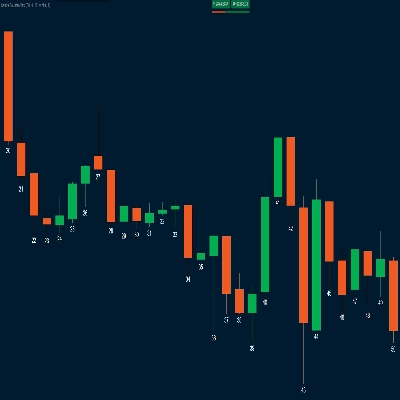
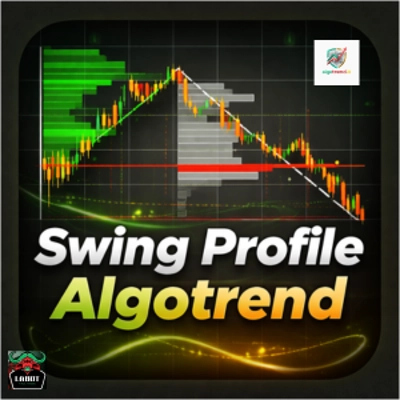
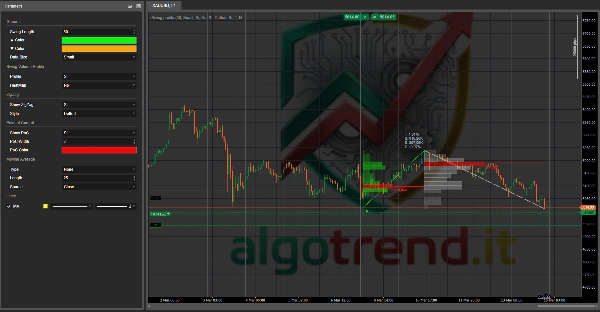
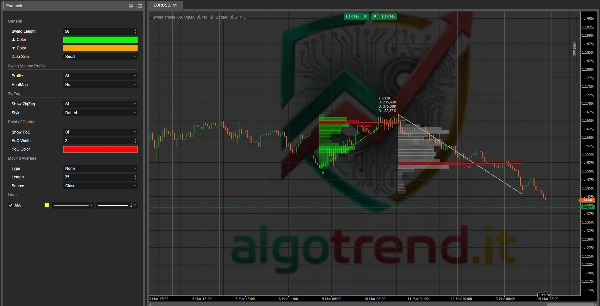
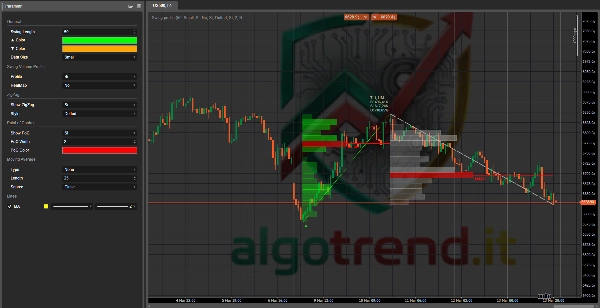
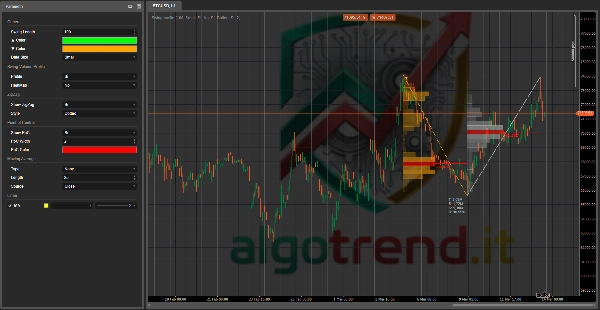
Swing profile Algotrend
Wskaźnik
5 pobrania
Version 1.0, Mar 2026
Windows, Mac
Przesłany obraz „Swing profile Algotrend”Przesłany obraz „Swing profile Algotrend”Przesłany obraz „Swing profile Algotrend”Przesłany obraz „Swing profile Algotrend”Przesłany obraz „Swing profile Algotrend”Przesłany obraz „Swing profile Algotrend”
42.09M
Wolumen transakcji
6.13M
Zysk w pipsach
106
Sprzedaż
4.86K
Bezpłatne instalacje

🔥 Indicator Description

Swing Profile cTrader is an advanced visual indicator that combines several tools into one:

  • Swing detection
  • Structural ZigZag
  • Single-swing volume profile
  • PoC (Point of Control)
  • Estimated volume delta
  • Optional moving average

The idea is simple but very powerful:
instead of looking only at price, the indicator shows where volume was concentrated inside each swing leg.

In practice, it does not just tell you:

“price moved up or down”

it also tells you:

“which area inside that swing was the real battlefield between buyers and sellers.”

That is its true advantage. 🚀

Swing Profile cTrader is an advanced indicator that analyzes price structure through dynamic swings, ZigZag logic, and volume profiling for each individual market leg.
For every swing, it highlights volume distribution, identifies the Point of Control, and estimates the balance between buyers and sellers through delta volume. This allows traders to identify equilibrium zones, hidden support and resistance levels, continuation areas, and potential trend exhaustion with greater precision.
The optional moving average integration makes the indicator suitable both for discretionary chart reading and for more structured directional filtering.

🧠 What It Shows on the Chart

1) ZigZag

The ZigZag line connects the main swing highs and swing lows.

It helps you:

  • see market structure
  • distinguish impulsive legs from corrective legs
  • understand whether the market is making:
    • higher highs / higher lows
    • or lower highs / lower lows

How to read it

  • ZigZag with rising swings = bullish structure
  • ZigZag with falling swings = bearish structure
  • short, choppy ZigZag = messy / sideways market


2) Swing Volume Profile

This is the core of the indicator 💥

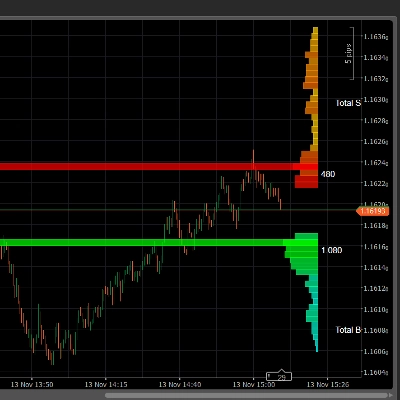
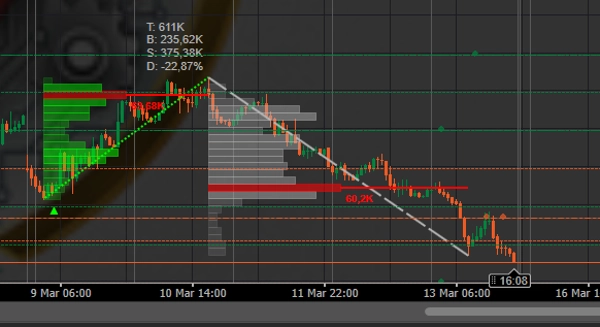
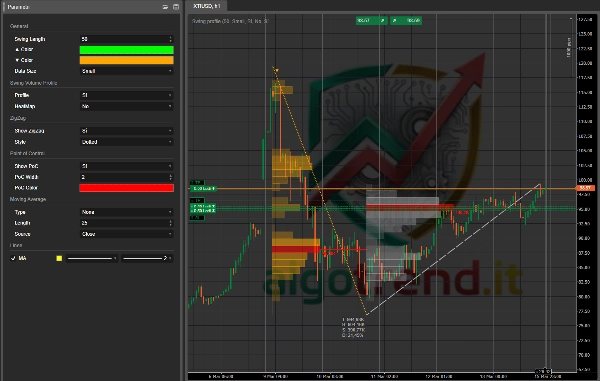
For each completed swing, the indicator builds a vertical volume profile distributed across price zones.

Each horizontal block represents:

  • a price range
  • with more or less traded volume inside that range

How to read it

  • longer blocks = more volume in that area
  • shorter blocks = less volume in that area

So you can immediately understand:

  • where the market accepted price
  • where the market rejected price
  • where hidden support/resistance may exist


3) PoC – Point of Control

The PoC is the price zone with the highest volume inside the swing.

It is the area where the highest concentration of activity occurred.

Trading meaning

The PoC is often:

  • a magnet for price
  • a zone of temporary equilibrium
  • a future support/resistance area

Practical rule

  • above the PoC = the market tends to keep strength
  • below the PoC = the market tends to lose strength
  • return to the PoC = key area to watch for reaction or breakout


4) Delta Volume

In the text panel you will find:

  • T = Total Volume
  • B = Buy Volume
  • S = Sell Volume
  • D = Delta Volume %

In your code, delta is estimated like this:

  • bullish bar → volume counted as buy
  • bearish bar → volume counted as sell

So it is not a true professional order-flow delta, but it is still very useful as a pressure-reading tool.

How to read it

  • positive delta = bullish pressure dominates
  • negative delta = bearish pressure dominates
  • delta near zero = balance / indecision


5) Optional Moving Average

The moving average works as a directional filter.

You can use it to avoid trading against the broader trend.

Simple usage

  • price above MA = long preference
  • price below MA = short preference


📖 How to Read It Properly

A. First read the structure

The first question is not “Should I enter?”
The first question is:

is the market building a bullish, bearish, or sideways structure?

Look at the ZigZag:

  • higher highs + higher lows = bullish
  • lower highs + lower lows = bearish
  • messy, compressed swings = range

If you do not understand the structure, do not use the signals.


B. Then read where volume was concentrated

Look at the profile of the most recently completed swing.

Ask yourself:

  • was volume concentrated at the top?
  • in the middle?
  • at the bottom?

Interpretation

  • volume concentrated in the upper part of a bullish swing
    = buyers are still active, healthy swing
  • volume concentrated in the lower part of a bullish swing
    = weaker push, possible late recovery but lower quality
  • volume concentrated in the upper part of a bearish swing
    = distribution and selling pressure starting from higher prices
  • volume concentrated in the lower part of a bearish swing
    = already extended trend, risk of exhaustion


C. Finally, watch the PoC

The PoC is often the real key to the trade.

If price returns to the PoC:

one of these 3 things can happen:

  1. it bounces
  2. it consolidates
  3. it breaks and accelerates

This means the PoC should be treated as:

  • dynamic support/resistance
  • retest area
  • decision level


🎯 Main Signals to Exploit

1) PoC Retest in Trend

This is one of the best signals ✅

Long scenario

  • bullish structure
  • bullish swing with good delta
  • price pulls back
  • price returns near the PoC of the previous swing
  • the PoC holds

Signal: possible long continuation

Short scenario

  • bearish structure
  • bearish swing with negative delta
  • price bounces
  • price returns to the PoC of the previous swing
  • the PoC rejects price

Signal: possible short continuation

👉 This is one of the smartest ways to use the indicator.


2) PoC Break

If price breaks the PoC decisively, it often means the equilibrium of the previous swing has changed.

How to read it

  • clean PoC break + close beyond it = possible shift in pressure
  • fake break + immediate return back inside = fake breakout

Useful trick

Do not watch only the break itself.
Watch how price behaves when it comes back to the PoC.

The retest after breakout is often more valuable than the breakout itself.


3) Reaction in Low-Volume Areas

Zones where the profile is narrow are low-interest areas.

When price moves through them:

  • it often accelerates
  • it often crosses them quickly

Practical use

If price enters a low-volume area:

  • do not expect much stability
  • expect easier movement

These are excellent areas for:

  • targets
  • accelerations
  • impulsive breaks


4) Delta Divergence

Now we get into the real tricks 😏

Classic bearish case

  • price makes a bullish swing
  • but delta does not improve
  • or it worsens
  • or the final push happens on poor volume

This may signal:

  • exhaustion
  • fragile upside movement
  • possible reversal or correction

Bullish case

  • price drops
  • but bearish delta does not really increase
  • the profile compresses
  • the PoC shifts higher or holds

This may signal:

  • tired selling
  • possible reversal


5) Strong Swings vs Weak Swings

Not all swings are equal.

Strong swing

  • well-defined profile
  • clear PoC
  • coherent volume
  • delta aligned with direction
  • clean ZigZag

Weak swing

  • scattered volume
  • messy profile
  • unconvincing delta
  • disordered structure

👉 The best signals come from strong swings, not ugly ones.


🧩 Real Tricks to Use It Better

Trick 1: never use the PoC alone

The PoC alone is not enough.

The PoC works best when it aligns with:

  • horizontal support/resistance
  • swing high/low
  • MA
  • trendline
  • psychological level

The more confluences there are, the stronger the signal.


Trick 2: look at where the swing started building

Do not stop at total volume.
Look at where inside the swing the volume was concentrated.

Example

Bullish swing with PoC very low:

  • can mean early accumulation followed by expansion
  • often good, but watch deep pullbacks

Bullish swing with PoC very high:

  • can mean the market accepted higher prices
  • very bullish if price stays above it afterward


Trick 3: the best trades are often on the return, not at the start

Many traders enter when they see a strong candle.
Often that is already late.

With this indicator, instead, you can wait for:

  • impulsive swing
  • PoC identification
  • return of price
  • confirmation of hold or rejection

This gives you cleaner entries and better stop placement.


Trick 4: use the live leg carefully

The live leg is useful, but it is also the most unstable part.

That is why in the code we made it optional.

Rule

  • completed swings = more reliable
  • live swings = more reactive but noisier

If you want precision, give more weight to completed swings.


Trick 5: do not confuse high volume with a strong signal

High volume does not automatically mean reversal or continuation.

High volume only means:

the market paid a lot of attention there.

Then you must understand whether that area is:

  • accumulation
  • distribution
  • absorption
  • equilibrium


Trick 6: use delta as confirmation, not as the boss

The delta here is an estimate, not a true footprint.

So it should be used like this:

  • never alone
  • yes as confirmation
  • yes to compare one swing against the previous one


✅ How to Use It Operationally

Ideal long setup

  • bullish structure
  • price above MA
  • bullish swing with good volume
  • positive or improving delta
  • pullback toward PoC or high-volume area
  • bullish reaction at the level

Entry:

  • on confirmation of the reaction

Stop:

  • below the swing or below the PoC, depending on aggressiveness

Target:

  • previous high
  • low-volume zone
  • swing extension


Ideal short setup

  • bearish structure
  • price below MA
  • bearish swing with good volume
  • negative or worsening delta
  • bounce toward the PoC
  • bearish rejection from the area

Entry:

  • on confirmation of the rejection

Stop:

  • above swing or above PoC

Target:

  • previous low
  • low-volume zone
  • new extension


⚠️ When NOT to Use It

Avoid it or reduce the weight of its signals when:

  • the market is flat and sideways
  • the swings are too small
  • the symbol has unreliable tick volume
  • the timeframe is too low and too noisy
  • major news is approaching


🛠️ Recommended Settings

For intraday

  • Swing Length: 20–40
  • Lookback Bars: 300–500
  • Max Bins: 30–50
  • Show Live Leg: false
  • HeatMap: false

For swing trading

  • Swing Length: 50–80
  • Lookback Bars: 500–800
  • Max Bins: 40–60

For a clean chart

  • Profile: true
  • HeatMap: false
  • Show ZigZag: true
  • Show PoC: true


📌 Super Practical Summary

Always read it in this order:

1. structure
trend or range?

2. swing
what is the latest important swing?

3. profile
where was volume concentrated?

4. PoC
where is the real equilibrium of the swing?

5. delta
does pressure confirm it or not?

6. context
does the level align with other confluences?

0.0
Opinie: 0
Opinie klientów
Ten produkt nie ma jeszcze opinii. Wypróbowałeś(-aś) go już? Bądź pierwszy(-a) i powiedz o tym innym!
Grid
NAS100
NZDUSD
Breakout
XAUUSD
Commodities
Forex
Signal
EURUSD
GBPUSD
BTCUSD
AI
SMC
ZigZag
Indices
Prop
Stocks
Supertrend
Crypto
USDJPY
Scalping

Więcej od tego autora

Wskaźnik
NAS100
NZDUSD
Martingale
+26
Read aggressive flow in real time. Flexible resets (Day/Week/Month), optional EMA smoothing, and non-repainting cumulati
cBot
NAS100
NZDUSD
Martingale
+26
The Prop-Ready Bot The Definitive Automaton for Challenges 🛡️ V2.0
Wskaźnik
Grid
NZDUSD
XAUUSD
+16
Editions: Free (core VWAP + bands) · Pro (multi‑VWAP, click‑to‑anchor, alerts).
cBot
Grid
NAS100
RSI
+20
A price-action-first algorithm to trade Breakout, Approach, and Return around prior High/Low levels—with Prop-style risk
Wskaźnik
NAS100
NZDUSD
Martingale
+26
Volume Bubbles is a lightweight yet powerful visual indicator for cTrader
cBot
Grid
Indices
XAUUSD
+7
Breakout scalping with prop-firm grade equity control.
cBot
NAS100
NZDUSD
Martingale
+26
N.B.: Results with an initial invested capital of 100 euros.
cBot
NAS100
NZDUSD
Martingale
+26
The Elliott Wave Pro Bot is a sophisticated and highly configurable algorithmic trading system
Wskaźnik
NAS100
NZDUSD
Martingale
+26
Breakout Channels automatically detects consolidation ranges and highlights when price breaks out of them.
cBot
NAS100
NZDUSD
Martingale
+26
✅ Buy 3 prop accounts and manage just 1: cut management effort by 66% with a professional tool.
Wskaźnik
NAS100
NZDUSD
Breakout
+14
ZigZag Free is a clean swing-detection tool that marks significant pivot highs/lows
cBot
NAS100
NZDUSD
Martingale
+26
Major Update Announcement: Advanced Prop Firm Risk Management is Here! 🚀

Możesz także polubić

Wskaźnik
Indices
FVG
Commodities
+3
Identifies institutional zones with Volume Delta (K) across any asset or chart for high-precision entry detection.
Wskaźnik
NAS100
NZDUSD
XAUUSD
+10
Volume Delta Oscillator Free Indicator
Wskaźnik
NAS100
NZDUSD
Breakout
+13
Smart money liquidity sweep detector at fractal levels. 100% free - no limitations.
Wskaźnik
NAS100
NZDUSD
Breakout
+13
Spot Inside Bar breakouts across all timeframes on cTrader
Wskaźnik
Grid
NAS100
NZDUSD
+15
The FZ indicator draws Fibonacci channel zones based on the highest and lowest prices over a user-defined period.
Wskaźnik
Indices
FVG
Commodities
+6
The only cTrader FVG indicator with Breakaway Gap detection, mitigation tracking, and full multi-asset compatibility.
Wskaźnik
NAS100
RSI
NZDUSD
+17
Institutional liquidity map for XAUUSD. Spot stop hunts, find the next target, and get a full trade setup automatically.
Wskaźnik
Grid
NAS100
NZDUSD
+13
PhantomGrid draws clear grid levels to help spot entries, exits, and key price zones with ease.
Wskaźnik
Indices
Prop
Stocks
+3
Visualize the four major trading sessions with color-coded rectangles showing session high/low ranges.
Wskaźnik
NAS100
RSI
NZDUSD
+14
Scalping & Swing signals in one. Smart S/R, Auto SL/TP, HTF panel. No repainting. Built for serious traders.
Wskaźnik
NAS100
NZDUSD
XAUUSD
+10
Sero is a stochastic-based momentum oscillator that gives clear, color-coded visual signals for market momentum shifts.
42.09M
Wolumen transakcji
6.13M
Zysk w pipsach
106
Sprzedaż
4.86K
Bezpłatne instalacje