Descripción
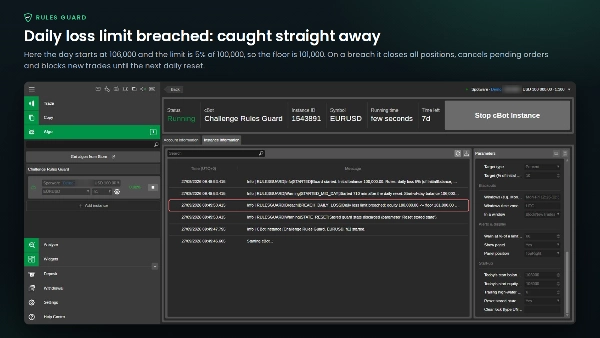
Challenge Rules Guard watches your whole cTrader account and enforces the risk rules of a prop-firm challenge or funded account, so one bad trade, a forgotten position or a revenge trade does not end your evaluation.
It is a risk-management tool, not a trading strategy: it never opens trades and gives no signals. Attach it to any chart. It monitors every position and pending order on the account (manual, mobile, web and other cBots) on every symbol.
What it enforces
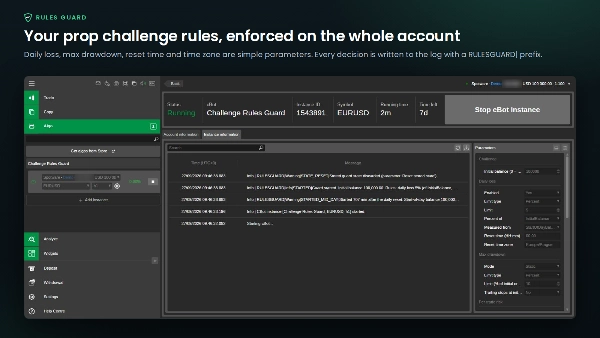
- Daily loss limit: a percent (of the initial balance or of the start-of-day value) or a fixed amount, measured on equity from the start-of-day balance, equity or the higher of the two. Reset time and time zone are configurable (for example 00:00 Europe/Prague or 17:00 America/New_York), and daylight-saving changes are handled.
- Maximum drawdown: static (from the initial balance) or trailing (equity high-water mark, closed-balance high-water mark or end-of-day balance), optionally stopping at the initial balance.
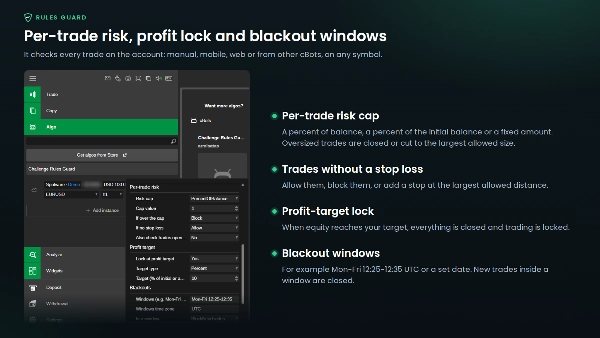
- Per-trade risk cap: percent of balance, percent of initial balance or a fixed amount. Oversized trades are closed or reduced to the largest allowed volume. Trades without a stop loss can be allowed, blocked or given a stop at the maximum allowed distance.
- Profit-target lock: when equity reaches your target, everything is closed and trading is locked, so you do not give the result back.
- Blackout windows: for example "Mon-Fri 14:25-14:40; Fri 20:00-24:00" or a specific date. New trades inside a window are closed; optionally everything is closed when the window starts.
On a breach it closes every position, cancels every pending order and keeps blocking: any new trade is closed straight away until the next daily reset (daily loss) or until you clear the lock yourself (maximum drawdown, profit target). A warning appears when a set share of a limit is used (80% by default).
The on-chart panel shows equity, today’s loss against the limit and the room left, the next reset in your firm’s time zone, the drawdown floor, the target, the risk cap and the next blackout. Every decision is written to the cBot log with a RULESGUARD| prefix.
Good to know
- It cannot stop an order from being sent. It closes or cancels new exposure as soon as the trade appears, and that trade still pays spread and commission.
- It only protects while it is running: cTrader open with the cBot started. It does not replace your firm’s own checks.
- Gaps, slippage and disconnections can push a loss past the limit before the close fills. Keep a buffer, for example 4.5% for a 5% rule.
- Blackout windows are times you enter. There is no automatic news calendar.
- Run one instance per account. Set every value to your own firm’s rules; your firm’s dashboard is always authoritative.
Symbols and timeframes: any. Account size and leverage: any. Amounts are in your account currency.
It does not guarantee passing any evaluation, does not generate profit and is not affiliated with any prop firm.
Trading involves risk. Past performance does not guarantee future results.
Resumen
- Daily loss limits configurable as a percentage or fixed amount, reset by customizable time and timezone settings.
- Maximum drawdown limits, either static or trailing, based on equity or balance high-water marks.
- Per-trade risk caps that restrict trade size and enforce stop-loss rules.
- Profit-target lock that closes all positions and blocks further trading once a profit goal is reached.
- Blackout windows during which new trades are closed or all positions can be closed automatically.
Upon breaching any limit, the cBot closes all positions and cancels pending orders, blocking new trades until reset or manual unlock. An on-chart panel displays real-time equity, loss status, drawdown floors, risk caps, profit targets, and blackout schedules. All actions are logged with a specific prefix for traceability.
The cBot operates only while running in cTrader and does not prevent order submissions but closes trades immediately after execution. It supports any account size, leverage, and currency. This tool assists in maintaining compliance with risk rules during evaluations but does not guarantee passing or generate profits.






![Logotipo de "[Fx4U]Risk & Reward Trading Tool Pro"](https://cdn.ctrader.com/image/webp/e26324ec-9547-4365-a38e-ccd0e7c4d86f_31374)