


Penerangan
IDEA
Saluran Fibonacci yang menyesuaikan dengan julat harga yang berkembang dari titik permulaan yang dipilih dan bukannya kekal tetap antara dua titik sejarah.
MASALAH
Alat Fibonacci tradisional biasanya menggambarkan julat menggunakan titik tetap yang dipilih.
Tetapi harga tidak berhenti berkembang selepas dua titik itu dipilih.
Apabila harga mencapai paras tertinggi atau terendah baru, julat itu sendiri telah berubah.
Peta Fibonacci tetap mungkin masih menggambarkan julat asal dengan tepat, tetapi ia tidak lagi mewakili julat penuh yang telah berkembang sejak titik permulaan yang dipilih.
Masalahnya bukan pada Fibonacci itu sendiri. Masalahnya adalah mengekalkan peta tetap yang terikat pada julat yang masih berkembang.
KONSEP TERAS: ANKOR MENENTUKAN PERMULAAN. JULAT BERKEMBANG DENGAN HARGA.
Saluran Fibonacci memisahkan titik permulaan daripada julat semasa.
Ankor menentukan di mana pengukuran bermula.
Harga kemudian menentukan sejauh mana julat itu telah berkembang.
Daripada menetapkan kedua-dua hujung pengukuran, saluran ini sentiasa mengukur julat yang berkembang dari ankornya yang dipilih.
Soalannya berubah daripada:
“Dua titik manakah yang harus menentukan julat Fibonacci?”
kepada:
“Dari titik manakah saya ingin mengukur julat semasa ia berkembang?”
Ankor adalah tetap. Julat berkembang.
APA YANG DILAKUKANNYA
Letakkan ankornya pada carta dan biarkan harga berkembang dari titik itu.
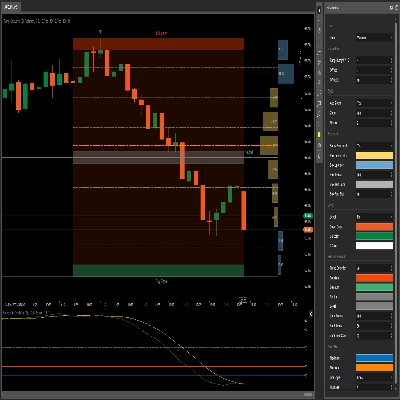
Penunjuk menjejaki paras tertinggi dan terendah yang sedang berjalan dari ankornya ke bar semasa dan mengira saluran Fibonacci dari ekstrem yang sedang berkembang itu.
Apabila harga mencipta ekstrem baru, julat berkembang dan tahap Fibonacci dikemas kini secara automatik.
Alihkan ankornya ke titik yang berbeza dan keseluruhan saluran dikira semula dari asal yang baru.
Hasilnya adalah peta Fibonacci yang kekal terikat pada julat harga yang sedang berkembang dan bukannya snapshot sejarah yang tetap.
BAGAIMANA IA BERFUNGSI
- Pilih ankornya.
- Ankor menentukan permulaan pengukuran.
- Harga berkembang dari titik itu.
- Paras tinggi dan rendah semasa menentukan julat yang sedang berkembang.
- Tahap Fibonacci dikira merentasi julat itu.
- Ekstrem baru mengemas kini saluran.
- Alihkan ankornya bila-bila masa rujukan analitik berubah.
Ankor boleh diseret terus pada carta.
FIBONACCI TANPA PENGGAMBARAN SEMULA
Saluran tidak tetap selepas pengiraan awal.
Apabila paras tinggi atau rendah baru melanjutkan julat yang diukur, geometri Fibonacci dikemas kini secara automatik.
Ini membolehkan pemerhatian bagaimana pergerakan harga yang sama mengubah hubungan nisbahnya semasa julat berkembang.
ARAHAN MENYESUAI SECARA AUTOMATIK
Saluran secara automatik mengubah orientasinya mengikut pergerakan yang sedang berkembang.
Untuk pergerakan menaik, pengukuran diorientasikan dari Tinggi ke Rendah.
Untuk pergerakan menurun, ia diorientasikan dari Rendah ke Tinggi.
Arah ditentukan dengan membandingkan penutupan semasa dengan harga buka bar ankornya.
TUJUH MOD SALURAN
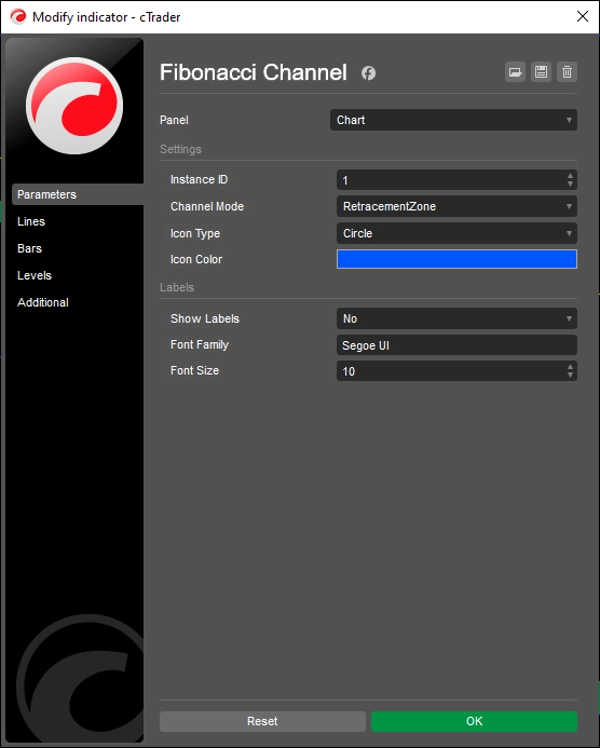
Pilih bagaimana geometri Fibonacci dipaparkan:
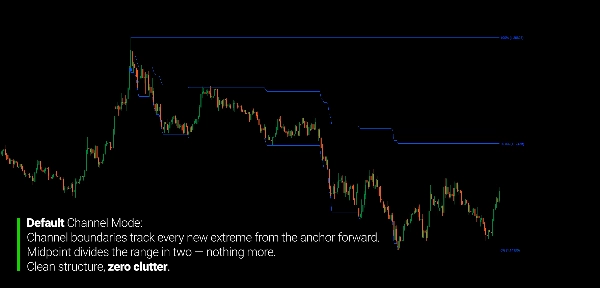
- Default
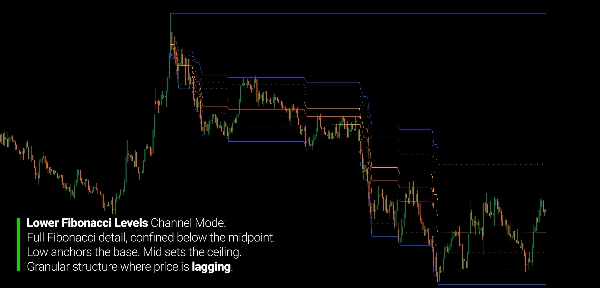
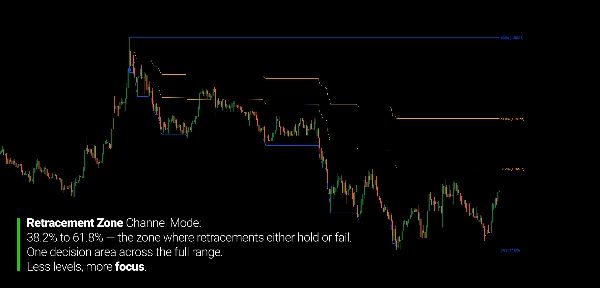
- Zon Retracement 38.2–61.8
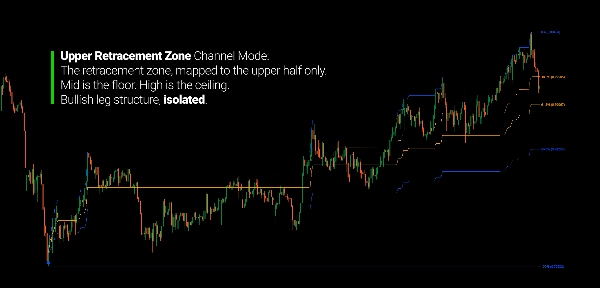
- Zon Retracement Atas
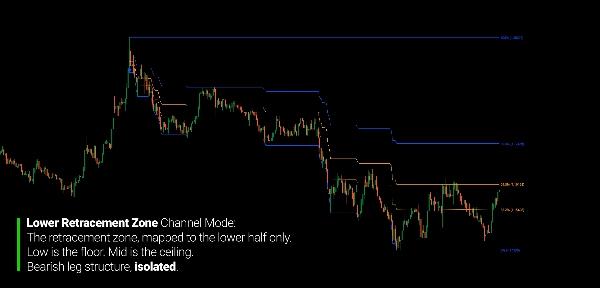
- Zon Retracement Bawah
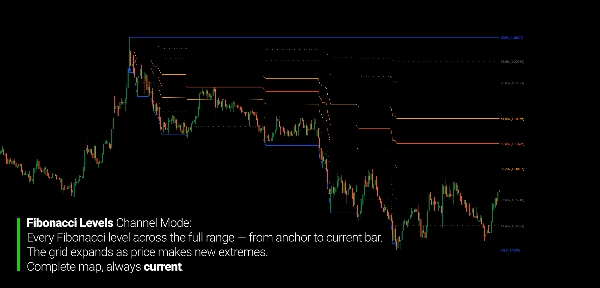
- Tahap Fibonacci
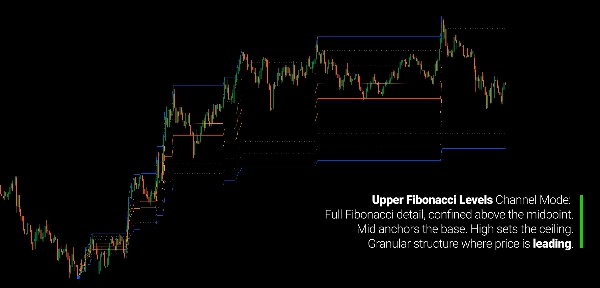
- Tahap Fibonacci Atas
- Tahap Fibonacci Bawah
Ini membolehkan julat asas yang sama dilihat sebagai saluran lengkap, zon terpilih, atau tahap Fibonacci individu.
ANKOR ADALAH BAHAGIAN PENTING
Ankor menentukan permulaan pengukuran.
Ia boleh diletakkan pada:
- Permulaan trend
- Pembalikan utama
- Pembukaan sesi
- Pengembangan ketara
- Mana-mana bar lain yang penting untuk analisis
Pilihan ankornya kekal di bawah kawalan anda.
Penunjuk mengendalikan julat yang sedang berkembang dari situ.
BACA JULAT, BUKAN HANYA TAHAP
Nisbah Fibonacci adalah ukuran rujukan, bukan ramalan.
Saluran menjadikan tiga elemen penting kelihatan:
Tinggi — ekstrem atas semasa.
Tengah — titik tengah julat yang sedang berkembang.
Rendah — ekstrem bawah semasa.
Tujuannya adalah untuk memerhati di mana harga berkembang dalam julat yang diukur, bukannya menganggap bahawa tahap Fibonacci mesti menghasilkan reaksi tertentu.
BERBILANG SALURAN
Beberapa Saluran Fibonacci bebas boleh diletakkan pada carta yang sama.
Ini membolehkan ankornya yang berbeza mewakili rujukan analitik dan pergerakan harga yang berbeza.
Setiap saluran berkembang secara bebas dari titik permulaannya sendiri.
DIBUAT UNTUK ANALISIS JULAT
Saluran Fibonacci direka untuk pedagang yang ingin mengkaji perkembangan harga dari titik permulaan yang jelas.
Ia boleh digunakan untuk mengkaji:
- Trend yang sedang berkembang
- Impuls dan pembetulan
- Julat harga yang berkembang
- Zon retracement
- Posisi relatif dalam julat
- Beberapa rujukan sejarah
- Konteks julat jangka masa lebih tinggi
Penunjuk mengautomasikan pengiraan.
Interpretasi kekal milik anda.
CIRI-CIRI UTAMA
- Ankor boleh diseret
- Julat harga yang berkembang secara automatik
- Pengiraan semula Fibonacci automatik
- Orientasi arah automatik
- Tujuh mod paparan saluran
- Zon retracement Fibonacci
- Beberapa saluran bebas
- Rujukan sejarah yang fleksibel
- Kemas kini julat masa nyata
- Analisis bersih pada carta
---
Perdagangan melibatkan risiko. Penunjuk ini adalah alat analisis teknikal dan harus digunakan bersama dengan pengurusan risiko yang sesuai.
Ringkasan
The indicator offers seven display modes, ranging from simple boundary lines to full Fibonacci grids applied to the entire range or selectively to the upper or lower halves. The draggable anchor icon enables real-time repositioning, instantly recalculating the channel and levels based on a structurally meaningful bar such as a trend start or key reversal.
Key features include multiple independent instances on the same chart, customizable anchor icon styles, and optional price labels with adjustable font settings. This tool serves as a structural reference framework for swing, position, and range traders who use Fibonacci levels to assess retracement zones and price structure rather than as direct trade signals. It supports visualization of market structure and proportional price zones, adapting continuously to price action from the selected anchor point.
Ulasan pelanggan
5 | 60 % | |
4 | 40 % | |
3 | 0 % | |
2 | 0 % | |
1 | 0 % |
Perbincangan
Soalan Lazim














Harga