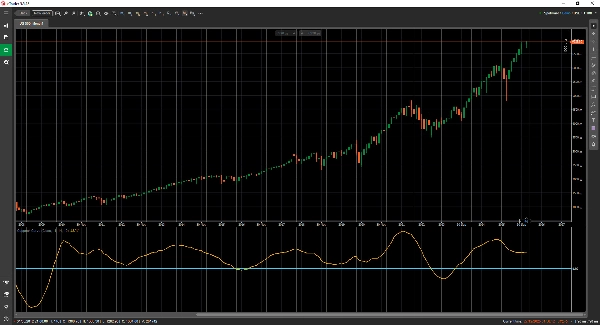
Description
What is the Coppock Curve?
The Coppock Curve is a long-term momentum indicator originally designed to identify major market bottoms in the S&P 500. It was created in 1962 by economist Edwin Coppock, who was famously asked by the Episcopal Church to find low-risk buying opportunities for their endowment.
In simple terms, it is a trend-following oscillator that tells you when a bear market has likely bottomed out and a new bull market is beginning.
The “Secret Sauce” (How it Works)
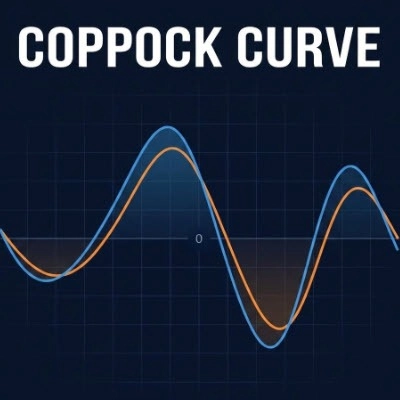
Unlike many indicators that are twitchy and reactive, the Coppock Curve is deliberately slow. It is calculated by taking a Weighted Moving Average (WMA) of the sum of two different Rates of Change (ROC).
Coppock = WMA(10) of (ROC(14) + ROC(11))
The Logic:
It measures the rate at which price momentum is changing over long periods (usually 11 and 14 months). By smoothing this data with a weighted average, it filters out almost all short-term market noise.
Fun Fact:
Coppock reportedly asked bishops how long it takes for a person to recover from the grief of losing a loved one. They said “11 to 14 months.” He applied those same timeframes to the market, reasoning that market psychology follows a similar cycle of grief and recovery.
Why is it Useful?
Traders and investors love the Coppock Curve for three main reasons:
- It Filters the Noise: Because it is calculated on monthly timeframes (traditionally), it ignores day-to-day or even week-to-week volatility. It doesn’t trigger often, but when it does, it’s usually significant.
- Clear Buy Signals: The signal is binary and easy to read. A “Buy” signal is generated when the curve is below the zero line and turns upward (starts rising).
- Psychological Anchor: It prevents you from trying to “catch a falling knife.” It forces you to wait until momentum has mathematically shifted from negative to positive before entering a position.
When to Use It
- Best for: Long-term investing, retirement allocations, and identifying the start of a new bull run.
- Not for: Day trading or shorting. It was not designed to identify sell signals or market tops.