
Description
THE IDEA
A moving average that starts from a chosen price point instead of forcing every analysis into a fixed lookback period.
THE PROBLEM
A traditional moving average is defined by a period.
20 bars. 50 bars. 200 bars.
But sometimes the important question is not how many bars you want to measure.
It is where the measurement should begin.
A fixed period looks backward from the current bar, but it does not know which price event matters to your analysis.
If a correction begins here, or an impulse begins there, a 50-period MA cannot be told:
"Start measuring from this event."
The period defines the measurement window.
It does not define its origin.
THE CORE CONCEPT: THE ANCHOR DEFINES THE ORIGIN. THE MA MEASURES FROM THERE.
Draggable Moving Average changes the reference point.
Traditional moving averages make the period the primary reference.
Draggable Moving Average makes the origin the primary reference.
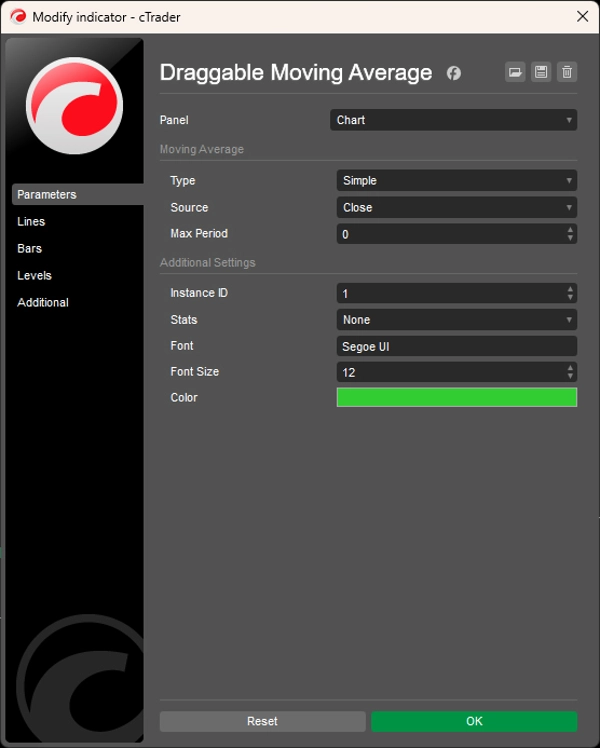
The period still determines how the calculation behaves, while the Max Period parameter caps the rolling calculation window as it develops forward from the anchor.
But the anchor determines where the measurement begins.
This changes the question from:
"Which MA period should I use?"
to:
"Which price event do I want this MA to measure from?"
WHAT IT DOES
Draggable Moving Average lets you define that origin yourself.
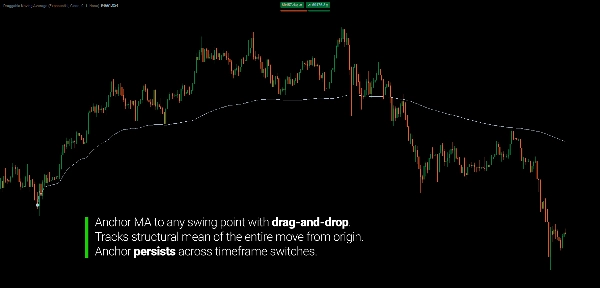
Place the anchor on any bar in price history, and the moving average begins calculating from that exact point forward.
Drag the anchor to another bar, and the MA recalculates instantly.
Switch timeframes, and the anchor remains attached to the same historical reference while the calculation adapts to the data available on the new chart.
The reference is explicit — not hidden inside a period.
HOW IT WORKS
The process is deliberately simple:
1. Place the anchor.
Choose any bar that matters to your analysis.
2. The MA starts there.
The calculation begins from your chosen origin and develops forward.
3. Let price develop.
As new bars appear, the average incorporates the evolving price data.
4. Move the anchor when your reference changes.
Drag the anchor to another bar and the entire calculation updates immediately.
There is no need to keep changing the MA period to approximate a different starting point.
Change the reference itself.
A MOVING AVERAGE BUILT AROUND THE MOVE
When an MA is anchored to the beginning of a specific price movement, the calculation develops from that origin forward.
That gives the MA a different context from a conventional rolling average.
A corrective move can have its own anchored MA.
An impulse can have another.
A major swing can have another.
You are no longer asking the MA to describe an arbitrary number of recent candles.
You are asking it to measure a specific part of the market.
WATCH HOW PRICE DEVELOPS AROUND THE MEAN
The anchored MA can be used as a reference for observing how price behaves during the movement.
Price may:
- Extend away from the mean during strong movement
- Return toward the mean during consolidation or correction
- Cross the mean as the character of the movement changes
- Revisit the mean after a directional transition
These behaviors are not treated as automatic trading signals.
The purpose is simpler:
to make the average of a defined price movement visible.
The significance comes from the movement you chose to measure — not from a particular MA number.
FIVE WAYS TO CALCULATE THE MEAN
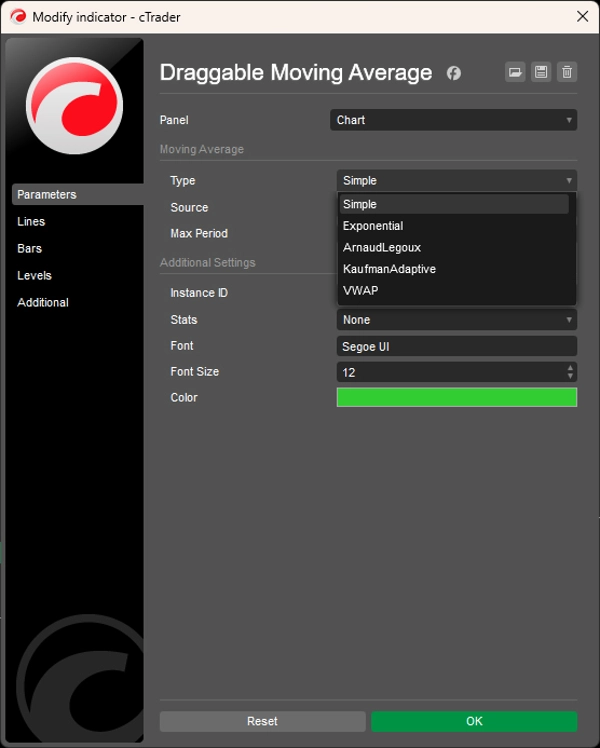
Choose the calculation that best fits your analysis:
Simple (SMA)
A straightforward arithmetic mean that develops from the anchor.
Exponential (EMA)
Places greater weight on more recent price data.
Arnaud Legoux (ALMA)
A weighted average designed to reduce lag while maintaining smoothness.
Kaufman Adaptive (KAMA)
Adjusts its smoothing according to market efficiency.
VWAP
Measures the volume-weighted average price from the selected origin.
All calculation types retain the same fundamental idea:
the anchor defines where the measurement begins.
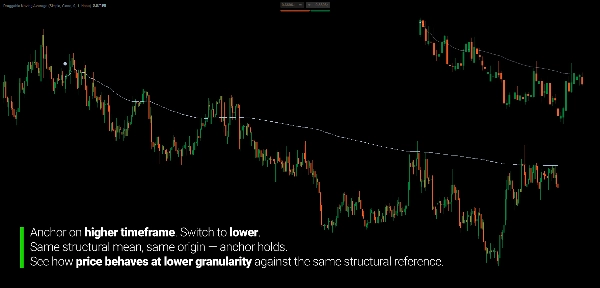
THE REFERENCE SURVIVES THE TIMEFRAME
One of the most useful properties of a defined anchor is that the reference does not disappear when you change timeframe.
Anchor the beginning of a move on the Daily chart.
Switch to H1.
Then M15.
The anchor remains tied to the same historical point while the MA recalculates using the data available on the new timeframe.
This makes it useful for multi-timeframe analysis where the same price event needs to remain the reference across different chart resolutions.
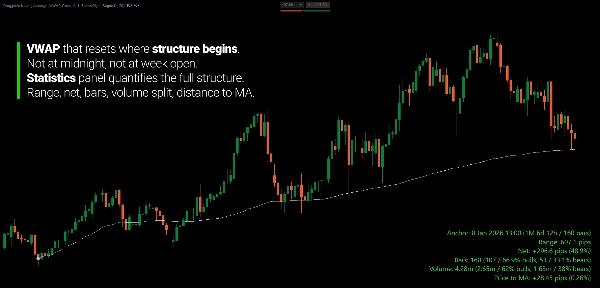
OPTIONAL STATISTICS
The optional statistics panel provides a quantitative view of the price movement between the anchor and the current bar.
It can display:
- Range in pips
- Net change in pips and percentage
- Bullish / bearish bar counts and percentages
- Bullish / bearish volume and percentages
- Price distance from the MA in pips and percentage
- Duration
- Number of bars since the anchor
The panel is optional.
The core tool remains the anchored moving average.
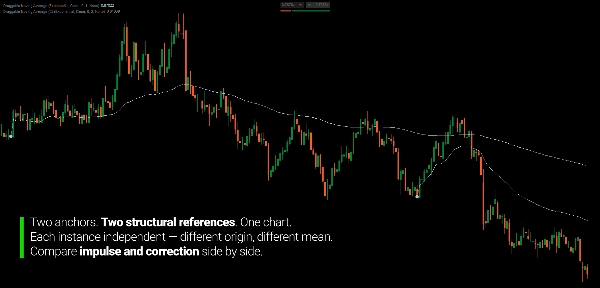
MULTIPLE REFERENCES
Multiple instances can be used simultaneously.
One MA can be anchored to the beginning of a correction.
Another can be anchored to the preceding impulse.
Each instance has its own identity, allowing different price movements to be measured independently on the same chart.
BUILT FOR MEASUREMENT, NOT SIGNAL CHASING
Draggable Moving Average does not tell you where to buy or sell.
It gives you something more fundamental:
a way to define exactly which part of the market you want the moving average to measure.
Use it to study:
- Impulse and corrective moves
- Swing development
- Price behavior around a defined mean
- Mean reversion within a specific movement
- Changes in the character of a movement
- Higher-timeframe references from lower-timeframe charts
- Different price distributions from different origins
The indicator does not decide which point matters.
You choose the reference. The MA measures what happens from there.
KEY FEATURES
- Fully draggable anchor
- User-defined starting point
- MA recalculates instantly when the anchor moves
- Anchor persists across timeframe changes
- Five MA methods: SMA, EMA, ALMA, KAMA, VWAP
- Eight selectable price sources
- Max Period cap with rolling window from the anchor origin
- Optional statistics panel with four corner positions
- Multiple independent instances
- Designed for multi-timeframe analysis
---
Trading involves risk. This indicator is a technical analysis tool and should be used together with appropriate risk management.
Summary
This approach transforms the MA into a structural mean that reflects the average price evolution from a defined origin, aiding in mean reversion and reversal detection. Price behavior around this anchored MA provides insights into momentum, consolidation, and potential trend exhaustion.
The indicator supports five MA calculation methods—Simple (SMA), Exponential (EMA), Arnaud Legoux (ALMA), Kaufman Adaptive (KAMA), and Volume Weighted Average Price (VWAP)—with a configurable maximum period to cap the lookback window. It offers eight price source options and an optional statistics panel displaying real-time metrics such as range, net change, volume splits, and price distance from the MA.
Multiple instances can run simultaneously, each with a unique ID, allowing concurrent analysis of different structural moves without conflicts. This tool is designed for swing and position traders, multi-timeframe analysts, and discretionary traders who require precise, structure-based MA anchoring rather than arbitrary period-based averages.
Customer reviews
Discussion
FAQ











Price
