

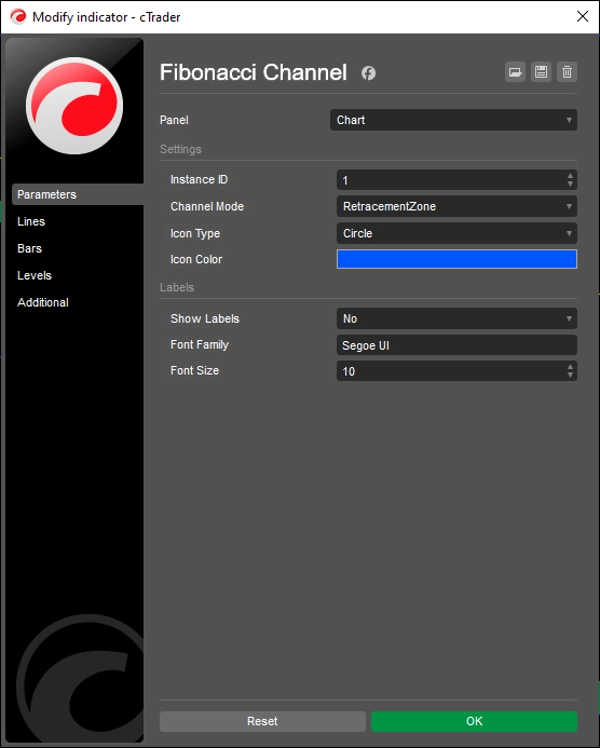

Description
THE IDEA
A Fibonacci channel that adapts to the price range developing from a chosen starting point instead of remaining fixed between two historical points.
THE PROBLEM
Traditional Fibonacci tools usually describe a range using selected fixed points.
But price does not stop developing after those two points are selected.
When price makes a new high or low, the range itself has changed.
A fixed Fibonacci map may still describe the original range accurately, but it no longer represents the full range that has developed since the chosen starting point.
The problem is not Fibonacci itself. The problem is keeping a fixed map attached to a range that is still developing.
THE CORE CONCEPT: THE ANCHOR DEFINES THE START. THE RANGE EVOLVES WITH PRICE.
Fibonacci Channel separates the starting point from the current range.
The anchor defines where the measurement begins.
Price then defines how far that range has developed.
Instead of fixing both ends of the measurement, the channel continuously measures the developing range from the chosen anchor.
The question changes from:
“Which two points should define the Fibonacci range?”
to:
“From which point do I want to measure the range as it develops?”
The anchor is fixed. The range evolves.
WHAT IT DOES
Place an anchor on the chart and let price develop from that point.
The indicator tracks the running highest high and lowest low from the anchor to the current bar and calculates the Fibonacci channel from those developing extremes.
When price creates a new extreme, the range expands and the Fibonacci levels update automatically.
Move the anchor to a different point and the entire channel recalculates from the new origin.
The result is a Fibonacci map that remains attached to a developing price range rather than a fixed historical snapshot.
HOW IT WORKS
- Choose an anchor.
- The anchor defines the beginning of the measurement.
- Price develops from that point.
- The current high and low define the developing range.
- Fibonacci levels are calculated across that range.
- New extremes update the channel.
- Move the anchor whenever the analytical reference changes.
The anchor can be dragged directly on the chart.
FIBONACCI WITHOUT THE REDRAW
The channel is not fixed after the initial calculation.
As new highs or lows extend the measured range, the Fibonacci geometry updates automatically.
This makes it possible to observe how the same price movement changes its proportional relationships as the range develops.
DIRECTION ADAPTS AUTOMATICALLY
The channel automatically changes its orientation according to the developing movement.
For bullish movement, the measurement is oriented from High to Low.
For bearish movement, it is oriented from Low to High.
The direction is determined by comparing the current close with the anchor bar's open price.
SEVEN CHANNEL MODES
Choose how the Fibonacci geometry is displayed:
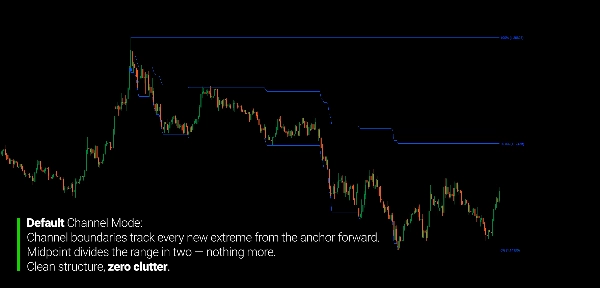
- Default
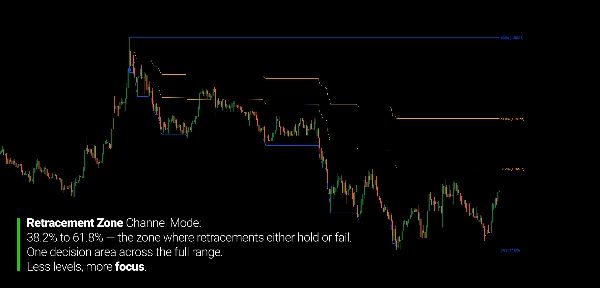
- Retracement Zone 38.2–61.8
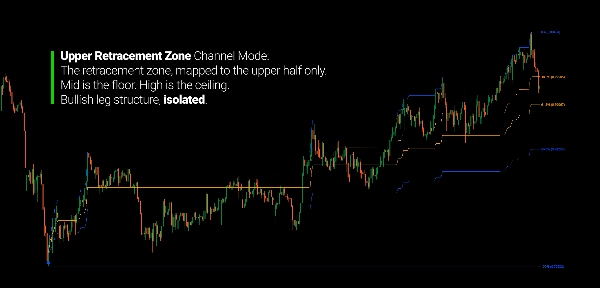
- Upper Retracement Zone
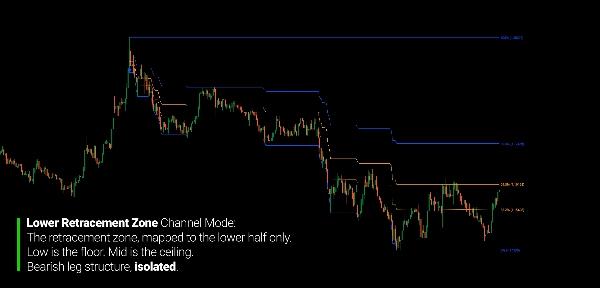
- Lower Retracement Zone
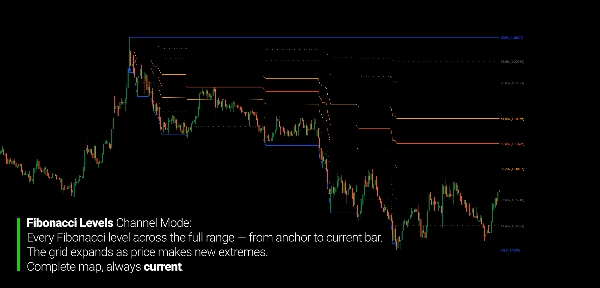
- Fibonacci Levels
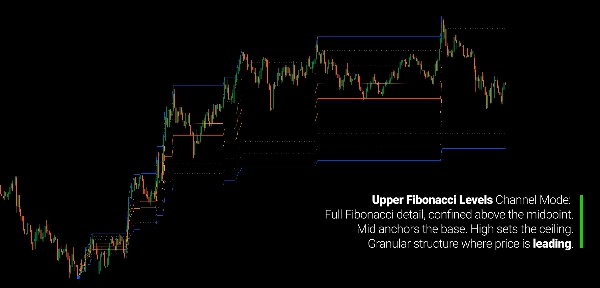
- Upper Fibonacci Levels
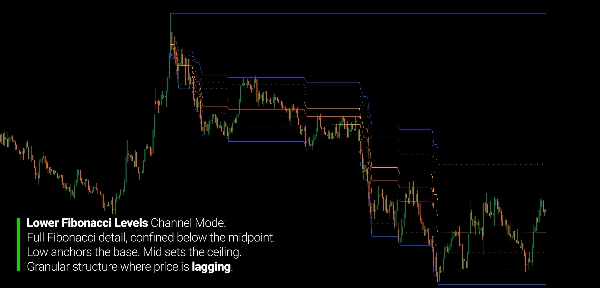
- Lower Fibonacci Levels
This allows the same underlying range to be viewed as a complete channel, selected zones, or individual Fibonacci levels.
THE ANCHOR IS THE IMPORTANT PART
The anchor defines the beginning of the measurement.
It can be placed at:
- The beginning of a trend
- A major reversal
- A session open
- A significant expansion
- Any other bar that matters to the analysis
The choice of anchor remains under your control.
The indicator handles the evolving range from there.
READ THE RANGE, NOT JUST THE LEVELS
The Fibonacci ratios are reference measurements, not predictions.
The channel makes three important elements visible:
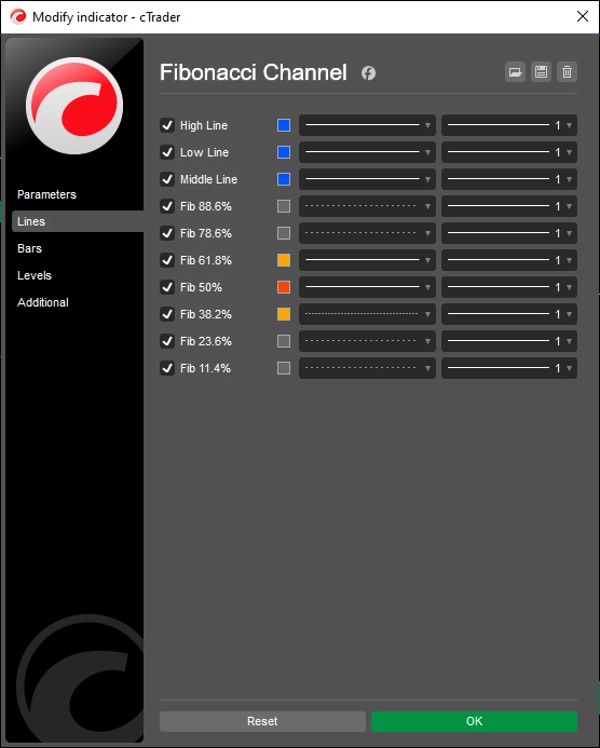
High — the current upper extreme.
Middle — the midpoint of the developing range.
Low — the current lower extreme.
The purpose is to observe where price is developing within the measured range, rather than assuming that a Fibonacci level must produce a particular reaction.
MULTIPLE CHANNELS
Multiple independent Fibonacci Channels can be placed on the same chart.
This allows different anchors to represent different analytical references and price movements.
Each channel develops independently from its own starting point.
BUILT FOR RANGE ANALYSIS
Fibonacci Channel is designed for traders who want to examine price development from a clearly defined starting point.
It can be used to study:
- Developing trends
- Impulses and corrections
- Expanding price ranges
- Retracement zones
- Relative position within a range
- Multiple historical references
- Higher-timeframe range context
The indicator automates the calculation.
The interpretation remains yours.
KEY FEATURES
- Draggable anchor
- Automatically evolving price range
- Automatic Fibonacci recalculation
- Automatic directional orientation
- Seven channel display modes
- Fibonacci retracement zones
- Multiple independent channels
- Flexible historical references
- Real-time range updates
- Clean on-chart analysis
---
Trading involves risk. This indicator is a technical analysis tool and should be used together with appropriate risk management.
Summary
The indicator offers seven display modes, ranging from simple boundary lines to full Fibonacci grids applied to the entire range or selectively to the upper or lower halves. The draggable anchor icon enables real-time repositioning, instantly recalculating the channel and levels based on a structurally meaningful bar such as a trend start or key reversal.
Key features include multiple independent instances on the same chart, customizable anchor icon styles, and optional price labels with adjustable font settings. This tool serves as a structural reference framework for swing, position, and range traders who use Fibonacci levels to assess retracement zones and price structure rather than as direct trade signals. It supports visualization of market structure and proportional price zones, adapting continuously to price action from the selected anchor point.
Discussion
Customer reviews
5 | 60 % | |
4 | 40 % | |
3 | 0 % | |
2 | 0 % | |
1 | 0 % |
FAQ



!["[Hamster-Coder] Moving Average MTF" logo](https://cdn.ctrader.com/image/webp/b11b98b1-194d-4b8e-b00e-d611826ad159_31226)


Price