

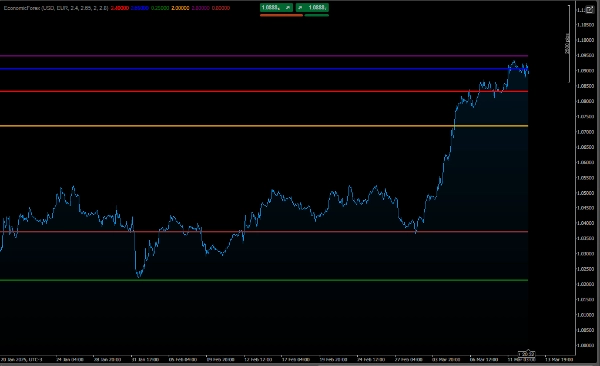
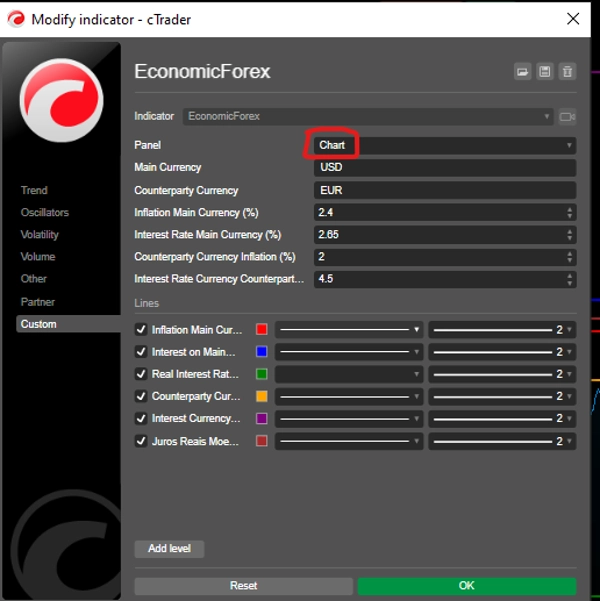

Description
✔ Website to enter data ,enter the indicators tab: https://tradingeconomics.com/
How to Interpret the Graph
Difference between Nominal and Real Interest Rates:
The nominal interest rate is the gross value of the interest rate.
The real interest rate takes inflation into account, showing the real purchasing power of money.
If inflation is higher than the nominal interest rate, the real interest rate will be negative, indicating a loss of purchasing power.
Currency Comparison:
The graph allows you to compare the economic conditions of the two currencies.
For example, if the real interest rate of the main currency is higher than that of the counterpart currency, this may indicate that the main currency is more attractive for investment.
Evolution Over Time:
The lines show how the inflation, nominal interest and real interest rates change over time, allowing you to identify trends.
Usage Example
Suppose you set the parameters as follows:
Main Currency: USD (US Dollar)
Inflation: 5%
Nominal Interest Rate: 6.5%
Counterparty Currency: EUR (Euro)
Inflation: 2%
Nominal Interest Rate: 4%
The chart will show:
USD:
Real Interest: 1.5% (6.5% - 5%)
EUR:
Real Interest: 2% (4% - 2%)
With this, you can compare the economic conditions of USD and EUR and make informed decisions in the forex market.
Conclusion
This code is a useful tool for traders and analysts who want to monitor and compare economic indicators of two currencies in a forex pair. It provides insights into inflation, nominal interest rates, and real interest rates, helping to understand the macroeconomic scenario and its implications for the forex market.
see this low risk algorithm:👇🏻
https://ctrader.com/pt/products/601?u=carneiroads
https://ctrader.com/pt/products/623?u=carneiroads
Summary
The indicator distinguishes between nominal interest rates (the gross interest rate) and real interest rates (adjusted for inflation), highlighting the purchasing power of money. It allows comparison of economic conditions between a main currency and a counterparty currency by plotting their respective inflation, nominal, and real interest rates over time. This helps identify trends and relative investment attractiveness; for example, a higher real interest rate in the main currency compared to the counterpart may indicate greater investment appeal.
Users input data such as inflation and nominal interest rates for each currency, which can be sourced from economic data websites like TradingEconomics.com. The tool supports informed decision-making in the forex market by providing a clear view of evolving economic factors affecting currency pairs.
Customer reviews
Discussion
FAQ














!["[Stellar Strategies] Market Session Ultimate" logo](https://cdn.ctrader.com/image/webp/61ffd537-0125-4246-9e72-42eca1791d64_28232)


Price