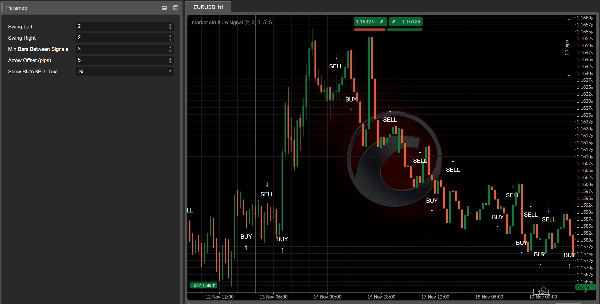

Description
📌 What the Indicator Does
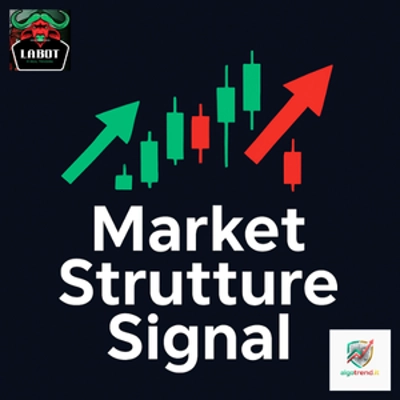
MarketStructureOscSignals is a pure price-action signal tool.
It:
- Detects swing highs and swing lows using a left/right lookback.
- Tracks whether those swings are forming:
- Higher Highs + Higher Lows → Bullish structure
- Lower Highs + Lower Lows → Bearish structure
- When the structure switches:
- From bearish → bullish → it plots a BUY signal
- From bullish → bearish → it plots a SELL signal
So every signal represents a true change in market structure, not just a moving average crossover.
⚙️ Inputs & How to Set Them
1. Swing Left / Swing Right
These control how “strict” a swing high/low is.
- Swing Left (default 2)
Number of bars to the left of the swing that must have lower highs (for a swing high) or higher lows (for a swing low). - Swing Right (default 2)
Number of bars to the right that must also confirm the swing.
How to use:
- Small values (1–2):
- More swings, more signals
- Works well on higher timeframes (H1, H4, D1)
- Larger values (3–4+):
- Only major structural turns
- Fewer but stronger signals
- Good on lower timeframes to avoid noise
2. Min Bars Between Signals
Minimum number of bars that must pass between two signals.
- Avoids clustering of arrows on every tiny pullback.
- Example:
- Set to
3→ at least 3 bars between one signal and the next. - On very fast charts (M1–M5) you might want
5–10. - On H1 or higher,
2–3is usually enough.
- Set to
3. Arrow Offset (pips)
How far the arrow and label are placed from the candle (in pips).
- For Forex:
5–10pips usually looks good.
- For indices (US500, US100, etc.):
- Use a larger offset (e.g. 20–50 “pips” depending on broker pip size).
If the arrows overlap the candles, increase this value.
If they are too far away, decrease it.
4. Show BUY/SELL Text
true→ shows both an arrow (↑/↓) and the text “BUY” or “SELL”.false→ only arrows.
If the chart feels cluttered, you can hide the text and keep just the arrows.
🔍 How Signals Are Generated (Logic)
Internally the indicator:
- Keeps track of the two most recent swing highs and two most recent swing lows:
_prevHigh,_lastHigh_prevLow,_lastLow
- From these it checks:
- Are highs and lows both rising?
- → Bullish trend (
StructureTrendSignal.Bullish)
- → Bullish trend (
- Are highs and lows both falling?
- → Bearish trend (
StructureTrendSignal.Bearish)
- → Bearish trend (
- If they’re not aligned, the previous trend is kept.
- Every time the structural trend changes:
Bearish → Bullish→ BUY signalBullish → Bearish→ SELL signal
- It also ensures:
- Trend was not
Unknown(so not at the very beginning). - Enough bars have passed since the last signal (
MinBarsBetweenSignals).
- Trend was not
This means each arrow marks a true structural shift, not random noise.
📈 How to Read BUY/SELL Signals on the Chart
✅ BUY Signal
What you see:
- An up arrow
↑under the candle - Optionally the text “BUY” near the arrow
What it means:
- Structure changed from bearish → bullish.
- Recent swing highs and lows are now both moving up.
- Market is likely transitioning into a new uptrend or resuming bullish structure.
How to use it:
- Look for long entries:
- On the signal candle or on the next few candles.
- Preferably after a small pullback to a support level (previous swing low, demand zone, VWAP, VA low, etc.).
- Use tools like Kalman Trend / EMA / Volume Profile to filter:
- Only take BUYs when higher timeframe or Kalman is also bullish.
✅ SELL Signal
What you see:
- A down arrow
↓above the candle - Optionally the text “SELL”
What it means:
- Structure changed from bullish → bearish.
- Swing highs and lows are now both moving down.
- Market is likely entering a downtrend or resuming bearish structure.
How to use it:
- Look for short entries:
- On the signal candle or on following candles near resistance.
- Ideal after a retest of a broken support (now resistance), VAH, supply zone, etc.
🎯 Practical Trading Uses
1. As a Standalone Entry Tool
Simple rule-set:
- Buy Setup
- Wait for a BUY arrow.
- Place a long order at/near the signal candle.
- Stop loss below recent swing low.
- Target previous swing high or a key resistance.
- Sell Setup
- Wait for a SELL arrow.
- Place a short order at/near the signal candle.
- Stop loss above recent swing high.
- Target previous swing low or key support.
This is the most basic usage and works best on H1, H4, and D1, where structure is cleaner.
2. As a Confirmation Tool with Your Other Indicators
This is where it gets powerful.
🔹 With Kalman Filter Trend
- Only take BUY signals when:
- Kalman Trend is sloping up and price is at or above the Kalman line.
- Only take SELL signals when:
- Kalman Trend is sloping down and price is at or below the Kalman line.
Effect:
Kalman gives you a smooth trend, MarketStructureOscSignals gives you precise structure shifts. Together they filter out a lot of bad trades.
🔹 With Volume Profile / Support & Resistance
- Strong BUY:
- BUY arrow appears near VA Low, previous swing low, or liquidity sweep, with rejection.
- Strong SELL:
- SELL arrow appears near VA High, previous swing high, or liquidity sweep at the top.
Here the signal is not just a technical pattern but is also anchored in liquidity and order flow zones.
3. For Scaling In / Out
You can also use new signals as:
- Scale-In Points
Add to a position when a new signal appears in the same direction as your existing trade and the higher timeframe is aligned. - Early Exit / Partial Exit
If you’re long and a SELL signal appears against your position (especially near key structure), you can: - Close a part of the position
- Or tighten stops
🧪 Recommended Starting Settings
For Forex H1 / H4:
Swing Left = 2Swing Right = 2Min Bars Between Signals = 3Arrow Offset = 5–10 pips
For Indices M15 / H1:
Swing Left = 2–3Swing Right = 2–3Min Bars Between Signals = 5Arrow Offsetadapted to symbol (e.g. 20–50 “pips” depending on broker)
For Crypto H1 / H4:
- Slightly higher swings to filter noise:
Swing Left = 3Swing Right = 3Min Bars Between Signals = 4–6
Always backtest with your preferred instrument and timeframe to fine-tune Swing and MinBarsBetweenSignals.
Summary
The indicator provides visual signals as arrows and optional text on the chart, marking significant structural shifts rather than simple moving average crossovers. Users can adjust parameters such as swing strictness, minimum bars between signals to avoid clustering, arrow offset for display clarity, and whether to show BUY/SELL text.
Market Strutture Signal Pro supports multiple markets including Forex, indices, commodities, stocks, and cryptocurrencies, with recommended settings tailored for different timeframes and asset classes. It can be used as a standalone entry tool or combined with other indicators like Kalman Filter Trend and Volume Profile to enhance trade confirmation and filtering. The indicator also supports scaling in/out strategies based on structural shifts.
This tool is suitable for traders focusing on higher timeframes (H1, H4, D1) for cleaner structure signals and can be fine-tuned through backtesting for specific instruments and timeframes.
Customer reviews
5 | 50 % | |
4 | 50 % | |
3 | 0 % | |
2 | 0 % | |
1 | 0 % |