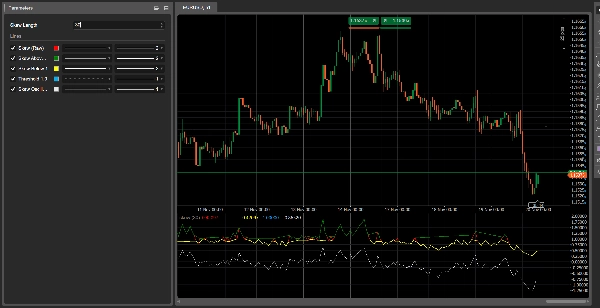

Description
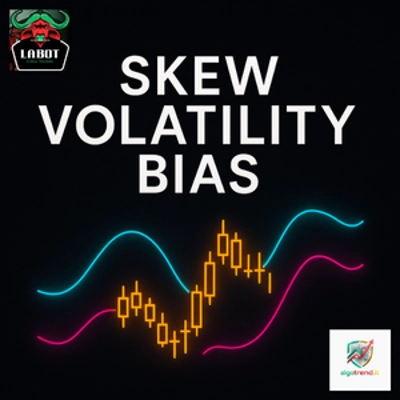
📈 Skew Volatility Bias Indicator – Professional Version (for cTrader)
Unlock a deeper understanding of market pressure, volatility imbalance, and directional conviction with the Skew Volatility Bias Indicator, the enhanced version of a classic volatility-based approach originally inspired by Pine Script and now fully optimized for cTrader.
This tool helps traders visualize which side of the market is hitting harder — buyers or sellers — by measuring volatility asymmetry and converting it into a clear, easy-to-read signal.
Whether you're trading indices, forex, commodities or crypto, this indicator serves as a powerful trend filter, regime detector, and bias confirmation tool.
1. What the Skew Indicator Measures
The indicator evaluates the balance of volatility between bullish and bearish candles.
It calculates a normalized True Range and feeds it into two adaptive averages:
- Deviation Max → volatility produced during up candles
- Deviation Min → volatility produced during down candles
Then it computes:
👉 Skew = DeviationMax / DeviationMin
This converts raw volatility into a clear directional reading:
- Skew > 1 → upside moves are stronger on average
- Skew < 1 → downside moves are stronger
- Skew ≈ 1 → volatility is symmetrical and the market is balanced
In short:
Skew reveals which side has “volatility dominance”.
2. Understanding the Lines
1. Skew (Raw) – Red line
The pure volatility ratio. This is the core signal.
2. Skew Above 1 – Green line
Shows bullish volatility dominance.
3. Skew Below 1 – Yellow line
Shows bearish volatility dominance.
4. Threshold 1.0 Line – Blue dotted line
Represents equilibrium.
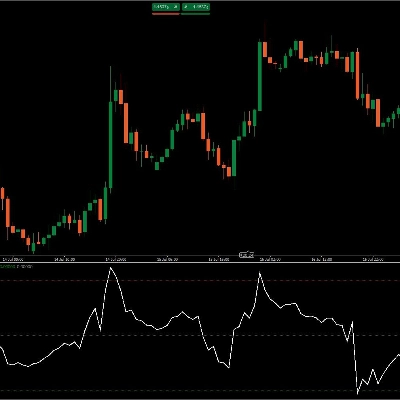
5. Skew Oscillator (log) – White line
More stable, smoother representation:
- above 0 = bullish volatility
- below 0 = bearish volatility
3. How to Read It
A) Market Regimes
🔹 Bullish Regime
- Skew > 1
- Green line active
- Oscillator above zero
→ Market favors longs.
🔹 Bearish Regime
- Skew < 1
- Yellow line active
- Oscillator below zero
→ Market favors shorts.
🔹 Neutral
- Skew ≈ 1
→ Market balanced, suitable for range trading.
4. Regime Shift Signals
Skew crossing above 1
→ Buyers gain volatility dominance
→ Bullish transition
Skew crossing below 1
→ Sellers gain volatility dominance
→ Bearish transition
These shifts often occur before price action confirms a trend, making Skew a powerful early indicator.
5. Practical Use Cases
1️⃣ Trend Filter for cBots
- trade long only when SkewOsc > 0
- trade short only when SkewOsc < 0
2️⃣ Trend Quality Confirmation
- Uptrend + Skew > 1 = strong trend
- Uptrend + Skew falling toward 1 = weakening trend
3️⃣ Market Sentiment / Risk Filter
Particularly effective on indices and FX major pairs.
6. Summary
- What it shows: volatility dominance
- Why it matters: volatility shifts precede price shifts
- How to use it: as a filter, confirmation tool, or sentiment gauge
- Best part: extremely light, fast, and adaptable
Summary
The indicator displays multiple lines: the raw Skew ratio (red), bullish dominance (green), bearish dominance (yellow), an equilibrium threshold at 1.0 (blue dotted), and a smoothed Skew Oscillator (white) that shows bullish volatility above zero and bearish below zero.
Traders use the indicator to detect market regimes—bullish, bearish, or neutral—and anticipate regime shifts when Skew crosses the equilibrium line. It serves as a trend filter for automated trading bots, confirms trend strength, and acts as a market sentiment or risk filter. The tool is applicable across indices, forex, commodities, and cryptocurrencies, providing a lightweight, fast, and adaptable measure of volatility dominance that often precedes price action changes.
Customer reviews
5 | 60 % | |
4 | 40 % | |
3 | 0 % | |
2 | 0 % | |
1 | 0 % |










!["[Hamster-Coder] Pivot Points MTF" logo](https://cdn.ctrader.com/image/webp/4c143e5a-309c-40e3-a578-f04d1e133ffa_31159)