

Description
📌 Kalman Filter Trend – Overview & Review
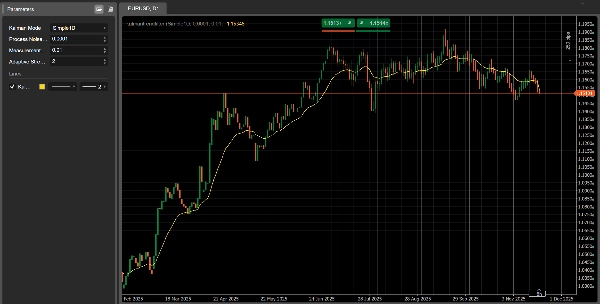
Kalman Filter Trend is an advanced trend-following indicator for cTrader, designed to deliver a smooth, highly responsive trend line with significantly less lag than traditional moving averages.
Where classic SMA/EMA filters react slowly and often miss early trend changes, the Kalman Filter:
- Continuously updates its estimate of “true” price
- Balances smoothness and responsiveness mathematically
- Adapts to volatility (Adaptive mode)
- Models both price and velocity (2D mode)
This makes it a powerful tool for both manual traders and automated system developers.
🎛 Modes & Parameters
Kalman Mode (3 Versions in One Indicator)
1️⃣ Simple1D
A classic 1D Kalman filter.
Fast, clean, and excellent for short-term trend detection.
2️⃣ PositionVelocity2D
Models both price and trend velocity.
Ideal as a directional filter in algorithmic strategies.
3️⃣ Adaptive1D
Automatically adjusts to volatility.
More reactive in fast markets, smoother in quiet conditions.
🧩 Key Parameters Explained
- Process Noise (Q):
Higher = faster trend reaction, lower = smoother line. - Measurement Noise (R):
Higher = filter trusts data less → smoother result. - Adaptive Strength:
Used only in Adaptive1D. Controls how strongly volatility affects the filter.
📈 How to Interpret Signals
1. Detecting Trend Direction
- Uptrend: Line sloping upward, price holding above the filter.
- Downtrend: Line sloping downward, price holding below the filter.
- Flat: Market is ranging, avoid breakout strategies.
2. Entry Signals (Crossover Logic)
Bullish Entry:
- Price closes above the Kalman line
- The line starts turning upward
Bearish Entry:
- Price closes below the Kalman line
- The line starts turning downward
3. Trend Strength (2D Mode)
The slope becomes a direct reading of momentum:
- Strong upward slope → strong bullish trend
- Strong downward slope → strong bearish trend
- Flattening slope → trend weakening or transition phase
📊 Practical Usage Examples
✔ Trend-Follow Strategy
Use Simple1D or Adaptive1D:
- Buy above the line when slope turns positive
- Sell below the line when slope turns negative
✔ Multi-Timeframe Approach
- Use Kalman on H1 for direction
- Use Kalman on M15 for precision entries
- Enter only in the direction indicated by the higher timeframe
✔ Bot Integration
Perfect for algorithmic trading:
- Allow only long if slope > 0
- Allow only short if slope < 0
- Use Adaptive1D for volatile indices like US500, NAS100, US2000
🌟 Join Our Community
If you want access to:
- Exclusive optimizations for each of our bots
- Advanced configuration tips
- Trading improvements
- Personalized technical help
- Updates and new tools
👉 Join our community by clicking the link on my profile page.
There you will find the best optimization settings for all our bots, updated regularly.
Summary
The indicator offers three modes: Simple1D for fast, short-term trend detection; PositionVelocity2D for modeling price and trend velocity, suitable as a directional filter in algorithmic strategies; and Adaptive1D, which adjusts automatically to volatility for smoother or more reactive behavior depending on market conditions.
Key parameters include Process Noise (Q) controlling trend reaction speed versus smoothness, Measurement Noise (R) affecting data trust and smoothing, and Adaptive Strength for volatility sensitivity in Adaptive1D mode.
Users interpret the indicator by trend direction (uptrend, downtrend, flat), entry signals based on price crossing and slope changes, and trend strength via slope magnitude in 2D mode. It supports various practical uses such as trend-follow strategies, multi-timeframe analysis, and integration into automated trading systems, particularly for indices and volatile markets.
Customer reviews
5 | 50 % | |
4 | 50 % | |
3 | 0 % | |
2 | 0 % | |
1 | 0 % |