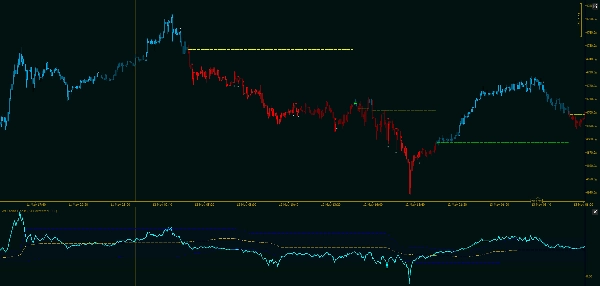
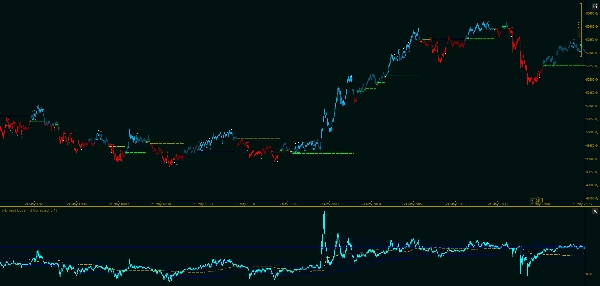
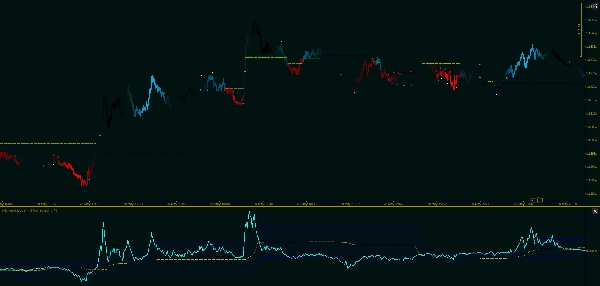
Description
Boosted Williams A/D — Adaptive Oscillator with Z-Score Regime Engine
A next-generation accumulation/distribution oscillator that goes far beyond the classic Williams A/D — engineered for traders who want clarity, context, and statistically grounded signals instead of noisy lines.
The Idea
The classic Williams Accumulation/Distribution line tells you whether smart money is quietly buying or selling — but on its own, it's slow, noisy, and offers no real context for when to act.
This tool rebuilds that idea from the ground up by layering four complementary technologies on top of the original A/D logic:
- Gap-filtered accumulation — corrects the original formula so price gaps and overnight jumps don't distort the picture.
- Adaptive volatility channel — a self-calibrating quantile band that defines what "normal" looks like right now, not based on a fixed lookback feel.
- Kalman-filtered smoothing — a state-space filter that removes noise without lagging like moving averages do.
- Robust Z-Score regime engine — a statistically rigorous layer that classifies the market into premium, discount, and active signal zones.
The result is a single, clean oscillator that doesn't just show accumulation — it tells you when accumulation has reached a statistically significant extreme.
The Purpose
This indicator was built to answer three questions traders actually care about:
"Where is price right now relative to its true behavioral range?"
The adaptive channel and premium/discount regime coloring answer this instantly.
"Is the current move statistically meaningful, or just noise?"
The Z-Score engine flags moves that exceed a robust deviation threshold — the kind real institutions react to.
"When does a signal actually begin and end?"
Built-in markers, trendlines, popup notifications, and sound alerts capture both the start and end of every signal sequence in real time.
In short: fewer false signals, clearer context, faster decisions.
Why This Is Superior to Generic Solutions
Most off-the-shelf oscillators — RSI, Stochastic, CCI, even the standard Williams A/D — share the same weaknesses:
- They use fixed-period averages that lag in trends and whip in ranges.
- They rely on mean and standard deviation for thresholds, which break down the moment the market goes non-normal (which is most of the time).
- They give a single line and leave context entirely up to the user.
- They have no concept of signal lifecycle — only crossings.
This tool is fundamentally different:
Robust statistics - The Z-Score engine uses the median and the Median Absolute Deviation (MAD) instead of mean/standard deviation. This makes it dramatically more resistant to outliers, spikes, and regime shifts — the exact conditions where generic oscillators fail.
Adaptive channel - Instead of arbitrary overbought/oversold levels, the indicator builds a quantile-based channel that continuously adapts to recent market behavior.
Kalman filtering - A two-state Kalman filter tracks both level and velocity of the underlying flow. It smooths noise while reacting quickly to genuine state changes — something no SMA, EMA, or smoothing combination can match.
Fractional differentiation - An optional fractional-differentiation engine preserves the memory of price action while still making the series stationary enough for meaningful statistical analysis. Classic indicators throw this memory away the moment they compute a return or difference.
Boosted output, not raw output - The oscillator amplifies its own signal whenever price extends outside the adaptive channel — meaning the indicator gets louder exactly when the market is doing something worth listening to.
Optional Heikin-Ashi parallel pipeline - A full parallel Heikin-Ashi processing chain is built in — letting you view the entire stack through a smoother price lens whenever swing-trading context matters more than tick-level precision.
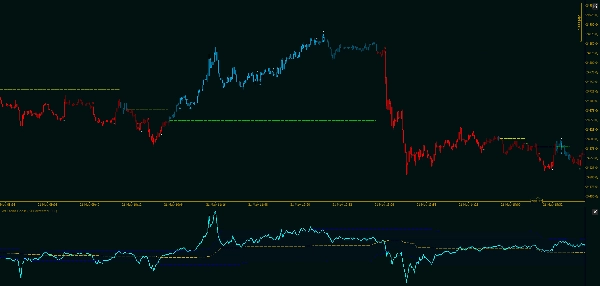
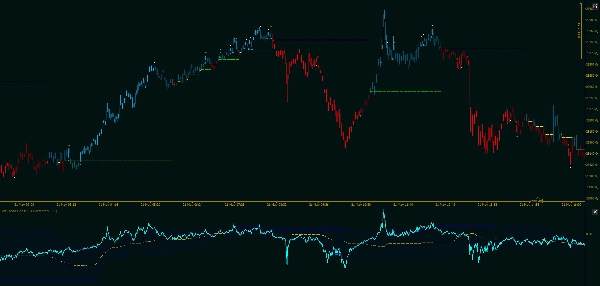
Full signal lifecycle, not just crossings - Every signal is treated as a lifecycle event: start marker, end marker, drawn trendline at the trigger level, and optional popup + sound alert at both ends. You see when a setup begins, how long it persists, and exactly when it has run its course.
Premium / Discount regime coloring - Bars are tinted in real time based on whether price is in a statistical premium (above mean) or discount (below mean) zone — giving you a constant, glanceable read on directional bias without adding a single extra panel.
Who It's For
Discretionary traders who want a single, intelligent oscillator instead of a screen full of overlays.
Systematic traders who need statistically grounded signals with clean start/end timestamps for backtesting and automation.
Swing and intraday traders who care about regime context as much as about entry signals.
The Bottom Line
This isn't a repackaging of a classic indicator with prettier colors. It's a complete rebuild that fuses robust statistics, modern filtering, fractional memory, and adaptive volatility analysis into one trading system.
If you've ever felt that your indicators are either too slow to be useful or too noisy to be trusted — this tool was built for you.
Summary
This indicator identifies market regimes—premium, discount, and active signal zones—offering real-time visual cues through bar coloring and trendlines. It tracks the full lifecycle of signals with start and end markers, trendlines, and optional alerts, enabling traders to see precisely when setups begin and conclude. An optional Heikin-Ashi processing pipeline provides a smoother price perspective for swing trading.
wt.Trend Boost is suitable for discretionary, systematic, swing, and intraday traders seeking statistically grounded, adaptive signals with reduced false positives and improved decision speed. It supports analysis on bar and tick data, delivering outputs as visualizations, signals, and filters. The tool addresses common oscillator limitations by employing robust statistics, adaptive channels, Kalman filtering, fractional differentiation, and boosted signal output to highlight significant market moves effectively.